 Dan Petrovic ·
08 July 2026
Dan Petrovic ·
08 July 2026
We spent 2.71 Billion tokens teaching a machine to reverse-engineer how AI search ranks pages. What it found overturns the usual SEO playbook: structure and intent beat every credential you've been told to add, and the engine that proved it reached #1 in 1,554 of 2,246 runs.
In AI search, users don't interact with the traditional search results anymore. The good old 'ten blue links' is now considered the raw data and is supplied as grounding context.
We went from this:
(#1) The 9 Best Running Shoes for Beginners
runnersworld.com
Tested picks for new runners, ranked by cushioning and fit.
(#2) Best Beginner Running Shoes (2026)
nytimes.com/wirecutter
Our favourite after 40 hours of testing and 50 miles per shoe.
(#3) How to Choose Your First Running Shoes
brooksrunning.com
A beginner's guide to cushioning, support, and fit.
To this:
For a first pair, most guides point to the (#1) Brooks Ghost as the safest all-rounder, thanks to its soft, forgiving cushioning. The (#3) Hoka Clifton is the other favourite if you want the most padding underfoot, while the (#3) ASICS Gel-Nimbus earns a mention for stability on longer first runs.
Between the search engine and the user is a language model which now acts as both a filter and a re-ranker. This opinionated mega-influencer decides what brand, product or service to recommend and in which order.
The question on every SEO's mind is, how do we influence the influencer?
Our algorithmic content optimization framework forms a set of testable hypotheses about why a page sits where it does, rewrites the page one careful edit at a time, asks an AI ranker to re-judge it against its real competitors, and keeps only the changes that genuinely move it up. In plain terms, it is a tireless scientist whose entire job is content optimization: propose, test, discard, repeat, until the page wins or the evidence runs out.
We let it run. A lot. Across 2,249 experiments on 113 properties it chewed through 2.71 Billion tokens of reading and writing, and in the process it produced something rare in our field: a large, controlled body of evidence about what an AI ranker actually rewards. This article is what that evidence says.
Every figure below is a total from real optimization runs on real client pages.
To put the ranking effort in perspective: the engine re-ranked every edit around five times and took the middle result, so a single fluke could never be mistaken for a real gain. That discipline is why there were nearly 56,000 ranking passes sitting on top of only 10,548 edits.
Every experiment follows the same loop, and it mirrors how a careful person would reason if they had infinite patience.
It stops when the page reaches the top, when it runs out of budget, or when the evidence on every remaining idea has settled. The result is a documented trail of what helped, what hurt, and what did nothing.
Here is the finding that should make anyone in this industry sit up. When we group every tested idea into the family it belongs to and measure how often each family produced a genuine rank improvement, the winners are not the things the SEO industry tells you to add.
| Idea family | What it covers | Win rate |
|---|---|---|
| Framing | How the page is angled: a list, a definition, a how-to | 31.4% |
| Alignment | Matching the query's actual words and intent | 26.2% |
| Architecture | Structure: the opening line, sentence length, formatting | 25.4% |
| Style | Voice, register, readability | 25.2% |
| Substance | Facts, named entities, numbers, definitions | 25.1% |
| Proof | Credentials: awards, expert endorsements, citations | 15.4% |
Proof came last, at roughly half the win rate of everything else. The single most effective levers were about how a page is framed and how well it speaks to the query. The least effective levers were exactly the trust signals that dominate optimization advice.
Zoom into individual tactics and the gap gets starker. These were the strongest and weakest single ideas across the whole program.
| Strongest levers | Win rate | Weakest levers | Win rate |
|---|---|---|---|
| "Best of" / top-N list framing | 38.4% | Awards and certifications | 13.1% |
| "What is" / definition framing | 36.7% | Expert endorsements | 14.8% |
| Clear category definitions | 33.3% | Scale signals (user counts, volumes) | 15.6% |
| Short, concise sentences | 33.1% | Statistics and study citations | 18.2% |
| How-to / step-by-step framing | 30.9% | .gov / .edu citations | 18.9% |
| Matching the query's intent | 27.7% | Adding more raw numbers | 20.7% |
The plain reading: an AI ranker choosing between two comparable pages is swayed far more by how clearly a page is framed and matched to the question than by how decorated it is with credentials. Awards, expert names, and citation badges are worth having for the humans who read your page, but they are close to the bottom of the list of things that tip an AI ranker in your favour.
One more number is worth dwelling on, because it is the opposite of how optimization is usually sold. Of every hypothesis the engine tested, it revised its belief downward 5,911 times and upward only 1,440 times. The machine spent most of its energy disproving plausible-sounding ideas. That is the whole point of testing: most confident advice does not survive contact with evidence, and a system that only ever finds reasons to agree with itself is not measuring anything.
Yes, and here is the full accounting. Not every edit is a winner, because that is what real experimentation looks like.
Three out of four edits either held steady or slipped. That miss rate is the method working as designed. The value is in cheaply finding the one edit in four that works, and never shipping the three that do not.
The 2.71 billion figure is not spread evenly, and the shape of it tells you something about the problem. Judging content is far more expensive than writing it. The ranking step alone consumed about 83% of all tokens, because every ranking pass re-reads the entire competitive field, every rival page alongside the one being edited, on each cycle. Writing the edits was comparatively cheap.
The same story shows up between the two modes the engine runs in. Optimising a full page rather than a short grounding snippet accounted for just under a third of all experiments but 91% of all tokens, because ranking whole pages against whole pages, over and over, is where the real work lives. Knowing this is what lets us aim the heavy machinery only where it earns its keep.
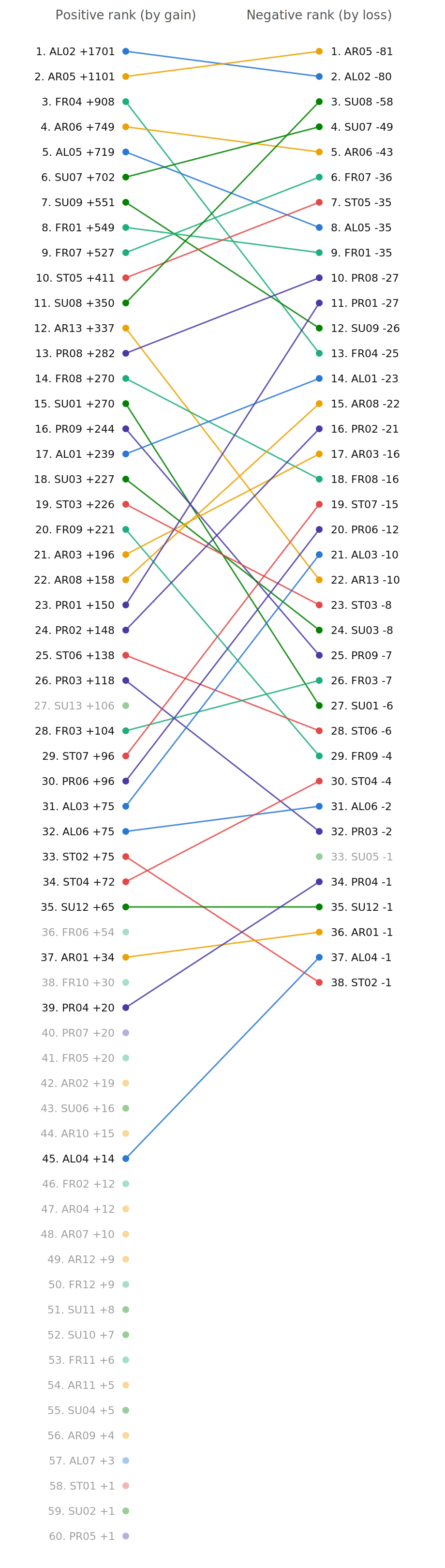
On the left are the top positive and negative rank factors specific to Gemini alongside the number of times they've increased or decreased the brand's rank during our testing.
Look at the top two most impactful rank factors. They're also at the top of the negative rank factor list. Not as strong (+1701, +1101 vs -81, -80) but still the message is clear. Something which can move your brands odds in your favour for one query or competitive set can do the exact opposite in a different setting.
This means that while we can rely on our rank factors as a general rule, every proposed content edit must be thoroughly tested on its own.
Here's how the above rank factors group by rank factor class.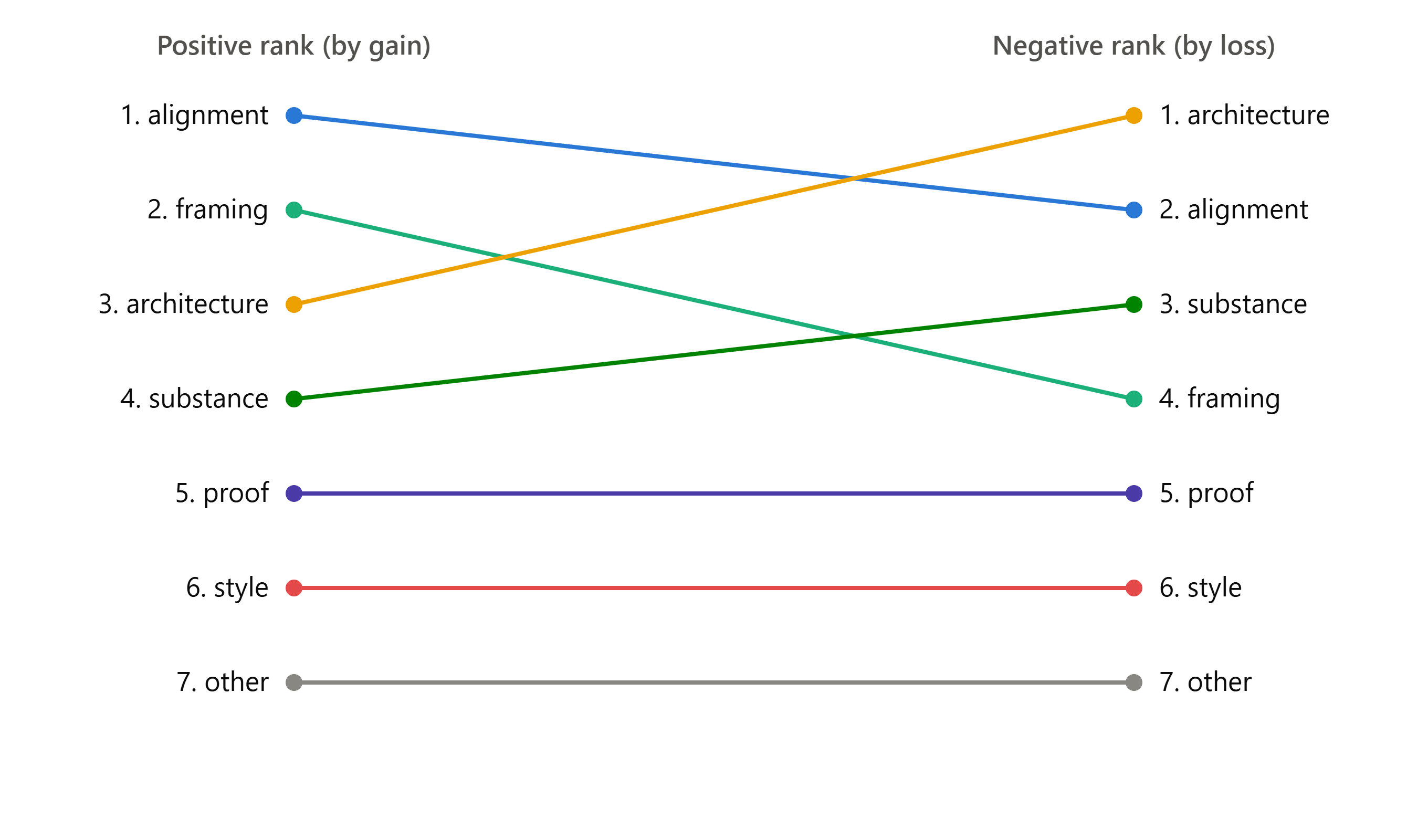
The comforting takeaway is that the biggest levers are the ones you can actually pull. How a page is framed, how directly it answers the query, how cleanly it is structured: these are all in your hands, and they are exactly what the evidence says move an AI ranker. The credential signals that are hardest to manufacture turn out to matter least to the machine, even as they remain worth having for the people who read you.
One caveat, stated plainly: this measures what shifts an AI ranker's preference between competing pages in a controlled setting, across four leading models. It is not a claim about every live search system, and it is not a substitute for building genuine authority over time. It is 2.71 billion tokens of tested evidence pointing in one clear direction. Most of what passes for optimization advice has never been tested at all. This has.
Content Optimizer is part of the AI-visibility platform built by DEJAN AI. Related reading: Grounding Snippets and In AI SEO, #10 is the new #1.