Selection Rate Optimization (SRO) is an AI SEO discipline which leads to preferential treatment of target brands, products and services in AI search.
In AI search systems such as Google's AI Mode driven by Gemini, OpenAI's ChatGPT or Anthropic's Claude, a large language model (LLM) acts as an interpretative layer between your content and the users. When presented with multiple grounding choices from search, the model reviews snippets from various sources and decides which one to select and how.
This is called Selection Rate (SR), the AI equivalent to a well-known human behaviour metric called Click-Through Rate (CTR).
When we onboard a new AI SEO client, SRO is one of the key strategic activities. Optimal selection rate and integration allow us to gain control over when and how our client’s brand is presented in generative search results.
We feature a mature, tested and fully automated snippet optimization pipeline built on state-of-the-art machine learning practices. We’re ready for both strategic precision tweaks and large-scale optimization efforts.
At the heart of our SR optimization pipeline is our grounding snippet generation algorithm, fine-tuned to Google’s own extractive summarization in the AI Mode and Gemini RAG pipelines. We use a powerful cross-encoder trained by Microsoft on a massive amount of search query data from Bing.
When compared side by side, reverse-engineered grounding snippets from Google and our own are nearly indistinguishable.
Project Setup
Optimization
Implementation
Traditional SEO optimizes for position in a ranked list of links. SRO optimizes for selection inside a generated answer. The two overlap, and they are not the same job. Classic SEO asks how to rank higher. SRO asks a harder question: once you rank, will the model choose your words over everyone else's? That shifts the work from links and authority signals toward the snippet itself, how precisely it answers, how cleanly it can be extracted, and how well it maps to the entities the query is really about. SRO picks up where ranking leaves off.
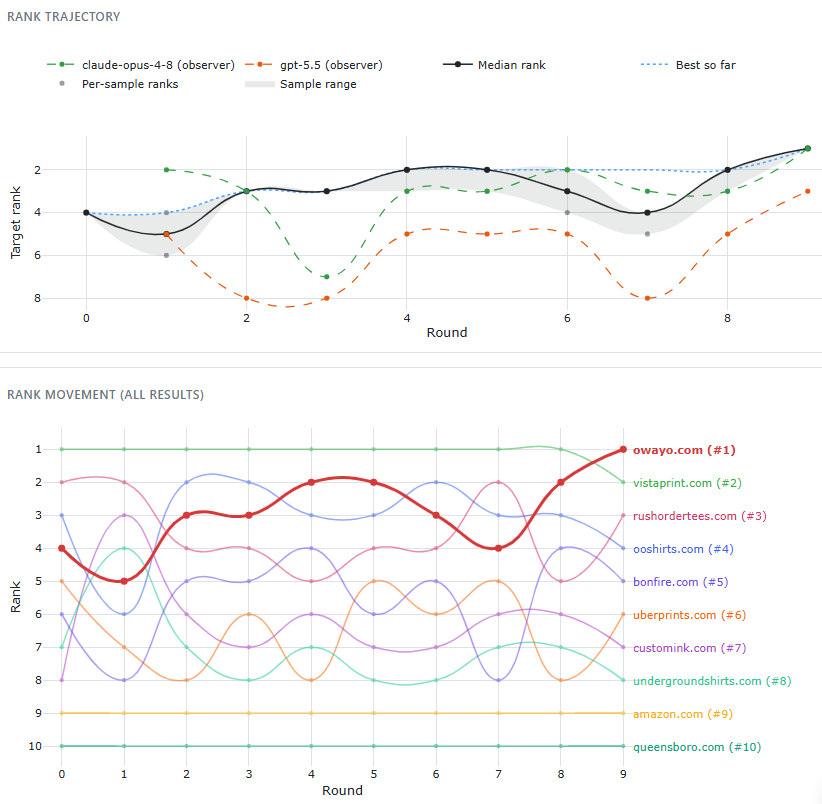
Ranking and selection are two different contests, and most brands only compete in the first.
When someone asks a question in AI search, the system retrieves a handful of candidate sources. A language model then reads a snippet from each, scores how well it answers the specific question, and selects the passage it will ground its response on. Ranking earns you a place in that candidate set. Selection decides whether you are the source that gets quoted, cited and shown to the user.
Selection Rate is the probability that the model picks your content once you are in the running. You can rank on page one and still lose every selection to a competitor whose snippet answers the question more directly. SRO is the practice of winning that second contest on purpose.
Most AI content advice is guesswork dressed up as strategy. Someone asserts what a language model "prefers," rewrites your page to match the theory, and hopes. We don't work that way.
Every change we propose is a real edit, shipped to your live page and then re-ranked inside the actual AI systems it targets. We measure what the model does, not what we assume it will do. If an edit lifts your selection rate, it stays. If it doesn't, we discard it and test the next hypothesis. Over successive rounds the page converges on the version the models genuinely select, backed by measured movement rather than opinion.
That feedback loop is the whole discipline. Reality votes, and we count the votes.
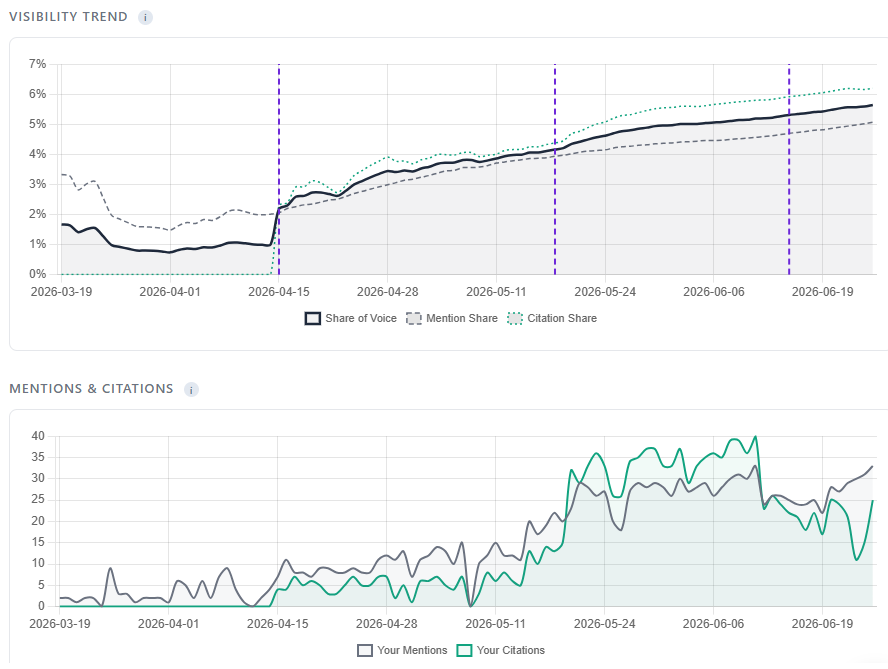
In classic search the page with the best position collected the click. In AI search the model reads for the user, and only the selected source is passed through. Everyone else is invisible, regardless of where they rank.
That changes the stakes. A page can hold a strong position, attract no selection, and quietly disappear from the answers your customers actually see. Traffic, mentions and brand presence now depend on being chosen at the moment of generation. SRO exists to make sure that choice goes your way.
SRO runs on machinery we built ourselves, not a repackaged SEO checklist. Our grounding-snippet engine is fine-tuned to the way Google's AI Mode and Gemini extract and summarise content, using a cross-encoder trained on a massive volume of real search data. Auxy, our optimization platform, runs the hypothesis-and-test loop and tracks how each edit moves your selection rate over time. Visibility tracking watches the live AI systems daily, so movement is observed, not inferred. We advise because we build. The same tools we sell our clients are the ones running under this page.
It overlaps with both. We focus specifically on selection rate, the measurable probability that a model chooses your content once it is retrieved, and we optimize against that number directly.
Yes, for the implementation step. We generate and test the changes, then either hand you the edits or implement them on your site, depending on the engagement.
Selection movement appears within the testing rounds themselves, because we re-rank after each edit rather than waiting on a monthly report. A full optimization cycle for a page typically runs over a small number of rounds.
Google's AI Mode and Gemini, OpenAI's ChatGPT, and Anthropic's Claude. Our snippet engine is tuned most closely to Google's grounding and summarization behaviour.
No. It builds on it. You still need to rank to enter the candidate set. SRO wins the selection that happens after.
Book a conference call with our senior strategy team to discuss your project in detail.