 Dan Petrovic ·
07 July 2026
Dan Petrovic ·
07 July 2026
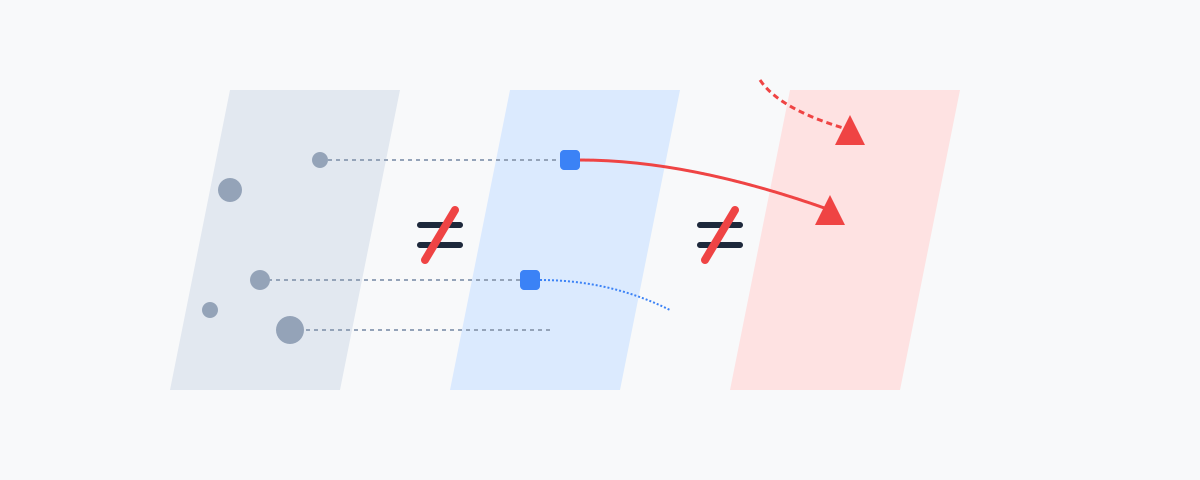
Being a cited grounding source does not mean your brand was mentioned in the answer, and being mentioned does not mean you were cited. They are correlated but distinct events produced at different stages of the AI answer pipeline — and conflating them is the source of most AI-visibility measurement
One of the most common mistakes in AI SEO is treating three different things as one: being retrieved as a grounding source, being cited in the answer, and being mentioned by name in the answer. They are related and strongly correlated, so they are easy to blur together. But they are distinct events, produced by distinct decisions at distinct stages of the pipeline — and the blur is the source of most AI-visibility measurement confusion.
Here is roughly what happens between a user's prompt and the answer they read.
Three different outcomes live inside that flow, and they are what people keep collapsing into one word.
A grounding source is a page the system retrieved and placed into the model's context as raw material for the answer. This is purely a retrieval outcome, decided at steps three and four, before a single word of the answer has been written. Whether your page becomes a grounding source depends on the fan-out queries, your relevance to them, and how the candidate set was narrowed.
Being a grounding source is necessary for a great deal of what follows, but on its own it is invisible. The user never sees the grounding set. It is the pool the model draws from, not the answer.
A citation is a grounding source the model chose to surface as a reference — the little numbered link, the "sources" list, the attribution attached to a claim. It is a subset of the grounding set: every citation was a grounding source, but most grounding sources are never cited. The model retrieved far more than it points at.
Critically, a citation attributes a source. It says "this claim rests on that page." It does not, by itself, say anything about your brand appearing in the readable text of the answer. This is Natzir Turrado's line, and it is the cleanest way to hold the distinction: citations are the bibliography, not the brainstorm.
A mention is your brand appearing by name in the body of the answer — the part the user actually reads and remembers. This is a generation decision, and it is driven far more by the model's prior — what it already believes about who matters for this topic — than by which pages happened to land in the grounding set. The model tends to decide who to talk about, then looks for sources to attach. The recommendation comes from the brainstorm; the citation comes from the bibliography.
A mention is the outcome with commercial weight. A user does not read the source list and form an impression of your brand; they read the sentence that names it, or the one that doesn't.
Because each outcome is decided by a different mechanism, every combination occurs:
The two are strongly correlated — a cited source is more likely to be mentioned, a mentioned brand more likely to be cited — but the correlation is well short of one. Treating either as a proxy for the other means silently accepting an error rate you never measured.
Because grounding, citation, and mention are three events and not one, they are three separate measurement problems, not three labels for the same number. A tool that counts one and reports it as another is not slightly imprecise — it is measuring a different layer of the stack than the one your budget is judged on.
The most common version of this error is a tracker reporting "cited as a grounding source" as though it were "cited in the answer" — collapsing the retrieval event into the attribution event. It inflates your apparent visibility with pages the user never saw referenced, let alone read your brand in.
The distinction also reframes what content can and cannot do. Retrieval — becoming a grounding source, and earning a citation — is genuinely responsive to content and relevance; that is the layer you can engineer. The mention, and above it the recommendation, lean on the model's prior, which barely moves in response to a single page. You can win retrieval completely and still lose the only line the user reads. That is why AI visibility is less about presence and more about influence — and why the honest metric isolates the mention rather than hiding behind a citation count.
If you need a single mental model, rank the outcomes by how much they are worth: citation is good, mention is better, recommendation is best. Every recommendation is a mention; not every mention is a recommendation; and a citation is no guarantee of either. The whole point of separating the terms is that you can be winning at the cheap end of that ladder while losing at the expensive end, and a metric that blurs them will never tell you which.
This piece grew out of a LinkedIn discussion with a sharp crowd. Natzir Turrado's "bibliography, not the brainstorm" framing, Douglas Lord on treating these as separate measurement problems, Lily Ray and David McSweeney on trackers mislabelling grounding as citation, Massimiliano Geraci on the gap widening with reasoning effort, and Mateusz Makosiewicz's story of a listicle that earned its citation and got a competitor recommended — all sharpened the thinking here. Cyrus Shepard made the fair counterpoint that for many stakeholder conversations the overlap is close enough to skate by. It is, right up until you are the one building the measurement.