
Article updated thanks to a sharp observation from Lukasz Rogala who makes my claim less certain and putting us back in the “needs more evidence category”.
There’s some evidence Google uses structured data to ground Gemini in its AI search. If true this is good news for AI SEO people and vindication for schema advocates in the industry.
“How can AI be used to improve SEO?”
The above prompt and associated fanout queries returned five final grounding sources:
| Snippet Source | Chunk Count |
|---|---|
| https://www.salesforce.com/marketing/ai/seo-guide/ | 18 |
| https://xponent21.com/insights/faq/how-does-ai-impact-seo/ | 27 |
| https://digitalmarketinginstitute.com/blog/ai-seo | 19 |
| https://researchfdi.com/future-of-seo-ai/ | 14 |
| https://www.seo.com/blog/how-to-use-ai-for-seo/ | 23 |
| Total | 101 |
Each source page was scraped and chunked. Each chunk was then scored against the prompt using a cross-encoder.

The idea was to compare the prediction against actual grounding chunks forming the RAG snippet for each page. See how accurate our model is.
Then I found an outlier initially dismissed as hallucination:
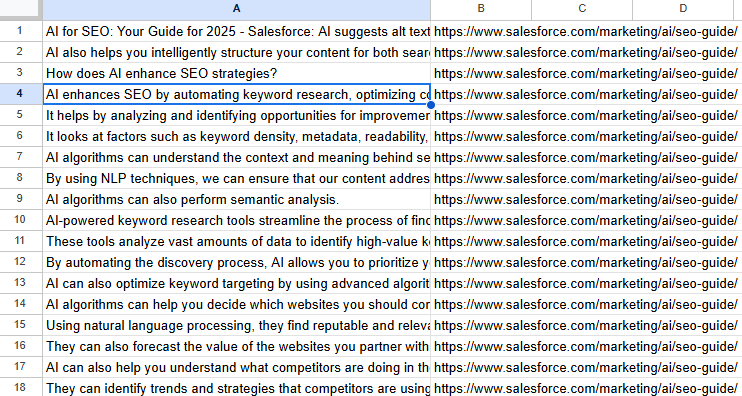
Here’s the exact sentence found in the grounding context:
AI enhances SEO by automating keyword research, optimizing content creation, predicting search trends, analyzing competitor strategies, and personalizing user experiences to boost rankings.Then I saw it in the SERPs and I knew it wasn’t model-hallucinated:

I clicked on “read more” but it didn’t land on the exact text chunk from the grounding:
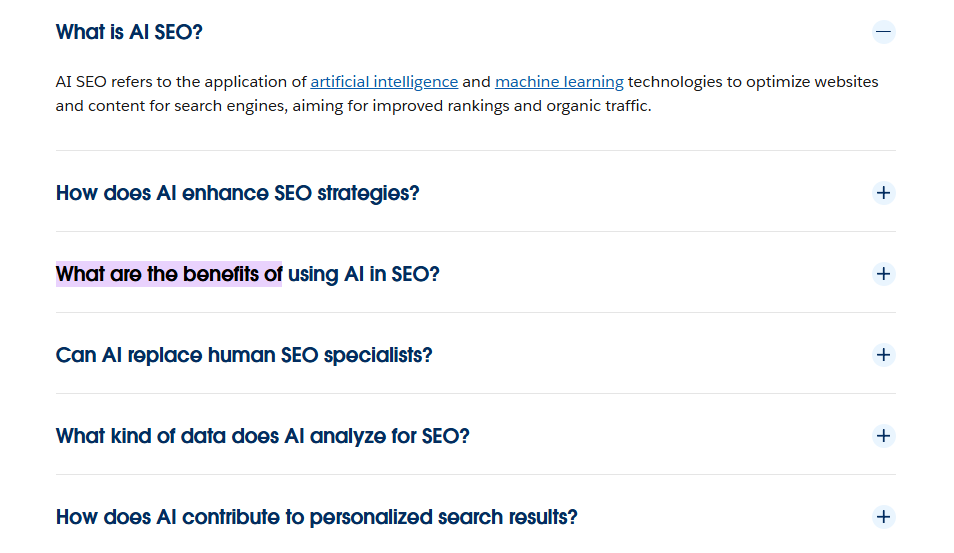
Why wasn’t it on the page? Did they do a page update maybe?
Or…. and so I inspected the source code and there it was:
<script type="application/ld+json">{"@context":"https://schema.org","@type":"Article","@id":"https://www.salesforce.com/marketing/ai/seo-guide/#Article","headline":"AI in SEO: A complete guide","description":"What is AI SEO and how do you use it to improve your SEO strategies? Learn how to use AI to help rank higher in search engines here. ","inLanguage":"en","mainEntityOfPage":{"@type":"WebPage","@id":"https://www.salesforce.com/marketing/ai/seo-guide/","url":"https://www.salesforce.com/marketing/ai/seo-guide/","name":"AI for SEO: Your Guide for 2025","description":"What is AI SEO and how do you use it to improve your SEO strategies? Learn how to use AI to help rank higher in search engines here. ","datePublished":"2024-08-09","dateModified":"2025-12-01","primaryImageOfPage":{"@type":"ImageObject","inLanguage":"en","@id":"https://www.salesforce.com/marketing/ai/seo-guide/#primaryImageOfPage","url":"https://wp.sfdcdigital.com/en-us/wp-content/uploads/sites/4/2023/06/marketing-category-og.jpg","contentUrl":"https://wp.sfdcdigital.com/en-us/wp-content/uploads/sites/4/2023/06/marketing-category-og.jpg"},"image":{"@id":"https://www.salesforce.com/marketing/ai/seo-guide/#primaryImageOfPage"}},"image":{"@id":"https://www.salesforce.com/marketing/ai/seo-guide/#primaryImageOfPage"},"thumbnailUrl":"https://wp.sfdcdigital.com/en-us/wp-content/uploads/sites/4/2023/06/marketing-category-og.jpg","hasPart":{"@type":"FAQPage","mainEntity":[{"@type":"Question","name":"What is AI SEO?","acceptedAnswer":{"@type":"Answer","text":"AI SEO refers to the application of artificial intelligence and machine learning technologies to optimize websites and content for search engines, aiming for improved rankings and organic traffic."}},{"@type":"Question","name":"How does AI enhance SEO strategies?","acceptedAnswer":{"@type":"Answer","text":"AI enhances SEO by automating keyword research, optimizing content creation, predicting search trends, analyzing competitor strategies, and personalizing user experiences to boost rankings."}},{"@type":"Question","name":"What are the benefits of using AI in SEO?","acceptedAnswer":{"@type":"Answer","text":"Benefits include increased efficiency in SEO tasks, more accurate data analysis, improved content relevance, better prediction of user intent, and ultimately, higher organic search visibility. Another benefit is the ability to analyze much larger datasets efficiently."}},{"@type":"Question","name":"Can AI replace human SEO specialists?","acceptedAnswer":{"@type":"Answer","text":"No, AI tools assist and augment human SEO specialists by automating repetitive tasks and providing data insights, allowing experts to focus on strategic decision-making and creativity."}},{"@type":"Question","name":"What kind of data does AI analyze for SEO?","acceptedAnswer":{"@type":"Answer","text":"AI analyzes vast amounts of data, including search queries, user behavior (clicks, dwell time), content performance, backlink profiles, and competitor strategies to identify optimization opportunities."}},{"@type":"Question","name":"How does AI contribute to personalized search results?","acceptedAnswer":{"@type":"Answer","text":"AI algorithms learn from individual user behavior and preferences to deliver more relevant and personalized search results, making the search experience more tailored."}}]}}</script>FAQ schema.
Update
Lukasz Rogala makes an excellent point, if anyone wants to run a test against this and let us know:

I’ve always claimed that hidden content doesn’t do well in search and still stand by this, but it’s very likely that Google took the segment from the hidden part of the page instead of schema.
If true the real story here is “Google’s RAG pipeline includes valid hidden content such as expanders, tabs and accordions.“
The problem: If the same sentence exists in both places, you can’t isolate which source Gemini is using.
| Hypothesis | Evidence Needed |
|---|---|
| Gemini reads LD+JSON | Sentence appears ONLY in LD+JSON, NOT in DOM (visible or hidden) |
| Gemini reads hidden DOM | Sentence appears in hidden DOM but NOT in LD+JSON |
| Gemini reads both | Find cases where they differ and see which one Gemini uses |
To definitively prove LD+JSON grounding, you’d need:
- A page where FAQ schema text is different from the visible/hidden DOM text
- Or a page where LD+JSON contains content that exists nowhere in the DOM
Quick test idea: Do you have control over a test page? You could:
- Put “ALPHA BANANA” in LD+JSON FAQ answer
- Put “BETA BANANA” in the hidden accordion
- Query Gemini and see which one it grounds on
Let us know in the comments!
The scoring of grounding chunks was done using: https://dejan.ai/tools/snippets/

Leave a Reply