
Popularity
Popularity signals are derived from user interactions based on ingested user events. The more the users interact with a document, the stronger the boosts are. These data requirements check the overall readiness of your events to generate the popularity signals. This is regardless of the specific search app that you choose.
Predicted CTR model
PCTR models predict the chances of viewing a document under a given context based on historical user events. It is an important factor considered in ranking. Threshold and metrics values are aggregated over all linked data stores with events data.
Personalised predicted CTR model
Personalised PCTR models take user-specific signals, such as their metadata or user history, into consideration. Only takes effect if at least 100,000 queries have been served by VAIS.

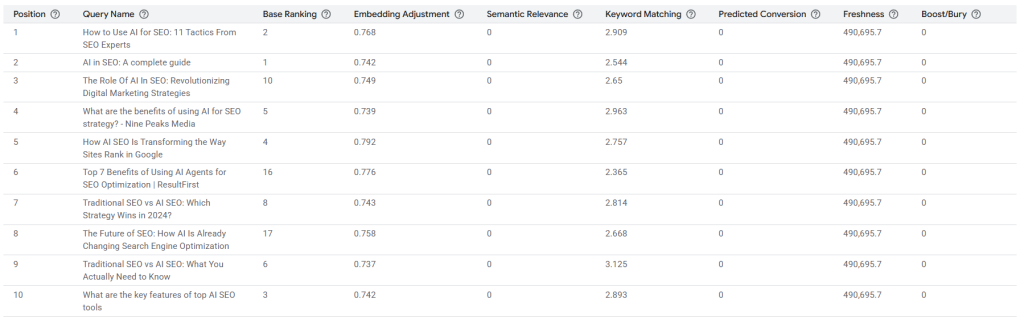
- Position – This shows the final rank of the document in the search results.
- Query Name – This is the identifier or title of the returned document.
- Base Ranking – This is the initial relevance score of the document provided by the core ranking algorithm, before any adjustments are made.
- Embedding Adjustment – This score is adjusted based on the semantic similarity between the query and document embeddings. It is also known as the Gecko score.
- Semantic Relevance – This is a more advanced relevance score from a cross-attention model (Jetstream) that better understands context and negation compared to embeddings.
- Keyword Matching – This score is based on the frequency and relevance of query keywords found in the document, typically using an algorithm like BM25.
- Predicted Conversion – This score predicts the likelihood of a user engaging with the result (e.g., clicking), based on historical user interaction data (PCTR/PCVR).
- Freshness – This score is adjusted based on the recency of the document, which is especially important for time-sensitive queries.
- Boost/Bury – This is a manual adjustment applied to the score to either promote (boost) or demote (bury) a document based on business rules.
This is the initial relevance score of the document provided by the core ranking algorithm, before any adjustments are made.
Modes of search
- Search: Search with a list of results
- Search with an answer: A generative summary above the search results
- Search with follow-ups: Conversational search with generative summaries and support for follow-up questions
How many top results go into AI search?
Five.
Snippets vs Extractive Answers
Snippets – Short fragments of text from the search result content
Extractive answers – Longer passages of text from the search result content
Per Search Metrics Comparison
- Baseline Search Count
- Comparison Search Count
- Search Count Delta
- Baseline CTR
- Comparison CTR
- CTR Delta
- Baseline No Results Rate
- Comparison No Results Rate
- No Results Rate Delta
Ignore adversarial query – Prevents LLM answers on adversarial queries.


Leave a Reply