An analysis of qualitative interviews with 1,250 professionals exploring how the general workforce, creatives, and scientists integrate AI into their work.
We often talk about artificial intelligence in the future tense, wondering who it will replace. But a major study of over twelve hundred professionals shows that the future is already here, and it looks a lot different than the hype. Instead of mass replacement, we are seeing a shift in how we work.
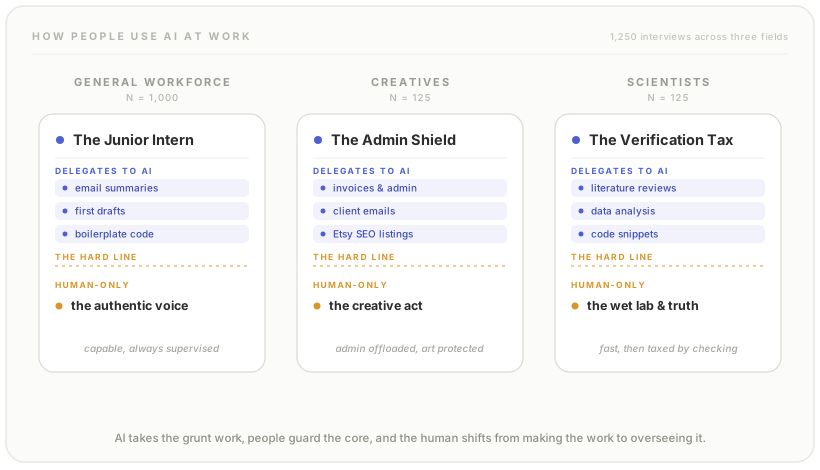
Across the general workforce, people treat AI like an eager but unreliable junior intern. They use it for grunt work, to summarize emails, and to break through writer's block. But they never trust the output blindly.
Artists and creatives are using AI in a surprising way. They are not using it to make art. Instead, they use it as an admin shield. By letting AI handle invoices, emails, and basic business tasks, they buy back precious time for their actual creative work. They draw a hard line at the soul of their craft, refusing to let machines do the actual writing, composing, or designing.
For scientists, the story is more complicated. They face what is called a verification tax. While AI can quickly analyze data and summarize research papers, its tendency to make things up means scientists must double-check every single line. This extra verification step often wipes out any time saved.
Ultimately, the rise of AI is not devaluing human expertise. It is reshaping it. The future of work is not about machines replacing us, but about humans shifting from being the generators of work to the editors, architects, and quality controllers.
A tool for conducting AI-powered qualitative research interviews at scale. In this study, we used Anthropic Interviewer to explore how 1,250 professionals integrate AI into their work and how they feel about its role in their future.
Associated Research: Introducing Anthropic Interviewer: What 1,250 professionals told us about working with AI
This repository contains interview transcripts from 1,250 professionals:
All participants provided informed consent for public release.
Data released under CC-BY, code released under MIT License
For inquiries, contact kunal@anthropic.com.
scientists_transcriptsDownload
workforce_transcripts_part_1Download
workforce_transcripts_part_2Download
workforce_transcripts_part_3Download
workforce_transcripts_part_4Download
license: mit
@online{handa2025interviewer, author = {Kunal Handa and Michael Stern and Saffron Huang and Jerry Hong and Esin Durmus and Miles McCain and Grace Yun and AJ Alt and Thomas Millar and Alex Tamkin and Jane Leibrock and Stuart Ritchie and Deep Ganguli}, title = {Introducing Anthropic Interviewer: What 1,250 professionals told us about working with AI}, year = {2025}, url = {https://anthropic.com/research/anthropic-interviewer},}In the tech world, we often talk about Artificial Intelligence in the future tense. We speculate on who it will replace and how it will reshape the economy. The reality is that the future has already arrived. It is quiet, uneven, and happening in offices, classrooms, workshops, and hospitals right now.
At Dejan AI, we wanted to move past the hype cycles. We analyzed a massive dataset of qualitative interviews with 1,250 professionals. This group spanned the entire workforce spectrum. We spoke to software engineers and legal assistants. We interviewed specialty candle makers, snow cone vendors, braille factory technicians, astrophysicists, and marine biologists.
We did not find a story of mass replacement. We found a story of adaptation, skepticism, and a fundamental shift in the definition of “work.”
Here is our analysis of how the modern world is actually collaborating with AI.
The “Overenthusiastic Intern”
The most consistent theme across the general workforce transcripts is how professionals conceptualize the AI. They treat it as an eager, highly capable, but occasionally unreliable junior intern.
Users delegate the “grunt work” to the AI. This includes summarizing long email chains, formatting citations, writing first drafts of difficult emails, or generating boilerplate code. Just as a manager would not send an intern’s work to a client without review, these professionals never trust the output blindly.
A software developer described treating the AI like “an eager but very junior developer… me calling the shots, reviewing and approving each step.” A paralegal noted they delegate smaller tasks but “supervise the work to make sure it’s accurate.”
The immediate value of AI is not in high-level strategy. It acts as a force multiplier for mid-level execution, provided the human operator has the expertise to review the work.
Writer’s block and analysis paralysis are fading away. Across almost every profession, the single most common use case for AI is not doing the final work. It is starting it.
We saw a recurring pattern we call the “0-to-60” workflow.
As one participant noted, they use it to “break through writer’s block… just using it to get fragments I can massage into something really good.”
There is a strong cultural resistance to sounding “like a bot.” Across the board, professionals are fiercely protective of their authentic voice. This is especially true in client-facing communications.
Users complained about over-enthusiastic tones and a lack of “grit” or distinct personality. A school secretary noted she can tell instantly when parents use AI to write emails because of the specific syntax. A physical therapist uses AI to draft professional letters but writes personal emails to patients manually to ensure they know “I care.”
As AI-generated text floods our inboxes, the ability to write with distinct human personality and empathy is becoming a differentiator.
Negotiating the “Soul” Boundary
There is a prevailing narrative in the media that AI is coming for creative jobs. The data shows a different reality. Creatives are not handing over the keys to the kingdom. They are building sophisticated boundaries.
The most consistent trend across the dataset was unexpected. When asked how they use AI, the vast majority of creatives did not talk about generating art. They talked about bureaucracy.
Wedding photographers, grant-writing musicians, and freelance illustrators are using LLMs to handle the “business of being creative.” They are generating invoices, writing difficult emails to clients, analyzing spreadsheet data, and optimizing SEO for Etsy listings.
As one wedding photographer noted, AI tools helped cut their gallery turnaround time from 12 weeks to 3 weeks. By offloading the technical culling and color-correction, they bought back time to focus on the artistic direction. For creatives, AI acts as a shield against the mundane. It protects the time needed for deep work.
There is a hard line drawn in the sand by 90% of the interviewees. They are happy to use AI for research, outlining, and brainstorming, but they refuse to let AI execute the core creative act.
We are seeing the emergence of “Human-in-the-Loop” as a premium value proposition. Creatives are positioning their personal touch and their unique voice as the luxury product.
While the utility of AI is clear, the anxiety in the dataset is palpable. It is not just about job loss. It is about market pollution.
Multiple interviewees expressed deep concern about the “slop.” This refers to the flood of low-effort, AI-generated books on Amazon, generic images on stock sites, and fake artists on Spotify. One game designer noted that internet searches are becoming useless because so much of the results are internet spam.
There is a genuine fear that high-quality, human-crafted work will be buried under an avalanche of mediocre, automated content.
The Trust Gap and the Verification Tax
In the creative world, an AI hallucination is a “happy accident.” In the scientific world, it is a liability. The narrative for scientists is starkly different. They use AI to overcome “data paralysis,” but the scientific method relies on reproducibility and truth. These are two things Generative AI struggles with.
The most universal use case among scientists is literature review. Almost every interviewee described using LLMs to scan vast repositories of academic papers to find gaps in research or summarize complex topics.
However, this utility comes with a warning label. The “hallucination” of citations is the single biggest frustration reported. One researcher noted that AI is great for finding trends in 1940s data but fails when asked for specific page numbers.
Scientists treat AI like a brilliant but unreliable grad student. They use it to cast a wide net, but they never put the AI’s findings into a paper without finding the primary source manually.
If there is one place AI is strictly forbidden, it is the “Wet Lab.” This is the physical bench where experiments happen.
Whether it is culturing bacteria, soldering circuits, or monitoring chemical reactions, scientists overwhelmingly rejected the idea of AI interference in physical experimentation. One microbiologist stated they need to see the color change with their own eyes. A chemist noted the AI doesn’t know that the equipment is 20 years old and has a specific quirk.
In science, tacit knowledge is viewed as irreplaceable. AI is welcome in the digital realm of data analysis, but it is barred from the physical realm of data collection.
Creatives talked about AI saving time. Scientists were more conflicted. Many reported a phenomenon we call the “Verification Tax.”
AI can write a summary or a code snippet in seconds. However, the time required for a PhD-level expert to verify that output line-by-line often negates the efficiency gains. One researcher studying toxic compounds noted they have to verify every single line because a decimal point error could be dangerous.
For scientists, speed is secondary to accuracy. If an AI tool cannot prove its work, it becomes a burden rather than a boost.
When we asked scientists what they wished AI could do, a surprising theme emerged. They did not want an AI that agrees with them. They want an AI that fights them.
Current LLMs are trained to be helpful and polite. Scientists found this annoying. They want an AI that acts as a Peer Reviewer. They want it to rip their ideas to shreds and tell them why their hypothesis is wrong. There is a massive market gap for “Adversarial AI”—models tuned not for politeness, but for rigorous, objective logic checking.
Reading through these 1,250 transcripts, it becomes clear that AI is not devaluing expertise. It is reshaping it. The professionals getting the most out of AI are the ones who already know their jobs inside and out.
The future of work is not “AI vs. Human.” It is Human + AI. The human shifts from being the generator of work to the architect, editor, and quality controller of work.
 Dan Petrovic ·
Dec 10, 10:22
Dan Petrovic ·
Dec 10, 10:22

This fits well with how I use AI. I use it to explore ranges of diagnoses for example but commonly find AI in that context to be out of focus and must run multiple, differently worded searches to narrow input. For example, in chronic kidney disease related hearing loss in hypertensive patients, AI drifted into Alport’s syndrome and Alstrom’s but the issue was not focused on renal disease and hearing loss related to hypertension. The AI user then must be savvy for what is useful and what is not. I.e., AI is very, very far from taking the place of highly knowledgeable humans.
I also use AI to find pertinent explanatory synopses on complex medical problems. But I must always edit those responses for pertinence and layman’s ability to understand.
AI generated images for PowerPoint in Designer have some predictable character that is more often than not flavored in ways that are repetitive from topic to topic. I.e., asking for an image of Elijah generates mountains, valleys, streams, and clouds very similar to what might ask for peace or storm or whatever. The pertinent to the landscape from the Eastern Lebanon (Sidon) to the Jordan River Valley is missing.
In summarizing hospital records for a hospital discharge summary, I recently found AI to be concise, complete, and well-focused but I had to add crucial information pertinent to the current hospitalization.
In summary, AI is helpful in broadening potential directions, in summarizing, but limited by inaccuracy, afflicted by distraction, and seldom optimally focused.