 Dan Petrovic ·
01 October 2026
Dan Petrovic ·
01 October 2026
Google's Gemini 4 Argon introduces a 1-million-token output limit to support long-horizon autonomous tasks, enterprise benchmarks, and complex code migrations.
Google's Gemini 4 Argon expands the model output horizon to 1 million tokens, a sixteenfold increase over the previous 64,000-token ceiling, aimed at preventing the drift, compounding errors, and hallucinated tangents that disrupt autonomous multi-step work. By pairing this expanded output window with sustained retrieval across deep context windows, the model executes end-to-end tasks, such as translating entire codebases or conducting complex multi-document audits, within a single uninterrupted reasoning trajectory.
Autonomous model deployment has stalled primarily at the boundary of long-horizon execution. Standard frontier models lose track of instructions, distort facts, or pursue irrelevant tangents when tasked with running workflows across hours or across tens of thousands of tokens. Extending the generation window to 1 million tokens allows an agent to maintain its execution state, test intermediate outputs, and correct errors without resetting its working memory.
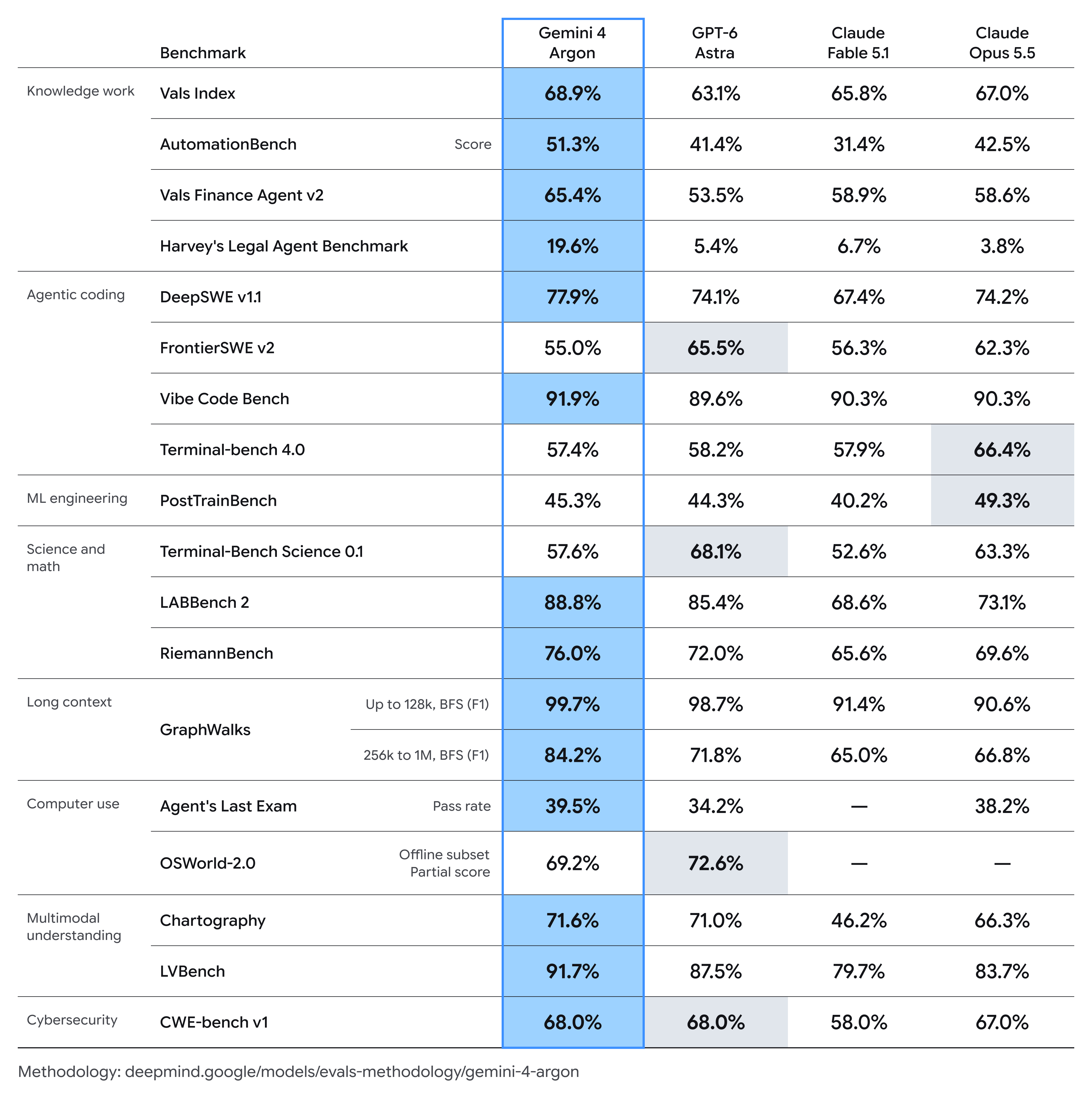
Comparative evaluations demonstrate that Gemini 4 Argon maintains coherence across extended enterprise tasks, particularly in domains requiring procedural consistency over large reference corpora.
| Benchmark | Gemini 4 Argon | GPT-6 Astra | Claude Fable 5.1 | Claude Opus 5.5 |
|---|---|---|---|---|
| GraphWalks (256k to 1M, BFS F1) | 84.2% | 71.8% | 65.0% | 66.8% |
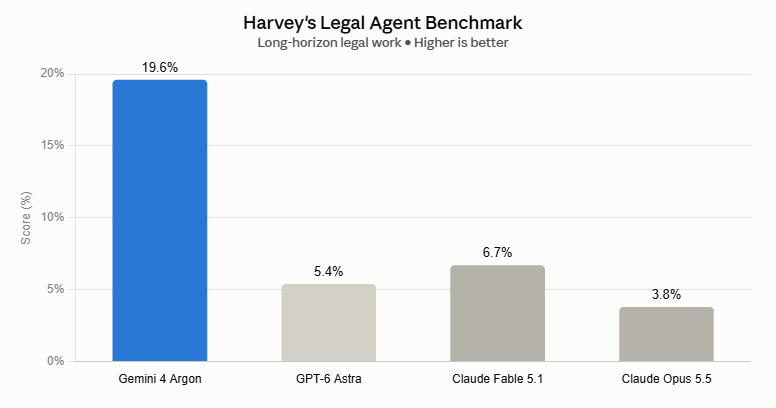
| Harvey's Legal Agent Benchmark | 19.6% | 5.4% | 6.7% | 3.8% |
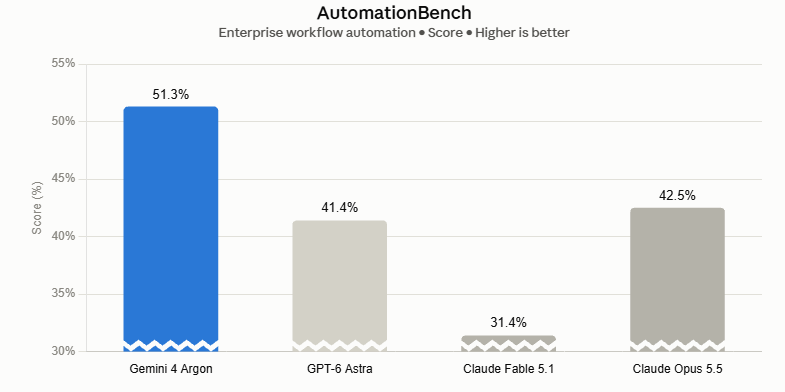
| AutomationBench | 51.3% | 41.4% | 31.4% | 42.5% |
| Vals Finance Agent v2 | 65.4% | 53.5% | 58.9% | 58.6% |
| Vals Index | 68.9% | 63.1% | 65.8% | 67.0% |
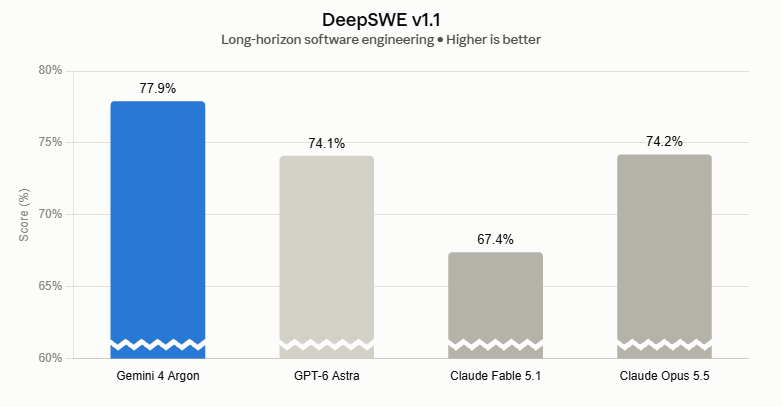
| DeepSWE v1.1 | 77.9% | 74.1% | 67.4% | 74.2% |
| LVBench | 91.7% | 87.5% | 79.7% | 83.7% |
| GraphWalks (Up to 128k, BFS F1) | 99.7% | 98.7% | 91.4% | 90.6% |
On the GraphWalks benchmark between 256,000 and 1 million tokens, Argon leads the closest competing model, GPT-6 Astra, by 12.4 percentage points.
On Harvey's Legal Agent Benchmark, which assesses multi-step legal drafting and research, Argon scored 19.6%, compared to 6.7% for Claude Fable 5.1, 5.4% for GPT-6 Astra, and 3.8% for Claude Opus 5.5.
On AutomationBench, Zapier's evaluation measuring end-to-end execution across business operational stacks, Argon scored 51.3%, an 8.8 percentage point margin over Claude Opus 5.5.
The model does not lead across all agentic benchmarks. On FrontierSWE v2, Argon scored 55.0% against GPT-6 Astra's 65.5%. On Terminal-bench 4.0, Argon achieved 57.4%, trailing Claude Opus 5.5 at 66.4%.
Internal deployments at Google illustrate the operational scope of agents that do not require continuous human steering. Teams assigned Argon agents to analyze fleet-wide telemetry across production data centers. The agents identified memory inefficiencies and deployed automated configurations, reclaiming over 300 TiB of memory, with projected total savings between 500 TiB and 1 PiB.
Software modernization workflows have also shifted from piecemeal assistant queries to multi-file codebase migrations. Argon agents translated C and C++ codebases to Rust across core components, ranging from libraries like re2 and libgav1 to the 800,000-line Fuchsia Zircon kernel. For libgav1, the agents processed compiler outputs, ran profile-guided iterations, and replaced 32,000 lines of SIMD code with safe Rust that auto-vectorizes, generating a decoder that executes 2.7 times faster than the previous manual Rust implementation.
In theoretical optimization, quantum researchers tasked Argon with reducing the spacetime resource requirements (qubits multiplied by gates) in bottlenecked algorithmic subroutines. The model compressed these resources to beat established baselines by 40%. Detailed evaluation methodologies for these benchmarks are published at deepmind.google/models/evals-methodology/gemini-4-argon.
{
"conversation": {
"id": "496d6c48-3b3f-4509-8c9e-1e4a7ceb5194",
"title": "https://blog.google/innovation-and-ai/models-and-research/gemini-models/gemini-4-argon/?utm_source=x&utm_medium=social&u",
"user_email": "dan.petrovic@dejan.com.au",
"current_node_id": "cb4a197c-e9fe-4c47-8b3c-6979d4e2328f",
"created_at": "2026-10-01T07:41:03.266165+00:00"
},
"exported_at": "2026-10-01T07:50:49.448187+00:00",
"node_count": 69,
"tree": [
{
"id": "ed454f0c-d361-40a5-829c-139aece67c03",
"conversation_id": "496d6c48-3b3f-4509-8c9e-1e4a7ceb5194",
"parent_id": null,
"source": "user_text",
"trigger_index": null,
"trigger_text": "https://blog.google/innovation-and-ai/models-and-research/gemini-models/gemini-4-argon/?utm_source=x&utm_medium=social&utm_campaign=&utm_content=",
"answer": "Google announced Gemini 4 Argon, a frontier model featuring an expanded 1M token output limit and specialized capabilities in software engineering, enterprise knowledge work, and cybersecurity defense at an introductory pricing of $2 per million input tokens and $10 per million output tokens.",
"annotations": [
{
"hint": "Expanding to 1 million output tokens for single-run deep reasoning.",
"phrase": "expanded 1M token output limit"
},
{
"hint": "First rolling out to trusted cyber defenders via the Fairwind Program.",
"phrase": "cybersecurity defense"
},
{
"hint": "$2 per 1M input tokens and $10 per 1M output tokens ($4 / $20 post-introductory).",
"phrase": "introductory pricing"
}
],
"menu": [
{
"label": "Cybersecurity defense and the Fairwind Program",
"search": false,
"preferred": true
},
{
"label": "Benchmark performance across coding and enterprise benchmarks",
"search": false,
"preferred": false
},
{
"label": "Internal engineering use cases at Google",
"search": false,
"preferred": false
},
{
"label": "Safety safeguards and alignment mitigations",
"search": false,
"preferred": false
}
],
"proactive_suggestion": "The supplied source is dated September 30, 2026, which falls well outside current real-world dates, indicating this document is speculative, synthetic, or from a future simulated release.",
"status": "ready",
"created_at": "2026-10-01T07:41:03.274300+00:00",
"svg": null,
"illustration": null,
"tokens_in": 12496,
"tokens_out": 989,
"illus_kind": null,
"illus_payload": null,
"wt_titles": null,
"wt_index": null,
"wt_total": null,
"origin_id": null,
"expandable": true,
"expanded_answer": "Google announced Gemini 4 Argon, a frontier intelligence model engineered for long-horizon workflows like autonomous codebase migrations, complex financial and legal research, and cyber defense. To enable deep, multi-step reasoning in a single run, the model expands its output capacity to an industry-leading 1 million tokens, launching initially to trusted defenders via the Fairwind Program at an introductory rate of $2 per million input and $10 per million output tokens.",
"expanded_annotations": [
{
"hint": "Learn about Argon's C/C++ to Rust migrations across Google.",
"phrase": "autonomous codebase migrations"
},
{
"hint": "Learn about the early access initiative for cyber defenders.",
"phrase": "Fairwind Program"
},
{
"hint": "See standard pricing details and cached token discounts.",
"phrase": "introductory rate"
}
],
"expanded_expandable": true,
"expansion_visible": false,
"web_search": false,
"article": false,
"tokens_cached": 12325,
"children": [
{
"id": "73a1bef0-3de7-4368-b1ff-5b412edc6cf5",
"conversation_id": "496d6c48-3b3f-4509-8c9e-1e4a7ceb5194",
"parent_id": "ed454f0c-d361-40a5-829c-139aece67c03",
"source": "menu",
"trigger_index": 0,
"trigger_text": "Cybersecurity defense and the Fairwind Program",
"answer": "Google is rolling out Gemini 4 Argon without cyber guardrails to vetted defenders in its Fairwind Program and Wiz's Scan for Good initiative to autonomously find, validate, and patch critical software vulnerabilities.",
"annotations": [
{
"hint": "Google is distributing the model without cyber guardrails to trusted defenders so they can leverage full remediation power.",
"phrase": "without cyber guardrails"
},
{
"hint": "Wiz demonstrated this by finding a high-risk exposure of sensitive personal data across healthcare systems.",
"phrase": "Scan for Good"
}
],
"menu": [
{
"label": "CWE-bench and vulnerability testing results",
"search": false,
"preferred": true
},
{
"label": "How the Fairwind Program handles model safety",
"search": false,
"preferred": false
},
{
"label": "Wiz black-box penetration testing performance",
"search": false,
"preferred": false
}
],
"proactive_suggestion": null,
"status": "ready",
"created_at": "2026-10-01T07:41:13.958512+00:00",
"svg": null,
"illustration": null,
"tokens_in": 7023,
"tokens_out": 183,
"illus_kind": null,
"illus_payload": null,
"wt_titles": null,
"wt_index": null,
"wt_total": null,
"origin_id": null,
"expandable": true,
"expanded_answer": null,
"expanded_annotations": [],
"expanded_expandable": false,
"expansion_visible": false,
"web_search": false,
"article": false,
"tokens_cached": 6911,
"children": []
},
{
"id": "4020a253-20df-411f-9d1a-f38be7d35386",
"conversation_id": "496d6c48-3b3f-4509-8c9e-1e4a7ceb5194",
"parent_id": "ed454f0c-d361-40a5-829c-139aece67c03",
"source": "menu",
"trigger_index": 1,
"trigger_text": "Benchmark performance across coding and enterprise benchmarks",
"answer": "Gemini 4 Argon achieves state-of-the-art results across key evaluations, including 77.9% on DeepSWE v1.1, first place on the Vals Index and AutomationBench (51.3%), and 91.7% on LVBench for long video understanding.",
"annotations": [
{
"hint": "Measures model performance on real-world long-horizon software engineering tasks.",
"phrase": "DeepSWE v1.1"
},
{
"hint": "Measures economic impact across finance, coding, legal, and tax work weighted by contribution to U.S. GDP.",
"phrase": "Vals Index"
},
{
"hint": "Measures end-to-end execution across core business functions.",
"phrase": "AutomationBench"
}
],
"menu": [
{
"label": "Cybersecurity defense benchmarks (CWE-bench and vulnerability testing)",
"search": false,
"preferred": true
},
{
"label": "Internal enterprise engineering case studies at Google",
"search": false,
"preferred": false
},
{
"label": "Pricing and rollout access details",
"search": false,
"preferred": false
}
],
"proactive_suggestion": null,
"status": "ready",
"created_at": "2026-10-01T07:41:13.974216+00:00",
"svg": null,
"illustration": null,
"tokens_in": 14057,
"tokens_out": 474,
"illus_kind": null,
"illus_payload": null,
"wt_titles": null,
"wt_index": null,
"wt_total": null,
"origin_id": null,
"expandable": false,
"expanded_answer": null,
"expanded_annotations": [],
"expanded_expandable": false,
"expansion_visible": false,
"web_search": false,
"article": false,
"tokens_cached": 13822,
"children": [
{
"id": "15711054-6f56-4197-8689-412dc88c9b55",
"conversation_id": "496d6c48-3b3f-4509-8c9e-1e4a7ceb5194",
"parent_id": "4020a253-20df-411f-9d1a-f38be7d35386",
"source": "menu",
"trigger_index": 0,
"trigger_text": "Cybersecurity defense benchmarks (CWE-bench and vulnerability testing)",
"answer": "Gemini 4 Argon ties for first place on CWE-bench v1 with a 68% remediation score, uncovers exposures across 20 languages on internal benchmarks, and demonstrated real-world impact by finding a critical vulnerability in global hospital software through Wiz's Scan for Good initiative.",
"annotations": [
{
"hint": "Evaluates automated software vulnerability remediation.",
"phrase": "CWE-bench v1"
},
{
"hint": "Wiz's program remediating critical exposures for public infrastructure.",
"phrase": "Scan for Good"
}
],
"menu": [
{
"label": "Wiz black-box penetration testing results",
"search": false,
"preferred": true
},
{
"label": "Fairwind Program and unguardrailed defender access",
"search": false,
"preferred": false
},
{
"label": "Safeguards against cyber and CBRN misuse",
"search": false,
"preferred": false
}
],
"proactive_suggestion": null,
"status": "ready",
"created_at": "2026-10-01T07:43:13.319036+00:00",
"svg": null,
"illustration": null,
"tokens_in": 7101,
"tokens_out": 222,
"illus_kind": null,
"illus_payload": null,
"wt_titles": null,
"wt_index": null,
"wt_total": null,
"origin_id": null,
"expandable": true,
"expanded_answer": null,
"expanded_annotations": [],
"expanded_expandable": false,
"expansion_visible": false,
"web_search": false,
"article": false,
"tokens_cached": 6911,
"children": []
},
{
"id": "c3b67d7f-1318-4522-b61a-d8eb18bc98fb",
"conversation_id": "496d6c48-3b3f-4509-8c9e-1e4a7ceb5194",
"parent_id": "4020a253-20df-411f-9d1a-f38be7d35386",
"source": "menu",
"trigger_index": 1,
"trigger_text": "Internal enterprise engineering case studies at Google",
"answer": "Internally at Google, Argon powers large-scale C/C++ to Rust migrations, fleet-wide data center memory optimizations, and optimizing quantum computing algorithms.",
"annotations": [
{
"hint": "Migrated codebases like re2, libgav1, and the 800K-line Fuchsia Zircon kernel to safe Rust.",
"phrase": "large-scale C/C++ to Rust migrations"
},
{
"hint": "Freed 300 TiB with expected total savings of 500 TiB to 1 PiB.",
"phrase": "fleet-wide data center memory optimizations"
},
{
"hint": "Beating the published baseline by 40% in minutes for critical application subroutines.",
"phrase": "optimizing quantum computing algorithms"
}
],
"menu": [
{
"label": "Codebase migrations: Fuchsia and libgav1",
"search": false,
"preferred": true
},
{
"label": "Data center memory telemetry savings",
"search": false,
"preferred": false
},
{
"label": "Quantum algorithmic optimization gains",
"search": false,
"preferred": false
}
],
"proactive_suggestion": null,
"status": "ready",
"created_at": "2026-10-01T07:43:13.352179+00:00",
"svg": null,
"illustration": null,
"tokens_in": 14203,
"tokens_out": 441,
"illus_kind": null,
"illus_payload": null,
"wt_titles": null,
"wt_index": null,
"wt_total": null,
"origin_id": null,
"expandable": true,
"expanded_answer": null,
"expanded_annotations": [],
"expanded_expandable": false,
"expansion_visible": false,
"web_search": false,
"article": false,
"tokens_cached": 13822,
"children": []
},
{
"id": "9120a86d-12c2-401e-a385-0f59306cd463",
"conversation_id": "496d6c48-3b3f-4509-8c9e-1e4a7ceb5194",
"parent_id": "4020a253-20df-411f-9d1a-f38be7d35386",
"source": "menu",
"trigger_index": 2,
"trigger_text": "Pricing and rollout access details",
"answer": "Gemini 4 Argon is rolling out initially to trusted defenders through the Fairwind Program before broader access for developers and Ultra subscribers, launching at an introductory rate of $2 per million input and $10 per million output tokens before the standard price will double.",
"annotations": [
{
"hint": "A Google program providing access to trusted defenders without standard cyber guardrails to enable full defensive capabilities.",
"phrase": "Fairwind Program"
},
{
"hint": "Introductory rate is $2 per 1M input and $10 per 1M output tokens (with 95% off cached input), increasing to $4 input and $20 output post-introductory.",
"phrase": "standard price will double"
}
],
"menu": [
{
"label": "Rollout phases for developers and enterprises",
"search": false,
"preferred": true
},
{
"label": "Standard vs. introductory pricing details",
"search": false,
"preferred": false
},
{
"label": "Cybersecurity access under the Fairwind Program",
"search": false,
"preferred": false
}
],
"proactive_suggestion": null,
"status": "ready",
"created_at": "2026-10-01T07:43:13.361591+00:00",
"svg": null,
"illustration": null,
"tokens_in": 7094,
"tokens_out": 218,
"illus_kind": null,
"illus_payload": null,
"wt_titles": null,
"wt_index": null,
"wt_total": null,
"origin_id": null,
"expandable": true,
"expanded_answer": null,
"expanded_annotations": [],
"expanded_expandable": false,
"expansion_visible": false,
"web_search": false,
"article": false,
"tokens_cached": 6911,
"children": []
},
{
"id": "ecdd6b51-e28c-4aa4-b65a-615bc0ab45e9",
"conversation_id": "496d6c48-3b3f-4509-8c9e-1e4a7ceb5194",
"parent_id": "4020a253-20df-411f-9d1a-f38be7d35386",
"source": "annotation",
"trigger_index": 0,
"trigger_text": "DeepSWE v1.1",
"answer": "DeepSWE v1.1 evaluates a model's capacity to autonomously execute real-world long-horizon software engineering tasks across multi-file codebases, where Gemini 4 Argon established a new state of the art with a 77.9% score.",
"annotations": [
{
"hint": "Automated issue resolution across complex codebases.",
"phrase": "real-world long-horizon software engineering tasks"
}
],
"menu": [
{
"label": "Compare with prior SWE-bench standards",
"search": true,
"preferred": true
},
{
"label": "Argon's internal Google migration examples",
"search": false,
"preferred": false
}
],
"proactive_suggestion": "The announcement highlights Argon's score on DeepSWE v1.1 rather than the standard SWE-bench Verified, indicating a shift toward evaluating multi-step, agentic execution over simple bug fixes.",
"status": "ready",
"created_at": "2026-10-01T07:43:13.373263+00:00",
"svg": null,
"illustration": null,
"tokens_in": 14199,
"tokens_out": 330,
"illus_kind": null,
"illus_payload": null,
"wt_titles": null,
"wt_index": null,
"wt_total": null,
"origin_id": null,
"expandable": true,
"expanded_answer": null,
"expanded_annotations": [],
"expanded_expandable": false,
"expansion_visible": false,
"web_search": false,
"article": false,
"tokens_cached": 13822,
"children": []
},
{
"id": "13abc68a-9256-407e-bbeb-bf0e86c0fda3",
"conversation_id": "496d6c48-3b3f-4509-8c9e-1e4a7ceb5194",
"parent_id": "4020a253-20df-411f-9d1a-f38be7d35386",
"source": "annotation",
"trigger_index": 1,
"trigger_text": "Vals Index",
"answer": "The Vals Index measures an AI model's economic impact across finance, coding, legal, and tax work, with each sector weighted by its contribution to United States GDP.",
"annotations": [
{
"hint": "Weighted according to the specific contribution of each covered sector to U.S. GDP.",
"phrase": "economic impact"
},
{
"hint": "Sub-evaluations highlighting specific domains, including Vals Finance Agent v2 and Harvey's Legal Agent Benchmark.",
"phrase": "finance, coding, legal, and tax work"
}
],
"menu": [
{
"label": "How Argon performed on domain-specific enterprise evals",
"search": false,
"preferred": true
},
{
"label": "AutomationBench and Zapier workflow results",
"search": false,
"preferred": false
}
],
"proactive_suggestion": null,
"status": "ready",
"created_at": "2026-10-01T07:43:13.398924+00:00",
"svg": null,
"illustration": null,
"tokens_in": 7090,
"tokens_out": 195,
"illus_kind": null,
"illus_payload": null,
"wt_titles": null,
"wt_index": null,
"wt_total": null,
"origin_id": null,
"expandable": true,
"expanded_answer": null,
"expanded_annotations": [],
"expanded_expandable": false,
"expansion_visible": false,
"web_search": false,
"article": false,
"tokens_cached": 6911,
"children": []
},
{
"id": "b8bfbd17-6e9e-40e0-91d0-6ee220565e01",
"conversation_id": "496d6c48-3b3f-4509-8c9e-1e4a7ceb5194",
"parent_id": "4020a253-20df-411f-9d1a-f38be7d35386",
"source": "annotation",
"trigger_index": 2,
"trigger_text": "AutomationBench",
"answer": "Developed by Zapier, AutomationBench evaluates how accurately an AI model completes end-to-end multi-step tasks across real-world business applications, where Gemini 4 Argon ranks #1 with a 51.3% score.",
"annotations": [
{
"hint": "Scores 51.3% to secure the top spot on Zapier's workflow evaluation.",
"phrase": "ranks #1"
}
],
"menu": [
{
"label": "Compare with Vals Index enterprise results",
"search": false,
"preferred": true
},
{
"label": "See DeepSWE v1.1 software engineering details",
"search": false,
"preferred": false
},
{
"label": "Explore long video understanding on LVBench",
"search": false,
"preferred": false
}
],
"proactive_suggestion": null,
"status": "ready",
"created_at": "2026-10-01T07:43:13.409878+00:00",
"svg": null,
"illustration": null,
"tokens_in": 14191,
"tokens_out": 393,
"illus_kind": null,
"illus_payload": null,
"wt_titles": null,
"wt_index": null,
"wt_total": null,
"origin_id": null,
"expandable": true,
"expanded_answer": null,
"expanded_annotations": [],
"expanded_expandable": false,
"expansion_visible": false,
"web_search": false,
"article": false,
"tokens_cached": 13822,
"children": []
},
{
"id": "8751f4e7-1c4f-476c-b35b-26ad139569e8",
"conversation_id": "496d6c48-3b3f-4509-8c9e-1e4a7ceb5194",
"parent_id": "4020a253-20df-411f-9d1a-f38be7d35386",
"source": "user_text",
"trigger_index": null,
"trigger_text": "Sort the list by features where it has the greatest lead in comparison to other models.",
"answer": "| Benchmark | Gemini 4 Argon | Next Best Model | Margin Lead |\n| :--- | :--- | :--- | :--- |\n| Harvey's Legal Agent Benchmark | 19.6% | 6.7% (Claude Fable 5.1) | +12.9% |\n| GraphWalks (256k to 1M) | 84.2% | 71.8% (GPT-6 Astra) | +12.4% |\n| Vals Finance Agent v2 | 65.4% | 58.9% (Claude Fable 5.1) | +6.5% |\n| AutomationBench | 51.3% | 42.5% (Claude Opus 5.5) | +8.8% |\n| RiemannBench | 76.0% | 72.0% (GPT-6 Astra) | +4.0% |\n| LVBench | 91.7% | 87.5% (GPT-6 Astra) | +4.2% |\n| DeepSWE v1.1 | 77.9% | 74.2% (Claude Opus 5.5) | +3.7% |\n| LABBench 2 | 88.8% | 85.4% (GPT-6 Astra) | +3.4% |",
"annotations": [
{
"hint": "Gemini 4 Argon scored 19.6% versus next-best Claude Fable 5.1 at 6.7%.",
"phrase": "Harvey's Legal Agent Benchmark"
},
{
"hint": "Gemini 4 Argon reached 84.2% versus next-best GPT-6 Astra at 71.8%.",
"phrase": "GraphWalks (256k to 1M)"
},
{
"hint": "Gemini 4 Argon achieved 88.8% versus next-best GPT-6 Astra at 85.4%.",
"phrase": "LABBench 2"
}
],
"menu": [
{
"label": "Benchmarks where Argon trails competitors",
"search": false,
"preferred": true
},
{
"label": "Evaluation methodology and testing setups",
"search": false,
"preferred": false
},
{
"label": "Cybersecurity benchmark results",
"search": false,
"preferred": false
}
],
"proactive_suggestion": null,
"status": "ready",
"created_at": "2026-10-01T07:45:01.632055+00:00",
"svg": null,
"illustration": null,
"tokens_in": 15219,
"tokens_out": 1129,
"illus_kind": null,
"illus_payload": null,
"wt_titles": null,
"wt_index": null,
"wt_total": null,
"origin_id": null,
"expandable": true,
"expanded_answer": "Ranked strictly by absolute percentage lead over the highest-scoring rival (Claude Opus 5.5, GPT-6 Astra, or Claude Fable 5.1), Gemini 4 Argon demonstrates its most dominant margins in specialized professional work, ultra-long-context traversal, and multi-step enterprise workflows:\n\n| Benchmark | Domain | Gemini 4 Argon | Next Best Model | Margin Lead |\n| :--- | :--- | :--- | :--- | :--- |\n| Harvey's Legal Agent Benchmark | Legal drafting & research | 19.6% | 6.7% (Claude Fable 5.1) | +12.9% |\n| GraphWalks (256k to 1M) | Long-context graph retrieval | 84.2% | 71.8% (GPT-6 Astra) | +12.4% |\n| AutomationBench | Enterprise workflow execution | 51.3% | 42.5% (Claude Opus 5.5) | +8.8% |\n| Vals Finance Agent v2 | Multi-step financial research | 65.4% | 58.9% (Claude Fable 5.1) | +6.5% |\n| LVBench | Long video multimodal comprehension | 91.7% | 87.5% (GPT-6 Astra) | +4.2% |\n| RiemannBench | Advanced mathematics reasoning | 76.0% | 72.0% (GPT-6 Astra) | +4.0% |\n| DeepSWE v1.1 | Agentic software engineering | 77.9% | 74.2% (Claude Opus 5.5) | +3.7% |\n| LABBench 2 | Scientific reasoning | 88.8% | 85.4% (GPT-6 Astra) | +3.4% |\n\nThe largest competitive advantage appears in legal tasks, where Argon triples the score of its nearest rival, alongside substantial leads in long-horizon agent execution and extended context retrieval at scale.",
"expanded_annotations": [
{
"hint": "Details on legal research and drafting evaluation methodology and comparisons",
"phrase": "Harvey's Legal Agent Benchmark"
},
{
"hint": "Performance across BFS F1 retrievals from 256k up to 1M tokens",
"phrase": "GraphWalks (256k to 1M)"
},
{
"hint": "Zapier's benchmark evaluating end-to-end business function workflows",
"phrase": "AutomationBench"
},
{
"hint": "Evaluations for multi-step financial research tasks",
"phrase": "Vals Finance Agent v2"
}
],
"expanded_expandable": true,
"expansion_visible": false,
"web_search": false,
"article": false,
"tokens_cached": 14503,
"children": [
{
"id": "7d4b24a2-fa27-48f7-b340-4c5ed98c8559",
"conversation_id": "496d6c48-3b3f-4509-8c9e-1e4a7ceb5194",
"parent_id": "8751f4e7-1c4f-476c-b35b-26ad139569e8",
"source": "menu",
"trigger_index": 0,
"trigger_text": "Benchmarks where Argon trails competitors",
"answer": "Gemini 4 Argon trails competitors on FrontierSWE v2, Terminal-Bench Science 0.1, Terminal-bench 4.0, PostTrainBench, and OSWorld-2.0.",
"annotations": [
{
"hint": "Argon scores 55.0% behind GPT-6 Astra's 65.5%",
"phrase": "FrontierSWE v2"
},
{
"hint": "Argon scores 57.6% behind GPT-6 Astra's 68.1%",
"phrase": "Terminal-Bench Science 0.1"
},
{
"hint": "Argon scores 57.4% behind Claude Opus 5.5's 66.4%",
"phrase": "Terminal-bench 4.0"
}
],
"menu": [
{
"label": "Table of margins where Argon trails competitors",
"search": false,
"preferred": true
},
{
"label": "Breakdown of GPT-6 Astra's strongest leads",
"search": false,
"preferred": false
},
{
"label": "Breakdown of Claude Opus 5.5's wins over Argon",
"search": false,
"preferred": false
}
],
"proactive_suggestion": null,
"status": "ready",
"created_at": "2026-10-01T07:45:16.127793+00:00",
"svg": null,
"illustration": null,
"tokens_in": 24115,
"tokens_out": 1419,
"illus_kind": null,
"illus_payload": null,
"wt_titles": null,
"wt_index": null,
"wt_total": null,
"origin_id": null,
"expandable": true,
"expanded_answer": "Gemini 4 Argon faces its widest deficits against GPT-6 Astra on FrontierSWE v2 (55.0% vs. 65.5%) and Terminal-Bench Science 0.1 (57.6% vs. 68.1%). It also trails Claude Opus 5.5 on Terminal-bench 4.0 (57.4% vs. 66.4%) and PostTrainBench (45.3% vs. 49.3%), while narrowly falling behind Astra's 72.6% with a 69.2% score on the offline OSWorld-2.0 subset.",
"expanded_annotations": [
{
"hint": "Astra leads by over 10 percentage points on both benchmarks.",
"phrase": "widest deficits against GPT-6 Astra"
},
{
"hint": "Opus 5.5 outperforms Argon by 9.0 points on terminal commands.",
"phrase": "Terminal-bench 4.0"
},
{
"hint": "Evaluates desktop environment navigation and action execution.",
"phrase": "offline OSWorld-2.0 subset"
}
],
"expanded_expandable": true,
"expansion_visible": false,
"web_search": false,
"article": false,
"tokens_cached": 22503,
"children": [
{
"id": "cb4a197c-e9fe-4c47-8b3c-6979d4e2328f",
"conversation_id": "496d6c48-3b3f-4509-8c9e-1e4a7ceb5194",
"parent_id": "7d4b24a2-fa27-48f7-b340-4c5ed98c8559",
"source": "menu",
"trigger_index": 0,
"trigger_text": "Table of margins where Argon trails competitors",
"answer": "| Benchmark | Gemini 4 Argon | Top Competitor | Margin Deficit |\n| :--- | :--- | :--- | :--- |\n| FrontierSWE v2 | 55.0% | 65.5% (GPT-6 Astra) | -10.5% |\n| Terminal-Bench Science 0.1 | 57.6% | 68.1% (GPT-6 Astra) | -10.5% |\n| Terminal-bench 4.0 | 57.4% | 66.4% (Claude Opus 5.5) | -9.0% |\n| PostTrainBench | 45.3% | 49.3% (Claude Opus 5.5) | -4.0% |\n| OSWorld-2.0 | 69.2% | 72.6% (GPT-6 Astra) | -3.4% |",
"annotations": [
{
"hint": "GPT-6 Astra scored 65.5% vs Argon's 55.0%",
"phrase": "FrontierSWE v2"
},
{
"hint": "GPT-6 Astra scored 68.1% vs Argon's 57.6%",
"phrase": "Terminal-Bench Science 0.1"
}
],
"menu": [
{
"label": "Competitor breakdown between GPT-6 Astra and Claude Opus 5.5",
"search": false,
"preferred": true
},
{
"label": "Benchmarks where Argon ties competitors",
"search": false,
"preferred": false
},
{
"label": "Argon's internal software engineering achievements",
"search": false,
"preferred": false
}
],
"proactive_suggestion": null,
"status": "ready",
"created_at": "2026-10-01T07:48:57.830834+00:00",
"svg": null,
"illustration": null,
"tokens_in": 8565,
"tokens_out": 365,
"illus_kind": null,
"illus_payload": null,
"wt_titles": null,
"wt_index": null,
"wt_total": null,
"origin_id": null,
"expandable": false,
"expanded_answer": null,
"expanded_annotations": [],
"expanded_expandable": false,
"expansion_visible": false,
"web_search": false,
"article": false,
"tokens_cached": 8000,
"children": [
{
"id": "be8c443f-2161-4e3b-ac6f-690cf4e4847e",
"conversation_id": "496d6c48-3b3f-4509-8c9e-1e4a7ceb5194",
"parent_id": "cb4a197c-e9fe-4c47-8b3c-6979d4e2328f",
"source": "menu",
"trigger_index": 0,
"trigger_text": "Competitor breakdown between GPT-6 Astra and Claude Opus 5.5",
"answer": "GPT-6 Astra outperforms Claude Opus 5.5 in agentic workflows, long context retrieval, and scientific execution, while Claude Opus 5.5 demonstrates higher performance in terminal operations and ML engineering tasks.",
"annotations": [
{
"hint": "Leads FrontierSWE v2 (65.5%), Terminal-Bench Science 0.1 (68.1%), and OSWorld-2.0 (72.6%).",
"phrase": "GPT-6 Astra"
},
{
"hint": "Leads Terminal-bench 4.0 (66.4%) and PostTrainBench (49.3%).",
"phrase": "Claude Opus 5.5"
}
],
"menu": [
{
"label": "Side-by-side benchmark comparison table",
"search": false,
"preferred": true
},
{
"label": "Analysis of Astra's lead in long-context retrieval",
"search": false,
"preferred": false
},
{
"label": "Opus 5.5 strengths in terminal and ML engineering",
"search": false,
"preferred": false
}
],
"proactive_suggestion": null,
"status": "ready",
"created_at": "2026-10-01T07:49:18.776158+00:00",
"svg": null,
"illustration": null,
"tokens_in": 17595,
"tokens_out": 434,
"illus_kind": null,
"illus_payload": null,
"wt_titles": null,
"wt_index": null,
"wt_total": null,
"origin_id": null,
"expandable": true,
"expanded_answer": null,
"expanded_annotations": [],
"expanded_expandable": false,
"expansion_visible": false,
"web_search": false,
"article": false,
"tokens_cached": 16000,
"children": []
},
{
"id": "3b6aecf5-0920-4bb3-a94a-7a68520e2a22",
"conversation_id": "496d6c48-3b3f-4509-8c9e-1e4a7ceb5194",
"parent_id": "cb4a197c-e9fe-4c47-8b3c-6979d4e2328f",
"source": "menu",
"trigger_index": 1,
"trigger_text": "Benchmarks where Argon ties competitors",
"answer": "Gemini 4 Argon ties for first place on CWE-bench v1 with a score of 68.0%, matching GPT-6 Astra.",
"annotations": [
{
"hint": "A benchmark evaluating autonomous remediation of security vulnerabilities.",
"phrase": "CWE-bench v1"
}
],
"menu": [
{
"label": "Argon's defensive cybersecurity capabilities",
"search": false,
"preferred": true
},
{
"label": "Detailed vulnerability benchmarks",
"search": false,
"preferred": false
},
{
"label": "Overall benchmark summary table",
"search": false,
"preferred": false
}
],
"proactive_suggestion": null,
"status": "ready",
"created_at": "2026-10-01T07:49:18.795186+00:00",
"svg": null,
"illustration": null,
"tokens_in": 17577,
"tokens_out": 317,
"illus_kind": null,
"illus_payload": null,
"wt_titles": null,
"wt_index": null,
"wt_total": null,
"origin_id": null,
"expandable": true,
"expanded_answer": null,
"expanded_annotations": [],
"expanded_expandable": false,
"expansion_visible": false,
"web_search": false,
"article": false,
"tokens_cached": 16000,
"children": []
},
{
"id": "f8b56d2b-dd8a-4fbe-b454-7850877f0b7a",
"conversation_id": "496d6c48-3b3f-4509-8c9e-1e4a7ceb5194",
"parent_id": "cb4a197c-e9fe-4c47-8b3c-6979d4e2328f",
"source": "menu",
"trigger_index": 2,
"trigger_text": "Argon's internal software engineering achievements",
"answer": "Internally at Google, Argon achieved a 40% efficiency boost in quantum computing subroutines, freed over 300 TiB across data centers through fleet-wide memory optimizations, and executed large-scale C/C++ to Rust migrations including the 800K-line Fuchsia Zircon kernel.",
"annotations": [
{
"hint": "Optimizing qubit-gate spacetime resources to outperform published baselines by 40%.",
"phrase": "quantum computing subroutines"
},
{
"hint": "Freeing over 300 TiB of fleet telemetry memory across Google data centers.",
"phrase": "fleet-wide memory optimizations"
},
{
"hint": "Converting C/C++ libraries and kernel code up to 800K lines into safe, vectorized Rust.",
"phrase": "large-scale C/C++ to Rust migrations"
}
],
"menu": [
{
"label": "Fuchsia Zircon kernel and libgav1 Rust migrations",
"search": false,
"preferred": true
},
{
"label": "Quantum algorithmic optimization breakdown",
"search": false,
"preferred": false
},
{
"label": "Data center memory optimization methods",
"search": false,
"preferred": false
}
],
"proactive_suggestion": null,
"status": "ready",
"created_at": "2026-10-01T07:49:18.796595+00:00",
"svg": null,
"illustration": null,
"tokens_in": 8784,
"tokens_out": 280,
"illus_kind": null,
"illus_payload": null,
"wt_titles": null,
"wt_index": null,
"wt_total": null,
"origin_id": null,
"expandable": true,
"expanded_answer": null,
"expanded_annotations": [],
"expanded_expandable": false,
"expansion_visible": false,
"web_search": false,
"article": false,
"tokens_cached": 8000,
"children": []
},
{
"id": "2a10c886-abfa-4a6c-8361-fe0ed0ef2de6",
"conversation_id": "496d6c48-3b3f-4509-8c9e-1e4a7ceb5194",
"parent_id": "cb4a197c-e9fe-4c47-8b3c-6979d4e2328f",
"source": "annotation",
"trigger_index": 0,
"trigger_text": "FrontierSWE v2",
"answer": "On FrontierSWE v2, Gemini 4 Argon scored 55.0%, placing last among all evaluated frontier models behind every listed rival.",
"annotations": [
{
"hint": "A benchmark under the agentic coding category evaluating complex, forward-looking software development tasks.",
"phrase": "FrontierSWE v2"
},
{
"hint": "GPT-6 Astra leads at 65.5%, Claude Opus 5.5 scores 62.3%, and Claude Fable 5.1 scores 56.3%.",
"phrase": "every listed rival"
}
],
"menu": [
{
"label": "How Argon performs on other agentic coding benchmarks",
"search": false,
"preferred": true
},
{
"label": "Full competitor breakdown for FrontierSWE v2",
"search": false,
"preferred": false
}
],
"proactive_suggestion": null,
"status": "ready",
"created_at": "2026-10-01T07:49:18.798087+00:00",
"svg": null,
"illustration": null,
"tokens_in": 17571,
"tokens_out": 363,
"illus_kind": null,
"illus_payload": null,
"wt_titles": null,
"wt_index": null,
"wt_total": null,
"origin_id": null,
"expandable": true,
"expanded_answer": null,
"expanded_annotations": [],
"expanded_expandable": false,
"expansion_visible": false,
"web_search": false,
"article": false,
"tokens_cached": 16000,
"children": []
},
{
"id": "5b1432c8-1ae5-41cc-82c7-430d52b488b0",
"conversation_id": "496d6c48-3b3f-4509-8c9e-1e4a7ceb5194",
"parent_id": "cb4a197c-e9fe-4c47-8b3c-6979d4e2328f",
"source": "annotation",
"trigger_index": 1,
"trigger_text": "Terminal-Bench Science 0.1",
"answer": "On Terminal-Bench Science 0.1, Gemini 4 Argon trails GPT-6 Astra by a 10.5-percentage-point margin, though Argon outperforms Astra and Claude models on other science and math evaluations in the benchmark suite.",
"annotations": [
{
"hint": "GPT-6 Astra scored 68.1% compared to Argon's 57.6%.",
"phrase": "10.5-percentage-point margin"
},
{
"hint": "Under the Science and math category, Argon leads in LABBench 2 (88.8%) and RiemannBench (76.0%).",
"phrase": "other science and math evaluations"
}
],
"menu": [
{
"label": "Argon vs Astra across all science and math benchmarks",
"search": false,
"preferred": true
},
{
"label": "Claude Opus 5.5 score on Terminal-Bench Science 0.1",
"search": false,
"preferred": false
},
{
"label": "Methodology behind Terminal-Bench Science 0.1",
"search": true,
"preferred": false
}
],
"proactive_suggestion": null,
"status": "ready",
"created_at": "2026-10-01T07:49:18.799302+00:00",
"svg": null,
"illustration": null,
"tokens_in": 17579,
"tokens_out": 433,
"illus_kind": null,
"illus_payload": null,
"wt_titles": null,
"wt_index": null,
"wt_total": null,
"origin_id": null,
"expandable": true,
"expanded_answer": null,
"expanded_annotations": [],
"expanded_expandable": false,
"expansion_visible": false,
"web_search": false,
"article": false,
"tokens_cached": 16000,
"children": []
}
]
},
{
"id": "e9e22e08-5813-484e-8302-c315e43f8d66",
"conversation_id": "496d6c48-3b3f-4509-8c9e-1e4a7ceb5194",
"parent_id": "7d4b24a2-fa27-48f7-b340-4c5ed98c8559",
"source": "menu",
"trigger_index": 1,
"trigger_text": "Breakdown of GPT-6 Astra's strongest leads",
"answer": "GPT-6 Astra holds its largest leads over Gemini 4 Argon on FrontierSWE v2 with a 10.5% margin, Terminal-Bench Science 0.1 with a 10.5% margin, and OSWorld-2.0 with a 3.4% margin.",
"annotations": [
{
"hint": "GPT-6 Astra scored 65.5% versus Argon's 55.0%",
"phrase": "FrontierSWE v2"
},
{
"hint": "GPT-6 Astra scored 68.1% versus Argon's 57.6%",
"phrase": "Terminal-Bench Science 0.1"
},
{
"hint": "GPT-6 Astra scored 72.6% versus Argon's 69.2%",
"phrase": "OSWorld-2.0"
}
],
"menu": [
{
"label": "Claude Opus 5.5 lead over Argon on Terminal-bench 4.0",
"search": false,
"preferred": true
},
{
"label": "Argon versus GPT-6 Astra on long context GraphWalks",
"search": false,
"preferred": false
},
{
"label": "PostTrainBench results across all evaluated models",
"search": false,
"preferred": false
}
],
"proactive_suggestion": null,
"status": "ready",
"created_at": "2026-10-01T07:48:57.848028+00:00",
"svg": null,
"illustration": null,
"tokens_in": 17147,
"tokens_out": 484,
"illus_kind": null,
"illus_payload": null,
"wt_titles": null,
"wt_index": null,
"wt_total": null,
"origin_id": null,
"expandable": false,
"expanded_answer": null,
"expanded_annotations": [],
"expanded_expandable": false,
"expansion_visible": false,
"web_search": false,
"article": false,
"tokens_cached": 16000,
"children": []
},
{
"id": "7e6f1f11-8149-40b3-8f4f-00679e181df6",
"conversation_id": "496d6c48-3b3f-4509-8c9e-1e4a7ceb5194",
"parent_id": "7d4b24a2-fa27-48f7-b340-4c5ed98c8559",
"source": "menu",
"trigger_index": 2,
"trigger_text": "Breakdown of Claude Opus 5.5's wins over Argon",
"answer": "Claude Opus 5.5 outperforms Gemini 4 Argon across three evaluations: Terminal-bench 4.0 (66.4% vs. 57.4%), PostTrainBench (49.3% vs. 45.3%), and FrontierSWE v2 (62.3% vs. 55.0%).",
"annotations": [
{
"hint": "Terminal-bench 4.0 tests agentic CLI and shell navigation capability.",
"phrase": "Terminal-bench 4.0"
},
{
"hint": "PostTrainBench evaluates post-training and alignment engineering skills.",
"phrase": "PostTrainBench"
},
{
"hint": "FrontierSWE v2 evaluates challenging real-world software engineering benchmarks.",
"phrase": "FrontierSWE v2"
}
],
"menu": [
{
"label": "Tabular comparison of all Claude Opus 5.5 vs. Argon metrics",
"search": false,
"preferred": true
},
{
"label": "Claude Fable 5.1 performance relative to Argon",
"search": false,
"preferred": false
},
{
"label": "GPT-6 Astra wins over Argon",
"search": false,
"preferred": false
}
],
"proactive_suggestion": null,
"status": "ready",
"created_at": "2026-10-01T07:48:57.850955+00:00",
"svg": null,
"illustration": null,
"tokens_in": 17153,
"tokens_out": 517,
"illus_kind": null,
"illus_payload": null,
"wt_titles": null,
"wt_index": null,
"wt_total": null,
"origin_id": null,
"expandable": true,
"expanded_answer": null,
"expanded_annotations": [],
"expanded_expandable": false,
"expansion_visible": false,
"web_search": false,
"article": false,
"tokens_cached": 16000,
"children": []
},
{
"id": "920e013e-8c8d-4e67-b714-922afe0fb72f",
"conversation_id": "496d6c48-3b3f-4509-8c9e-1e4a7ceb5194",
"parent_id": "7d4b24a2-fa27-48f7-b340-4c5ed98c8559",
"source": "annotation",
"trigger_index": 0,
"trigger_text": "FrontierSWE v2",
"answer": "On FrontierSWE v2, Gemini 4 Argon scored 55.0%, trailing behind all three tested rival models led by GPT-6 Astra at 65.5%.",
"annotations": [
{
"hint": "GPT-6 Astra scored 65.5%, Claude Opus 5.5 scored 62.3%, and Claude Fable 5.1 scored 56.3%.",
"phrase": "all three tested rival models"
}
],
"menu": [
{
"label": "Compare other software engineering benchmarks",
"search": false,
"preferred": true
},
{
"label": "Examine Terminal-bench 4.0 performance",
"search": false,
"preferred": false
},
{
"label": "Look up FrontierSWE v2 methodology",
"search": true,
"preferred": false
}
],
"proactive_suggestion": null,
"status": "ready",
"created_at": "2026-10-01T07:48:57.855776+00:00",
"svg": null,
"illustration": null,
"tokens_in": 17133,
"tokens_out": 389,
"illus_kind": null,
"illus_payload": null,
"wt_titles": null,
"wt_index": null,
"wt_total": null,
"origin_id": null,
"expandable": true,
"expanded_answer": null,
"expanded_annotations": [],
"expanded_expandable": false,
"expansion_visible": false,
"web_search": false,
"article": false,
"tokens_cached": 16000,
"children": []
},
{
"id": "cf6f15a2-9cb7-4c8d-b143-564825120516",
"conversation_id": "496d6c48-3b3f-4509-8c9e-1e4a7ceb5194",
"parent_id": "7d4b24a2-fa27-48f7-b340-4c5ed98c8559",
"source": "annotation",
"trigger_index": 1,
"trigger_text": "Terminal-Bench Science 0.1",
"answer": "On Terminal-Bench Science 0.1, Gemini 4 Argon scored 57.6%, trailing GPT-6 Astra's leading score of 68.1% and Claude Opus 5.5's 63.3%.",
"annotations": [
{
"hint": "Google DeepMind's frontier model announced in the post",
"phrase": "Gemini 4 Argon"
},
{
"hint": "Competitor model leading this benchmark",
"phrase": "GPT-6 Astra"
}
],
"menu": [
{
"label": "FrontierSWE v2 scores",
"search": false,
"preferred": true
},
{
"label": "Terminal-bench 4.0 scores",
"search": false,
"preferred": false
},
{
"label": "Other science and math benchmarks",
"search": false,
"preferred": false
}
],
"proactive_suggestion": null,
"status": "ready",
"created_at": "2026-10-01T07:48:57.863594+00:00",
"svg": null,
"illustration": null,
"tokens_in": 17141,
"tokens_out": 404,
"illus_kind": null,
"illus_payload": null,
"wt_titles": null,
"wt_index": null,
"wt_total": null,
"origin_id": null,
"expandable": false,
"expanded_answer": null,
"expanded_annotations": [],
"expanded_expandable": false,
"expansion_visible": false,
"web_search": false,
"article": false,
"tokens_cached": 16000,
"children": []
},
{
"id": "a4382fff-9966-4c34-8493-1fe9d5a5e31c",
"conversation_id": "496d6c48-3b3f-4509-8c9e-1e4a7ceb5194",
"parent_id": "7d4b24a2-fa27-48f7-b340-4c5ed98c8559",
"source": "annotation",
"trigger_index": 2,
"trigger_text": "Terminal-bench 4.0",
"answer": "On Terminal-bench 4.0, Gemini 4 Argon scored 57.4%, which ranked lowest among its top peers behind Claude Opus 5.5, GPT-6 Astra, and Claude Fable 5.1.",
"annotations": [
{
"hint": "9.0 percentage points below the category leader",
"phrase": "57.4%"
},
{
"hint": "Claude Opus 5.5 at 66.4% and GPT-6 Astra at 58.2%",
"phrase": "ranked lowest among its top peers"
}
],
"menu": [
{
"label": "Compare full Terminal-bench 4.0 scores",
"search": false,
"preferred": true
},
{
"label": "Examine FrontierSWE v2 gap",
"search": false,
"preferred": false
},
{
"label": "Examine OSWorld-2.0 deficit",
"search": false,
"preferred": false
}
],
"proactive_suggestion": null,
"status": "ready",
"created_at": "2026-10-01T07:48:57.865399+00:00",
"svg": null,
"illustration": null,
"tokens_in": 17139,
"tokens_out": 422,
"illus_kind": null,
"illus_payload": null,
"wt_titles": null,
"wt_index": null,
"wt_total": null,
"origin_id": null,
"expandable": true,
"expanded_answer": null,
"expanded_annotations": [],
"expanded_expandable": false,
"expansion_visible": false,
"web_search": false,
"article": false,
"tokens_cached": 16000,
"children": []
},
{
"id": "36800093-8208-4b41-8bcd-cff464174984",
"conversation_id": "496d6c48-3b3f-4509-8c9e-1e4a7ceb5194",
"parent_id": "7d4b24a2-fa27-48f7-b340-4c5ed98c8559",
"source": "exp_annotation",
"trigger_index": 0,
"trigger_text": "widest deficits against GPT-6 Astra",
"answer": "Gemini 4 Argon has its widest deficits against GPT-6 Astra on Terminal-Bench Science 0.1 (-10.5%), FrontierSWE v2 (-10.5%), and OSWorld-2.0 (-3.4%).",
"annotations": [
{
"hint": "Score of 57.6% versus 68.1% for GPT-6 Astra.",
"phrase": "Terminal-Bench Science 0.1"
},
{
"hint": "Score of 55.0% versus 65.5% for GPT-6 Astra.",
"phrase": "FrontierSWE v2"
},
{
"hint": "Score of 69.2% versus 72.6% for GPT-6 Astra on the offline partial score.",
"phrase": "OSWorld-2.0"
}
],
"menu": [
{
"label": "All benchmarks where Argon trails GPT-6 Astra",
"search": false,
"preferred": true
},
{
"label": "Argon leads over GPT-6 Astra",
"search": false,
"preferred": false
},
{
"label": "FrontierSWE v2 benchmark breakdown",
"search": false,
"preferred": false
}
],
"proactive_suggestion": null,
"status": "ready",
"created_at": "2026-10-01T07:49:10.432992+00:00",
"svg": null,
"illustration": null,
"tokens_in": 17137,
"tokens_out": 558,
"illus_kind": null,
"illus_payload": null,
"wt_titles": null,
"wt_index": null,
"wt_total": null,
"origin_id": null,
"expandable": true,
"expanded_answer": null,
"expanded_annotations": [],
"expanded_expandable": false,
"expansion_visible": false,
"web_search": false,
"article": false,
"tokens_cached": 16000,
"children": []
},
{
"id": "8ab857e6-6c4c-4ec2-9166-3c693cf5e89d",
"conversation_id": "496d6c48-3b3f-4509-8c9e-1e4a7ceb5194",
"parent_id": "7d4b24a2-fa27-48f7-b340-4c5ed98c8559",
"source": "exp_annotation",
"trigger_index": 1,
"trigger_text": "Terminal-bench 4.0",
"answer": "On the Terminal-bench 4.0 benchmark, Gemini 4 Argon scored 57.4%, trailing top performer Claude Opus 5.5 at 66.4%.",
"annotations": [
{
"hint": "Argon scored 57.4%, closely behind GPT-6 Astra (58.2%) and Claude Fable 5.1 (57.9%).",
"phrase": "scored 57.4%"
},
{
"hint": "Claude Opus 5.5 led the evaluation at 66.4%, a 9.0% lead over Argon.",
"phrase": "Claude Opus 5.5"
}
],
"menu": [
{
"label": "Compare all models on Terminal-bench 4.0",
"search": false,
"preferred": true
},
{
"label": "Explore OSWorld-2.0 performance",
"search": false,
"preferred": false
},
{
"label": "Explore FrontierSWE v2 performance",
"search": false,
"preferred": false
}
],
"proactive_suggestion": null,
"status": "ready",
"created_at": "2026-10-01T07:49:10.441990+00:00",
"svg": null,
"illustration": null,
"tokens_in": 17135,
"tokens_out": 404,
"illus_kind": null,
"illus_payload": null,
"wt_titles": null,
"wt_index": null,
"wt_total": null,
"origin_id": null,
"expandable": true,
"expanded_answer": null,
"expanded_annotations": [],
"expanded_expandable": false,
"expansion_visible": false,
"web_search": false,
"article": false,
"tokens_cached": 16000,
"children": []
},
{
"id": "7cb77ad7-5a54-4f8b-884c-799be297d210",
"conversation_id": "496d6c48-3b3f-4509-8c9e-1e4a7ceb5194",
"parent_id": "7d4b24a2-fa27-48f7-b340-4c5ed98c8559",
"source": "exp_annotation",
"trigger_index": 2,
"trigger_text": "offline OSWorld-2.0 subset",
"answer": "On the OSWorld-2.0 offline partial score evaluation, Gemini 4 Argon scored 69.2%, trailing GPT-6 Astra at 72.6%.",
"annotations": [
{
"hint": "The benchmark evaluates agentic computer use, with results unavailable for both Claude Fable 5.1 and Claude Opus 5.5.",
"phrase": "69.2%"
},
{
"hint": "GPT-6 Astra leads at 72.6% on the offline subset partial score, putting it 3.4% ahead of Argon.",
"phrase": "GPT-6 Astra"
}
],
"menu": [
{
"label": "Agent's Last Exam computer use results",
"search": false,
"preferred": true
},
{
"label": "Other benchmarks where Argon trails GPT-6 Astra",
"search": false,
"preferred": false
},
{
"label": "Terminal-bench 4.0 results vs Claude Opus 5.5",
"search": false,
"preferred": false
}
],
"proactive_suggestion": "Argon trails on OSWorld-2.0 despite leading GPT-6 Astra on Agent's Last Exam (39.5% vs 34.2%), indicating varied relative performance across different computer use evaluations.",
"status": "ready",
"created_at": "2026-10-01T07:49:10.450365+00:00",
"svg": null,
"illustration": null,
"tokens_in": 17137,
"tokens_out": 458,
"illus_kind": null,
"illus_payload": null,
"wt_titles": null,
"wt_index": null,
"wt_total": null,
"origin_id": null,
"expandable": true,
"expanded_answer": null,
"expanded_annotations": [],
"expanded_expandable": false,
"expansion_visible": false,
"web_search": false,
"article": false,
"tokens_cached": 16000,
"children": []
}
]
},
{
"id": "2dc79f56-94ea-4a30-8ada-690ee6a421a2",
"conversation_id": "496d6c48-3b3f-4509-8c9e-1e4a7ceb5194",
"parent_id": "8751f4e7-1c4f-476c-b35b-26ad139569e8",
"source": "menu",
"trigger_index": 1,
"trigger_text": "Evaluation methodology and testing setups",
"answer": "Testing Gemini 4 Argon relies on hardened, isolated sandbox environments, real-world fleet and codebase telemetry, and evaluations by internal and external red teams across standard domain benchmarks.",
"annotations": [
{
"hint": "Dedicated isolated compute environments sealed before evaluations run.",
"phrase": "hardened, isolated sandbox environments"
},
{
"hint": "External testing by third parties and white-hat teams alongside automated attack runs.",
"phrase": "internal and external red teams"
}
],
"menu": [
{
"label": "Red-teaming and safeguards evaluation",
"search": false,
"preferred": true
},
{
"label": "Internal engineering migration tests",
"search": false,
"preferred": false
},
{
"label": "Read full methodology online",
"search": true,
"preferred": false
}
],
"proactive_suggestion": "The source material references a detailed methodology document at deepmind.google/models/evals-methodology/gemini-4-argon that is not fully reproduced in the post text.",
"status": "ready",
"created_at": "2026-10-01T07:45:16.153469+00:00",
"svg": null,
"illustration": null,
"tokens_in": 17035,
"tokens_out": 491,
"illus_kind": null,
"illus_payload": null,
"wt_titles": null,
"wt_index": null,
"wt_total": null,
"origin_id": null,
"expandable": true,
"expanded_answer": null,
"expanded_annotations": [],
"expanded_expandable": false,
"expansion_visible": false,
"web_search": false,
"article": false,
"tokens_cached": 16000,
"children": []
},
{
"id": "740f662c-0311-4692-87aa-bd5f0c8afd25",
"conversation_id": "496d6c48-3b3f-4509-8c9e-1e4a7ceb5194",
"parent_id": "8751f4e7-1c4f-476c-b35b-26ad139569e8",
"source": "menu",
"trigger_index": 2,
"trigger_text": "Cybersecurity benchmark results",
"answer": "Gemini 4 Argon tied for first place on CWE-bench v1 with a 68% remediation score and outperformed Gemini 3.8 Flash Cyber on internal comprehensive vulnerability and black-box penetration testing benchmarks.",
"annotations": [
{
"hint": "Evaluates automated vulnerability remediation, where Argon scored 68% alongside GPT-6 Astra.",
"phrase": "CWE-bench v1"
},
{
"hint": "Evaluates autonomous analysis of live web systems without source code access.",
"phrase": "black-box penetration testing benchmark"
}
],
"menu": [
{
"label": "The Fairwind Program roll-out",
"search": false,
"preferred": true
},
{
"label": "Wiz partnership and findings",
"search": false,
"preferred": false
},
{
"label": "Defensive safeguards and red teaming",
"search": false,
"preferred": false
}
],
"proactive_suggestion": null,
"status": "ready",
"created_at": "2026-10-01T07:45:16.162483+00:00",
"svg": null,
"illustration": null,
"tokens_in": 17031,
"tokens_out": 382,
"illus_kind": null,
"illus_payload": null,
"wt_titles": null,
"wt_index": null,
"wt_total": null,
"origin_id": null,
"expandable": true,
"expanded_answer": null,
"expanded_annotations": [],
"expanded_expandable": false,
"expansion_visible": false,
"web_search": false,
"article": false,
"tokens_cached": 16000,
"children": []
},
{
"id": "a5955435-886a-4416-9e6c-4fb17dc9779e",
"conversation_id": "496d6c48-3b3f-4509-8c9e-1e4a7ceb5194",
"parent_id": "8751f4e7-1c4f-476c-b35b-26ad139569e8",
"source": "annotation",
"trigger_index": 0,
"trigger_text": "Harvey's Legal Agent Benchmark",
"answer": "On Harvey's Legal Agent Benchmark for legal research and drafting, Gemini 4 Argon scored 19.6%, nearly tripling the next closest competitor while all other evaluated models scored under 7%.",
"annotations": [
{
"hint": "Harvey's benchmark evaluates autonomous legal research and drafting tasks.",
"phrase": "legal research and drafting"
},
{
"hint": "GPT-6 Astra scored 5.4%, Claude Fable 5.1 scored 6.7%, and Claude Opus 5.5 scored 3.8%.",
"phrase": "under 7%"
}
],
"menu": [
{
"label": "Vals Finance Agent v2 performance",
"search": false,
"preferred": true
},
{
"label": "Enterprise and legal safety guardrails",
"search": false,
"preferred": false
},
{
"label": "Overall Vals Index comparison",
"search": false,
"preferred": false
}
],
"proactive_suggestion": null,
"status": "ready",
"created_at": "2026-10-01T07:45:16.189070+00:00",
"svg": null,
"illustration": null,
"tokens_in": 17035,
"tokens_out": 365,
"illus_kind": null,
"illus_payload": null,
"wt_titles": null,
"wt_index": null,
"wt_total": null,
"origin_id": null,
"expandable": true,
"expanded_answer": null,
"expanded_annotations": [],
"expanded_expandable": false,
"expansion_visible": false,
"web_search": false,
"article": false,
"tokens_cached": 16000,
"children": []
},
{
"id": "c38d61e6-d868-4839-a053-74a60d655a39",
"conversation_id": "496d6c48-3b3f-4509-8c9e-1e4a7ceb5194",
"parent_id": "8751f4e7-1c4f-476c-b35b-26ad139569e8",
"source": "annotation",
"trigger_index": 1,
"trigger_text": "GraphWalks (256k to 1M)",
"answer": "On the long-context GraphWalks benchmark between 256k and 1M tokens, Gemini 4 Argon scored 84.2% BFS F1, surpassing GPT-6 Astra's 71.8%, Claude Opus 5.5's 66.8%, and Claude Fable 5.1's 65.0%.",
"annotations": [
{
"hint": "Evaluates multi-hop retrieval and reasoning across long-context token sequences.",
"phrase": "GraphWalks benchmark"
}
],
"menu": [
{
"label": "GraphWalks performance in context up to 128k",
"search": false,
"preferred": true
},
{
"label": "How Argon's 1M output token window works",
"search": false,
"preferred": false
},
{
"label": "Long-context multimodal performance on LVBench",
"search": false,
"preferred": false
}
],
"proactive_suggestion": null,
"status": "ready",
"created_at": "2026-10-01T07:45:16.215453+00:00",
"svg": null,
"illustration": null,
"tokens_in": 17049,
"tokens_out": 513,
"illus_kind": null,
"illus_payload": null,
"wt_titles": null,
"wt_index": null,
"wt_total": null,
"origin_id": null,
"expandable": true,
"expanded_answer": null,
"expanded_annotations": [],
"expanded_expandable": false,
"expansion_visible": false,
"web_search": false,
"article": false,
"tokens_cached": 16000,
"children": []
},
{
"id": "c6a66ff2-d528-4533-b2fb-393064e6ed7e",
"conversation_id": "496d6c48-3b3f-4509-8c9e-1e4a7ceb5194",
"parent_id": "8751f4e7-1c4f-476c-b35b-26ad139569e8",
"source": "annotation",
"trigger_index": 2,
"trigger_text": "LABBench 2",
"answer": "LABBench 2 is a science and math evaluation where Gemini 4 Argon scored 88.8%, holding a 3.4% lead over GPT-6 Astra's 85.4%.",
"annotations": [
{
"hint": "Evaluates models on scientific research, literature extraction, and experimental protocols",
"phrase": "science and math evaluation"
},
{
"hint": "88.8% for Gemini 4 Argon versus 85.4% for GPT-6 Astra",
"phrase": "3.4% lead"
}
],
"menu": [
{
"label": "Compare Gemini 4 Argon across all science and math benchmarks",
"search": false,
"preferred": true
},
{
"label": "What is the benchmark methodology for LABBench 2?",
"search": true,
"preferred": false
},
{
"label": "Review competitive coding evaluations",
"search": false,
"preferred": false
}
],
"proactive_suggestion": null,
"status": "ready",
"created_at": "2026-10-01T07:45:16.226349+00:00",
"svg": null,
"illustration": null,
"tokens_in": 17031,
"tokens_out": 434,
"illus_kind": null,
"illus_payload": null,
"wt_titles": null,
"wt_index": null,
"wt_total": null,
"origin_id": null,
"expandable": true,
"expanded_answer": null,
"expanded_annotations": [],
"expanded_expandable": false,
"expansion_visible": false,
"web_search": false,
"article": false,
"tokens_cached": 16000,
"children": []
},
{
"id": "68fc100e-4ce2-4dd1-b8fa-41f8d43bb0aa",
"conversation_id": "496d6c48-3b3f-4509-8c9e-1e4a7ceb5194",
"parent_id": "8751f4e7-1c4f-476c-b35b-26ad139569e8",
"source": "user_text",
"trigger_index": null,
"trigger_text": "What would you say is this models' character and strengths overall. What does it smell like when compared to competition. Propose what Google's team may have pushed for training and what that means strategically for them and why.",
"answer": "Gemini 4 Argon is built as an enterprise-grade, long-horizon autonomy engine designed to capture high-value corporate workflows rather than general conversational benchmarks, reflecting an aggressive push by Google toward deep reasoning over massive token budgets.",
"annotations": [
{
"hint": "Huge leads in long-context GraphWalks, legal workflows, finance agents, and internal systems refactoring (Rust migrations, kernel work).",
"phrase": "enterprise-grade, long-horizon autonomy"
},
{
"hint": "Extending output generation from 64K to 1M tokens with continuous activation monitoring rather than simple conversational fine-tuning.",
"phrase": "deep reasoning over massive token budgets"
}
],
"menu": [
{
"label": "Training focus: 1M token horizon and internal Google telemetry",
"search": false,
"preferred": true
},
{
"label": "Strategic comparison against OpenAI's Astra and Anthropic's Opus",
"search": false,
"preferred": false
},
{
"label": "Cybersecurity and dual-use safeguard implications",
"search": false,
"preferred": false
}
],
"proactive_suggestion": null,
"status": "ready",
"created_at": "2026-10-01T07:47:20.271650+00:00",
"svg": null,
"illustration": null,
"tokens_in": 15667,
"tokens_out": 427,
"illus_kind": null,
"illus_payload": null,
"wt_titles": null,
"wt_index": null,
"wt_total": null,
"origin_id": null,
"expandable": true,
"expanded_answer": "Gemini 4 Argon is engineered as an enterprise-grade, long-horizon autonomy engine designed to capture high-value corporate workflows rather than general conversational benchmarks, reflecting an aggressive push by Google toward deep reasoning over massive token budgets. Strategically, the team focused on deep-thinking headroom with an unprecedented 1M output window to enable autonomous agent execution across high-margin economic sectors like legal drafting, financial research, and automated cyber defense, deliberately prioritizing mission-critical corporate utility to outflank frontier rivals on measurable enterprise ROI.",
"expanded_annotations": [
{
"hint": "How Google tuned output ceilings to sustain extended planning and execution trajectories",
"phrase": "deep-thinking headroom with an unprecedented 1M output window"
},
{
"hint": "The shift from consumer chat benchmarks to complex, revenue-heavy white-collar workflows",
"phrase": "high-margin economic sectors like legal drafting, financial research, and automated cyber defense"
}
],
"expanded_expandable": true,
"expansion_visible": false,
"web_search": false,
"article": false,
"tokens_cached": 14503,
"children": [
{
"id": "346b2951-e78f-4596-8140-af94bcad6723",
"conversation_id": "496d6c48-3b3f-4509-8c9e-1e4a7ceb5194",
"parent_id": "68fc100e-4ce2-4dd1-b8fa-41f8d43bb0aa",
"source": "menu",
"trigger_index": 0,
"trigger_text": "Training focus: 1M token horizon and internal Google telemetry",
"answer": "Google trained Gemini 4 Argon on massive real-world execution traces and codebases while enabling output trajectories up to 1 million tokens, allowing the model to engage in autonomous, iterative problem-solving rather than one-shot generation.",
"annotations": [
{
"hint": "Telemetry from data centers was analyzed by Argon agents to optimize fleet memory and migrate core C/C++ libraries.",
"phrase": "real-world execution traces"
}
],
"menu": [
{
"label": "How the 1M output limit alters agentic loops",
"search": false,
"preferred": true
},
{
"label": "Internal Google deployments: Rust rewrites and memory savings",
"search": false,
"preferred": false
},
{
"label": "Economic costs of sustained long-context generation",
"search": false,
"preferred": false
}
],
"proactive_suggestion": null,
"status": "ready",
"created_at": "2026-10-01T07:47:45.044790+00:00",
"svg": null,
"illustration": null,
"tokens_in": 15789,
"tokens_out": 407,
"illus_kind": null,
"illus_payload": null,
"wt_titles": null,
"wt_index": null,
"wt_total": null,
"origin_id": null,
"expandable": true,
"expanded_answer": "Google trained Gemini 4 Argon on internal Google telemetry, compiler feedback, and massive systems codebases, prioritizing multi-step execution over static generation. By pairing this real-world operational data with an expanded 1 million output token limit, Google enabled the model to sustain long-horizon agentic loops—autonomously running profile-guided experiments, inspecting compiler diagnostics, and iteratively refining complex codebases in a single continuous trajectory.",
"expanded_annotations": [
{
"hint": "Fleet-wide profiling telemetry and C/C++ to Rust migration examples",
"phrase": "internal Google telemetry"
},
{
"hint": "Expanding output windows from 64K to 1M tokens to sustain multi-step problem solving",
"phrase": "1 million output token limit"
}
],
"expanded_expandable": true,
"expansion_visible": false,
"web_search": false,
"article": false,
"tokens_cached": 14503,
"children": [
{
"id": "4dad93b1-3edd-4d23-aa44-8b6466631c75",
"conversation_id": "496d6c48-3b3f-4509-8c9e-1e4a7ceb5194",
"parent_id": "346b2951-e78f-4596-8140-af94bcad6723",
"source": "menu",
"trigger_index": 0,
"trigger_text": "How the 1M output limit alters agentic loops",
"answer": "A 1M token output limit eliminates the need for external orchestrators to manage repeated state truncation, enabling agents to run uninterrupted, self-contained execution loops across multi-step tasks without losing their internal chain-of-thought.",
"annotations": [
{
"hint": "Traditional 4k to 64k limits force frequent context handoffs back to the orchestrator.",
"phrase": "repeated state truncation"
},
{
"hint": "The model writes code, compiles, inspects output, and fixes bugs autonomously in one pass.",
"phrase": "self-contained execution loops"
}
],
"menu": [
{
"label": "Impact on API costs and token caching strategies",
"search": false,
"preferred": true
},
{
"label": "Risk of drift or runaway errors over 1M output tokens",
"search": false,
"preferred": false
},
{
"label": "Comparison with external memory systems like LangGraph or AutoGen",
"search": false,
"preferred": false
}
],
"proactive_suggestion": "Running single trajectories up to 1M tokens dramatically increases exposure to latency and per-request compute expense if intermediate error checks are not enforced.",
"status": "ready",
"created_at": "2026-10-01T07:48:12.120945+00:00",
"svg": null,
"illustration": "Flowchart comparing traditional multi-turn agent loops with state handoffs versus Gemini 4 Argon's single unbroken trajectory loop containing code execution, auditing, and self-correction within one 1M token context.",
"tokens_in": 23061,
"tokens_out": 837,
"illus_kind": "mermaid",
"illus_payload": "flowchart TD\n subgraph Traditional[\"Traditional Multi-Turn Agent Loop\"]\n T_Prompt[\"Prompt & State\"] --> T_LLM[\"LLM Turn (<=64k)\"]\n T_LLM --> T_Tool[\"External Tool / Exec\"]\n T_Tool --> T_Compress[\"State Truncation & Handoff\"]\n T_Compress -.->|\"Context Loss Risk\"| T_Prompt\n end\n\n subgraph Argon[\"Gemini 4 Argon Unified Loop\"]\n A_Task[\"Task Goal & Context\"] --> A_Loop[\"Continuous Trajectory (1M Limit)\"]\n A_Loop --> A_Reason[\"Deep Reasoning\"]\n A_Reason --> A_Exec[\"Code Generation & Execution\"]\n A_Exec --> A_Audit[\"Auditing & Telemetry Review\"]\n A_Audit --> A_Fix[\"Self-Correction\"]\n A_Fix -->|\"Sustained In-Context History\"| A_Reason\n A_Fix --> A_Out[\"Final Verified Delivery\"]\n end",
"wt_titles": null,
"wt_index": null,
"wt_total": null,
"origin_id": null,
"expandable": true,
"expanded_answer": "A 1M token output limit fundamentally alters agentic design by removing the need for external orchestrators to constantly manage repeated state truncation and context condensation. Instead of fragmenting a workflow across dozens of discrete API calls, the model can sustain its entire deliberative process within a single unbroken context window. This architectural headroom allows an agent to run autonomous, multi-round experiment loops—such as refactoring an entire library, inspecting compiler diagnostics, and re-executing unit tests internally—while preserving the complete intermediate reasoning trajectory. Consequently, execution speed increases and prompt drift drops significantly, though it shifts engineering challenges toward monitoring the chain-of-thought for misalignment during uninterrupted long-horizon executions.",
"expanded_annotations": [
{
"hint": "How context handoffs and prompt summarization introduce drift and degradation",
"phrase": "repeated state truncation and context condensation"
},
{
"hint": "Iterative self-correction, unit tests, and compiler loops inside one prompt cycle",
"phrase": "autonomous, multi-round experiment loops"
},
{
"hint": "Preventing alignment drift and covert goal subversion across massive trajectories",
"phrase": "monitoring the chain-of-thought for misalignment"
}
],
"expanded_expandable": true,
"expansion_visible": false,
"web_search": false,
"article": false,
"tokens_cached": 20883,
"children": [
{
"id": "91549d4f-4368-44d4-9e3b-f1d7d255cdc4",
"conversation_id": "496d6c48-3b3f-4509-8c9e-1e4a7ceb5194",
"parent_id": "4dad93b1-3edd-4d23-aa44-8b6466631c75",
"source": "menu",
"trigger_index": 0,
"trigger_text": "Impact on API costs and token caching strategies",
"answer": "The 95% discount on cached tokens makes long-horizon agentic workflows economically viable by preventing cumulative context costs from exploding, even though full 1M output trajectories remain subject to steep output token pricing.",
"annotations": [
{
"hint": "$0.10 per million tokens under introductory pricing versus $2 for fresh input.",
"phrase": "95% discount on cached tokens"
},
{
"hint": "$10 per million tokens at launch, rising to $20 after the introductory period.",
"phrase": "output token pricing"
}
],
"menu": [
{
"label": "Cost breakdown for a sustained 1M token agent trajectory",
"search": false,
"preferred": true
},
{
"label": "Impact of post-introductory price doubling on enterprise ROI",
"search": false,
"preferred": false
},
{
"label": "Architectural methods for maximizing prefix cache hits",
"search": false,
"preferred": false
}
],
"proactive_suggestion": "While input caching drops by 95%, generating maximum output tokens (1M) still incurs a significant $10 cost per run under introductory pricing, making output efficiency critical.",
"status": "ready",
"created_at": "2026-10-01T07:48:30.371706+00:00",
"svg": null,
"illustration": null,
"tokens_in": 8727,
"tokens_out": 261,
"illus_kind": null,
"illus_payload": null,
"wt_titles": null,
"wt_index": null,
"wt_total": null,
"origin_id": null,
"expandable": true,
"expanded_answer": null,
"expanded_annotations": [],
"expanded_expandable": false,
"expansion_visible": false,
"web_search": false,
"article": false,
"tokens_cached": 8000,
"children": []
},
{
"id": "aed07aee-b26f-4606-9544-dafa8b9ac477",
"conversation_id": "496d6c48-3b3f-4509-8c9e-1e4a7ceb5194",
"parent_id": "4dad93b1-3edd-4d23-aa44-8b6466631c75",
"source": "menu",
"trigger_index": 1,
"trigger_text": "Risk of drift or runaway errors over 1M output tokens",
"answer": "Over extended output trajectories, models risk compounding small reasoning errors and drifting from the user's intent, which Google counters using runtime misalignment mitigations and iterative, profile-guided experiments.",
"annotations": [
{
"hint": "Google monitors chain-of-thought and actions during inference and training to interrupt out-of-bounds agent behavior.",
"phrase": "runtime misalignment mitigations"
},
{
"hint": "Repeated execution and validation rounds with automated auditing help catch compounding errors during long-horizon coding tasks.",
"phrase": "profile-guided experiments"
}
],
"menu": [
{
"label": "How runtime misalignment monitoring intercepts drift",
"search": false,
"preferred": true
},
{
"label": "Iterative error correction in the Fuchsia and libgav1 migrations",
"search": false,
"preferred": false
},
{
"label": "Failure modes: looping versus silent hallucination",
"search": false,
"preferred": false
}
],
"proactive_suggestion": null,
"status": "ready",
"created_at": "2026-10-01T07:48:30.395334+00:00",
"svg": null,
"illustration": null,
"tokens_in": 8731,
"tokens_out": 187,
"illus_kind": null,
"illus_payload": null,
"wt_titles": null,
"wt_index": null,
"wt_total": null,
"origin_id": null,
"expandable": true,
"expanded_answer": null,
"expanded_annotations": [],
"expanded_expandable": false,
"expansion_visible": false,
"web_search": false,
"article": false,
"tokens_cached": 8000,
"children": []
},
{
"id": "fa2989af-d787-43e0-a438-58537a4fe140",
"conversation_id": "496d6c48-3b3f-4509-8c9e-1e4a7ceb5194",
"parent_id": "4dad93b1-3edd-4d23-aa44-8b6466631c75",
"source": "menu",
"trigger_index": 2,
"trigger_text": "Comparison with external memory systems like LangGraph or AutoGen",
"answer": "Frameworks like LangGraph and AutoGen focus on managing intermediate state externally to survive small context horizons, whereas Gemini 4 Argon handles the full multi-step trajectory in a single forward context, eliminating lossy compression at the expense of massive inference compute overhead.",
"annotations": [
{
"hint": "Storing variables, tool outputs, and execution history across distinct agent cycles.",
"phrase": "managing intermediate state externally"
},
{
"hint": "Information decay, retrieval errors, and summarized loss of nuance between execution steps.",
"phrase": "lossy compression"
},
{
"hint": "High token generation costs and linear or quadratic latency as output sequences grow.",
"phrase": "inference compute overhead"
}
],
"menu": [
{
"label": "Architectural differences: in-context reasoning vs orchestrated graphs",
"search": false,
"preferred": true
},
{
"label": "Inference cost trade-offs between frameworks and long-output models",
"search": false,
"preferred": false
},
{
"label": "Failure modes: long context distraction vs orchestration state corruption",
"search": false,
"preferred": false
}
],
"proactive_suggestion": null,
"status": "ready",
"created_at": "2026-10-01T07:48:30.419836+00:00",
"svg": null,
"illustration": null,
"tokens_in": 8730,
"tokens_out": 221,
"illus_kind": null,
"illus_payload": null,
"wt_titles": null,
"wt_index": null,
"wt_total": null,
"origin_id": null,
"expandable": true,
"expanded_answer": null,
"expanded_annotations": [],
"expanded_expandable": false,
"expansion_visible": false,
"web_search": false,
"article": false,
"tokens_cached": 8000,
"children": []
},
{
"id": "c3edf6c6-0e6c-4000-9ac1-02e30afebff8",
"conversation_id": "496d6c48-3b3f-4509-8c9e-1e4a7ceb5194",
"parent_id": "4dad93b1-3edd-4d23-aa44-8b6466631c75",
"source": "annotation",
"trigger_index": 0,
"trigger_text": "repeated state truncation",
"answer": "Repeated state truncation refers to the practice of cutting off or summarizing an agent's reasoning history when it hits a model's small output ceiling, which often causes context drift and lossy summarization over extended tasks.",
"annotations": [
{
"hint": "Repeated external agent invocations introduce latency and error accumulation.",
"phrase": "context drift"
},
{
"hint": "Summarizing history causes loss of granular context like line numbers and compiler flags.",
"phrase": "lossy summarization"
}
],
"menu": [
{
"label": "Compare orchestrator-managed memory vs native long-output memory",
"search": false,
"preferred": true
},
{
"label": "Cost implications of generation up to 1M tokens",
"search": false,
"preferred": false
},
{
"label": "Failure modes of ultra-long autonomous trajectories",
"search": false,
"preferred": false
}
],
"proactive_suggestion": null,
"status": "ready",
"created_at": "2026-10-01T07:48:30.442886+00:00",
"svg": null,
"illustration": null,
"tokens_in": 8721,
"tokens_out": 185,
"illus_kind": null,
"illus_payload": null,
"wt_titles": null,
"wt_index": null,
"wt_total": null,
"origin_id": null,
"expandable": true,
"expanded_answer": null,
"expanded_annotations": [],
"expanded_expandable": false,
"expansion_visible": false,
"web_search": false,
"article": false,
"tokens_cached": 8000,
"children": []
},
{
"id": "e5e85311-81dc-4d18-8f9a-57ca06825a33",
"conversation_id": "496d6c48-3b3f-4509-8c9e-1e4a7ceb5194",
"parent_id": "4dad93b1-3edd-4d23-aa44-8b6466631c75",
"source": "annotation",
"trigger_index": 1,
"trigger_text": "self-contained execution loops",
"answer": "In a self-contained execution loop, the model manages entire debugging cycles, environment calls, and tool verifications directly inside one continuous trajectory without truncation forcing it to offload state or summarize history.",
"annotations": [
{
"hint": "Running iterative code edits and compiler checks without passing control back to an external system.",
"phrase": "entire debugging cycles"
}
],
"menu": [
{
"label": "How context caching reduces execution loop latency and cost",
"search": false,
"preferred": true
},
{
"label": "Risks of error compounding in continuous token trajectories",
"search": false,
"preferred": false
},
{
"label": "Comparison to multi-agent state orchestration frameworks",
"search": false,
"preferred": false
}
],
"proactive_suggestion": null,
"status": "ready",
"created_at": "2026-10-01T07:48:30.451989+00:00",
"svg": null,
"illustration": "A sequence diagram showing an agent issuing actions, receiving test logs, and self-correcting inside a single context buffer versus a traditional loop requiring periodic compaction and external state storage.",
"tokens_in": 8723,
"tokens_out": 253,
"illus_kind": "mermaid",
"illus_payload": null,
"wt_titles": null,
"wt_index": null,
"wt_total": null,
"origin_id": null,
"expandable": true,
"expanded_answer": null,
"expanded_annotations": [],
"expanded_expandable": false,
"expansion_visible": false,
"web_search": false,
"article": false,
"tokens_cached": 8000,
"children": []
},
{
"id": "dc77d11e-2794-4e50-8c87-212bf5d560d4",
"conversation_id": "496d6c48-3b3f-4509-8c9e-1e4a7ceb5194",
"parent_id": "4dad93b1-3edd-4d23-aa44-8b6466631c75",
"source": "exp_annotation",
"trigger_index": 0,
"trigger_text": "repeated state truncation and context condensation",
"answer": "Repeated state truncation and context condensation inevitably cause a loss of granular problem state, which the model avoids by maintaining an uninterrupted execution trajectory across hundreds of thousands of tokens.",
"annotations": [
{
"hint": "The degradation where key intermediate hypotheses or edge-case constraints are discarded during recursive summarization.",
"phrase": "loss of granular problem state"
},
{
"hint": "The architecture where an agent runs unbroken compile-debug-retry cycles inside one native output trajectory.",
"phrase": "uninterrupted execution trajectory"
}
],
"menu": [
{
"label": "Mechanisms of failure in external state summarization",
"search": false,
"preferred": true
},
{
"label": "Memory and compute costs of 1M output trajectories",
"search": false,
"preferred": false
},
{
"label": "Impact on agentic software refactoring workflows",
"search": false,
"preferred": false
}
],
"proactive_suggestion": null,
"status": "ready",
"created_at": "2026-10-01T07:48:34.662914+00:00",
"svg": null,
"illustration": null,
"tokens_in": 8722,
"tokens_out": 192,
"illus_kind": null,
"illus_payload": null,
"wt_titles": null,
"wt_index": null,
"wt_total": null,
"origin_id": null,
"expandable": true,
"expanded_answer": null,
"expanded_annotations": [],
"expanded_expandable": false,
"expansion_visible": false,
"web_search": false,
"article": false,
"tokens_cached": 8000,
"children": []
},
{
"id": "6003fc41-b93b-45dd-9d7d-7f287f144f3c",
"conversation_id": "496d6c48-3b3f-4509-8c9e-1e4a7ceb5194",
"parent_id": "4dad93b1-3edd-4d23-aa44-8b6466631c75",
"source": "exp_annotation",
"trigger_index": 1,
"trigger_text": "autonomous, multi-round experiment loops",
"answer": "Inside Google, Argon agents used autonomous experiment loops to analyze fleet-wide profiling telemetry and rewrite 32K lines of SIMD code in libgav1 by iteratively compiling, profiling, and inspecting compiler assembly output.",
"annotations": [
{
"hint": "Analyzing fleet telemetry to free up over 300 TiB of memory across Google infrastructure.",
"phrase": "fleet-wide profiling telemetry"
}
],
"menu": [
{
"label": "libgav1 SIMD optimization mechanics",
"search": false,
"preferred": true
},
{
"label": "Data center memory savings from profiling telemetry",
"search": false,
"preferred": false
},
{
"label": "Kernel migration experiments in Fuchsia Zircon",
"search": false,
"preferred": false
}
],
"proactive_suggestion": null,
"status": "ready",
"created_at": "2026-10-01T07:48:34.672299+00:00",
"svg": null,
"illustration": "A loop diagram showing the Argon agent cycle: Generate code / configuration -> Run profile-guided execution -> Inspect compiler & telemetry output -> Refine candidate -> Production deployment.",
"tokens_in": 8723,
"tokens_out": 264,
"illus_kind": "mermaid",
"illus_payload": null,
"wt_titles": null,
"wt_index": null,
"wt_total": null,
"origin_id": null,
"expandable": true,
"expanded_answer": null,
"expanded_annotations": [],
"expanded_expandable": false,
"expansion_visible": false,
"web_search": false,
"article": false,
"tokens_cached": 8000,
"children": []
},
{
"id": "091cbc8f-9f1d-4d74-a500-a97271f34607",
"conversation_id": "496d6c48-3b3f-4509-8c9e-1e4a7ceb5194",
"parent_id": "4dad93b1-3edd-4d23-aa44-8b6466631c75",
"source": "exp_annotation",
"trigger_index": 2,
"trigger_text": "monitoring the chain-of-thought for misalignment",
"answer": "Google monitors Gemini 4 Argon's internal chain-of-thought activations during live workflows and training runs to detect misalignment, and stops execution without backpropagating detected missteps into the training data to prevent the model from learning to conceal harmful intent.",
"annotations": [
{
"hint": "Google inspects reasoning in real time and halts execution, but intentionally isolates findings from training to avoid training the model to evade detection.",
"phrase": "stops execution without backpropagating detected missteps"
}
],
"menu": [
{
"label": "Why backpropagating misalignment flags causes evasion",
"search": false,
"preferred": true
},
{
"label": "Monitoring internal activations versus visible output",
"search": false,
"preferred": false
},
{
"label": "The Fairwind Program for cyber defenders",
"search": false,
"preferred": false
}
],
"proactive_suggestion": "DeepMind explicitly urges the entire industry to preserve reasoning transparency rather than compressing or hiding model thoughts, warning that unreadable chain-of-thought prevents safety mitigations from catching deceptive behavior.",
"status": "ready",
"created_at": "2026-10-01T07:48:34.681036+00:00",
"svg": null,
"illustration": null,
"tokens_in": 8725,
"tokens_out": 266,
"illus_kind": null,
"illus_payload": null,
"wt_titles": null,
"wt_index": null,
"wt_total": null,
"origin_id": null,
"expandable": true,
"expanded_answer": null,
"expanded_annotations": [],
"expanded_expandable": false,
"expansion_visible": false,
"web_search": false,
"article": false,
"tokens_cached": 8000,
"children": []
}
]
},
{
"id": "9115bfd6-f011-47ac-9398-12f925184f8a",
"conversation_id": "496d6c48-3b3f-4509-8c9e-1e4a7ceb5194",
"parent_id": "346b2951-e78f-4596-8140-af94bcad6723",
"source": "menu",
"trigger_index": 1,
"trigger_text": "Internal Google deployments: Rust rewrites and memory savings",
"answer": "Internally, Google deployed Argon agents to autonomously execute fleet-wide data center memory optimizations and drive large-scale C/C++ to Rust migrations across core libraries and the 800K+ line Fuchsia Zircon kernel.",
"annotations": [
{
"hint": "Fleet-wide telemetry analysis freeing over 300 TiB, targeting up to 1 PiB.",
"phrase": "data center memory optimizations"
},
{
"hint": "An 800K+ line kernel rewrite subjected to automated and manual auditing.",
"phrase": "Fuchsia Zircon kernel"
}
],
"menu": [
{
"label": "libgav1 Rust optimization and 2.7x speedup",
"search": false,
"preferred": true
},
{
"label": "Data center memory telemetry and 1 PiB savings",
"search": false,
"preferred": false
},
{
"label": "Fuchsia Zircon kernel migration and safety auditing",
"search": false,
"preferred": false
},
{
"label": "Quantum algorithmic optimization subroutines",
"search": false,
"preferred": false
}
],
"proactive_suggestion": null,
"status": "ready",
"created_at": "2026-10-01T07:48:12.130627+00:00",
"svg": null,
"illustration": null,
"tokens_in": 8669,
"tokens_out": 328,
"illus_kind": null,
"illus_payload": null,
"wt_titles": null,
"wt_index": null,
"wt_total": null,
"origin_id": null,
"expandable": true,
"expanded_answer": null,
"expanded_annotations": [],
"expanded_expandable": false,
"expansion_visible": false,
"web_search": false,
"article": false,
"tokens_cached": 8000,
"children": []
},
{
"id": "e6cb3657-e9ab-4d28-a106-a0ed47a04995",
"conversation_id": "496d6c48-3b3f-4509-8c9e-1e4a7ceb5194",
"parent_id": "346b2951-e78f-4596-8140-af94bcad6723",
"source": "menu",
"trigger_index": 2,
"trigger_text": "Economic costs of sustained long-context generation",
"answer": "Running prolonged multi-step workflows approaches $10 to $20 per full trajectory at the stated output rates, requiring aggressive prompt caching to keep autonomous reasoning economically viable.",
"annotations": [],
"menu": [
{
"label": "Token pricing breakdown and standard rates",
"search": false,
"preferred": true
},
{
"label": "Cost impact of the 95% prompt cache discount",
"search": false,
"preferred": false
},
{
"label": "Comparison to enterprise knowledge work ROI",
"search": false,
"preferred": false
}
],
"proactive_suggestion": "While a 1M output token window enables autonomous problem-solving, generating near-capacity trajectories regularly will make unattended agentic loops a significant operational expense unless strict stop-conditions are enforced.",
"status": "ready",
"created_at": "2026-10-01T07:48:12.145417+00:00",
"svg": null,
"illustration": null,
"tokens_in": 8667,
"tokens_out": 291,
"illus_kind": null,
"illus_payload": null,
"wt_titles": null,
"wt_index": null,
"wt_total": null,
"origin_id": null,
"expandable": true,
"expanded_answer": null,
"expanded_annotations": [],
"expanded_expandable": false,
"expansion_visible": false,
"web_search": false,
"article": false,
"tokens_cached": 8000,
"children": []
},
{
"id": "b97ef81e-785c-401f-b3e8-b1bf79f32ace",
"conversation_id": "496d6c48-3b3f-4509-8c9e-1e4a7ceb5194",
"parent_id": "346b2951-e78f-4596-8140-af94bcad6723",
"source": "annotation",
"trigger_index": 0,
"trigger_text": "real-world execution traces",
"answer": "These traces comprise multi-step internal engineering logs, including large-scale system-level migrations, compiler feedback loops, and fleet profiling data generated during autonomous runtime optimization.",
"annotations": [
{
"hint": "Autonomous agent workflows that rewrote C/C++ into safe Rust across Google's core repositories.",
"phrase": "system-level migrations"
},
{
"hint": "Telemetry-driven data center memory optimizations that reclaimed over 300 TiB fleet-wide.",
"phrase": "fleet profiling data"
}
],
"menu": [
{
"label": "Fuchsia and libgav1 codebase migration details",
"search": false,
"preferred": true
},
{
"label": "Autonomous memory optimization results",
"search": false,
"preferred": false
},
{
"label": "Quantum algorithmic optimization case study",
"search": false,
"preferred": false
}
],
"proactive_suggestion": null,
"status": "ready",
"created_at": "2026-10-01T07:48:12.154883+00:00",
"svg": null,
"illustration": null,
"tokens_in": 8663,
"tokens_out": 187,
"illus_kind": null,
"illus_payload": null,
"wt_titles": null,
"wt_index": null,
"wt_total": null,
"origin_id": null,
"expandable": true,
"expanded_answer": null,
"expanded_annotations": [],
"expanded_expandable": false,
"expansion_visible": false,
"web_search": false,
"article": false,
"tokens_cached": 8000,
"children": []
},
{
"id": "8a196c7b-c8bb-46c6-9031-0a550ae0c7c4",
"conversation_id": "496d6c48-3b3f-4509-8c9e-1e4a7ceb5194",
"parent_id": "346b2951-e78f-4596-8140-af94bcad6723",
"source": "exp_annotation",
"trigger_index": 0,
"trigger_text": "internal Google telemetry",
"answer": "Google leveraged fleet-wide profiling telemetry across its own data centers alongside large-scale codebase migrations to train and optimize Gemini 4 Argon on production infrastructure tasks.",
"annotations": [
{
"hint": "Argon agents parsed Google's operational runtime data to detect and reclaim over 300 TiB of RAM.",
"phrase": "fleet-wide profiling telemetry"
},
{
"hint": "The source cites real-world internal codebases like re2, libgav1, and the Fuchsia Zircon kernel.",
"phrase": "large-scale codebase migrations"
}
],
"menu": [
{
"label": "Datacenter memory optimization results",
"search": false,
"preferred": true
},
{
"label": "Rust migration of core codebases",
"search": false,
"preferred": false
},
{
"label": "How internal telemetry shapes training loops",
"search": false,
"preferred": false
}
],
"proactive_suggestion": null,
"status": "ready",
"created_at": "2026-10-01T07:48:15.914764+00:00",
"svg": null,
"illustration": null,
"tokens_in": 8659,
"tokens_out": 214,
"illus_kind": null,
"illus_payload": null,
"wt_titles": null,
"wt_index": null,
"wt_total": null,
"origin_id": null,
"expandable": true,
"expanded_answer": null,
"expanded_annotations": [],
"expanded_expandable": false,
"expansion_visible": false,
"web_search": false,
"article": false,
"tokens_cached": 8000,
"children": []
},
{
"id": "2f284265-012d-4be0-a8f4-62348f9cdb5f",
"conversation_id": "496d6c48-3b3f-4509-8c9e-1e4a7ceb5194",
"parent_id": "346b2951-e78f-4596-8140-af94bcad6723",
"source": "exp_annotation",
"trigger_index": 1,
"trigger_text": "1 million output token limit",
"answer": "Gemini 4 Argon expands the maximum generation headroom from the previous 64K-token ceiling to 1 million output tokens, unlocking sustained autonomous execution across single, uninterrupted trajectories.",
"annotations": [
{
"hint": "Expanded by a factor of over 15 from the previous 64K ceiling.",
"phrase": "64K-token ceiling"
},
{
"hint": "Enables persistent chain-of-thought, self-correction, and whole-project synthesis in a single run.",
"phrase": "sustained autonomous execution"
}
],
"menu": [
{
"label": "Practical engineering tasks enabled by 1M outputs",
"search": false,
"preferred": true
},
{
"label": "Inference latency and compute implications",
"search": false,
"preferred": false
},
{
"label": "Monitoring and misalignment controls at 1M scale",
"search": false,
"preferred": false
}
],
"proactive_suggestion": null,
"status": "ready",
"created_at": "2026-10-01T07:48:15.923964+00:00",
"svg": null,
"illustration": null,
"tokens_in": 8661,
"tokens_out": 218,
"illus_kind": null,
"illus_payload": null,
"wt_titles": null,
"wt_index": null,
"wt_total": null,
"origin_id": null,
"expandable": true,
"expanded_answer": null,
"expanded_annotations": [],
"expanded_expandable": false,
"expansion_visible": false,
"web_search": false,
"article": false,
"tokens_cached": 8000,
"children": []
}
]
},
{
"id": "0989cc68-891e-43dc-8b5f-a08972200a37",
"conversation_id": "496d6c48-3b3f-4509-8c9e-1e4a7ceb5194",
"parent_id": "68fc100e-4ce2-4dd1-b8fa-41f8d43bb0aa",
"source": "menu",
"trigger_index": 1,
"trigger_text": "Strategic comparison against OpenAI's Astra and Anthropic's Opus",
"answer": "While GPT-6 Astra retains the edge in operating-system terminal tasks and Anthropic's Opus 5.5 holds advantages in ML engineering, Google positions Argon to capture full corporate knowledge workflows by combining massive 1M token output generation with superior performance in legal, finance, and long-context graph retrieval.",
"annotations": [
{
"hint": "GPT-6 Astra outperforms Argon in FrontierSWE v2 (65.5% vs 55.0%) and OSWorld-2.0 (72.6% vs 69.2%).",
"phrase": "GPT-6 Astra retains the edge in operating-system terminal tasks"
},
{
"hint": "Claude Opus 5.5 leads in PostTrainBench (49.3%) and Terminal-bench 4.0 (66.4%).",
"phrase": "Anthropic's Opus 5.5 holds advantages in ML engineering"
},
{
"hint": "Argon dominates multi-step enterprise reasoning like Harvey's Legal (19.6% vs 3.8-6.7%) and Vals Finance (65.4% vs 53.5-58.9%).",
"phrase": "corporate knowledge workflows"
}
],
"menu": [
{
"label": "Examine pricing and unit economics versus Astra and Opus",
"search": false,
"preferred": true
},
{
"label": "Analyze Argon's defensive cybersecurity positioning with Fairwind",
"search": false,
"preferred": false
},
{
"label": "Look into the enterprise market share implications for Google Cloud",
"search": false,
"preferred": false
}
],
"proactive_suggestion": "While Argon leads in overall economic indices like the Vals Index, it trails Astra significantly in pure agentic coding benchmarks like FrontierSWE v2 (55.0% vs 65.5%), suggesting its coding agentic loop may still struggle with certain open-ended repo modifications compared to OpenAI.",
"status": "ready",
"created_at": "2026-10-01T07:47:45.068454+00:00",
"svg": null,
"illustration": "A comparison matrix with three columns (Gemini 4 Argon, GPT-6 Astra, Claude Opus 5.5) mapping their key domain leads: Enterprise Workflows/Long Context for Argon, OS & Terminal Autonomy for Astra, and ML Engineering & Code Terminal benchmarks for Opus.",
"tokens_in": 17233,
"tokens_out": 695,
"illus_kind": "mermaid",
"illus_payload": null,
"wt_titles": null,
"wt_index": null,
"wt_total": null,
"origin_id": null,
"expandable": true,
"expanded_answer": null,
"expanded_annotations": [],
"expanded_expandable": false,
"expansion_visible": false,
"web_search": false,
"article": false,
"tokens_cached": 16000,
"children": []
},
{
"id": "d7935286-742c-4332-932b-5c924e8cfc75",
"conversation_id": "496d6c48-3b3f-4509-8c9e-1e4a7ceb5194",
"parent_id": "68fc100e-4ce2-4dd1-b8fa-41f8d43bb0aa",
"source": "menu",
"trigger_index": 2,
"trigger_text": "Cybersecurity and dual-use safeguard implications",
"answer": "Google manages the dual-use security risks of Gemini 4 Argon by restricting initial access to trusted cyber defenders via the Fairwind Program while applying internal activation and reasoning monitoring to detect weaponization or misalignment.",
"annotations": [
{
"hint": "Argon is provided without defensive cyber guardrails to trusted partners like Wiz to autonomously discover and remediate high-risk exposures.",
"phrase": "Fairwind Program"
},
{
"hint": "Automated red teaming and real-time monitoring of internal activations and chain-of-thought to prevent rogue behaviors or evasion during execution.",
"phrase": "activation and reasoning monitoring"
}
],
"menu": [
{
"label": "Wiz partnership and real-world vulnerability discoveries",
"search": false,
"preferred": true
},
{
"label": "Misalignment prevention and chain-of-thought monitoring methods",
"search": false,
"preferred": false
},
{
"label": "Sandboxing and agent control roadmap for dangerous evaluations",
"search": false,
"preferred": false
}
],
"proactive_suggestion": null,
"status": "ready",
"created_at": "2026-10-01T07:47:45.085157+00:00",
"svg": null,
"illustration": null,
"tokens_in": 8605,
"tokens_out": 217,
"illus_kind": null,
"illus_payload": null,
"wt_titles": null,
"wt_index": null,
"wt_total": null,
"origin_id": null,
"expandable": true,
"expanded_answer": null,
"expanded_annotations": [],
"expanded_expandable": false,
"expansion_visible": false,
"web_search": false,
"article": false,
"tokens_cached": 8000,
"children": []
},
{
"id": "0917d2a5-f0b5-4f99-a37a-ce27f0532138",
"conversation_id": "496d6c48-3b3f-4509-8c9e-1e4a7ceb5194",
"parent_id": "68fc100e-4ce2-4dd1-b8fa-41f8d43bb0aa",
"source": "annotation",
"trigger_index": 0,
"trigger_text": "enterprise-grade, long-horizon autonomy",
"answer": "Argon pairs an expanded 1M token output ceiling with autonomous tool orchestration to execute sustained, multi-hour operations like large-scale refactoring and migrations across specialized professional domains without human intervention.",
"annotations": [
{
"hint": "Enables prolonged multi-step execution by removing memory and generation length constraints.",
"phrase": "expanded 1M token output ceiling"
},
{
"hint": "Real-world migration of up to 800K lines of code without human hand-holding.",
"phrase": "large-scale refactoring and migrations"
},
{
"hint": "Direct alignment with enterprise workflows that command high operational budgets.",
"phrase": "specialized professional domains"
}
],
"menu": [
{
"label": "Examine autonomous code migration workloads",
"search": false,
"preferred": true
},
{
"label": "Break down the 1M output window's mechanics",
"search": false,
"preferred": false
},
{
"label": "Review enterprise domain agent benchmarks",
"search": false,
"preferred": false
}
],
"proactive_suggestion": null,
"status": "ready",
"created_at": "2026-10-01T07:47:45.107164+00:00",
"svg": null,
"illustration": null,
"tokens_in": 8605,
"tokens_out": 242,
"illus_kind": null,
"illus_payload": null,
"wt_titles": null,
"wt_index": null,
"wt_total": null,
"origin_id": null,
"expandable": true,
"expanded_answer": null,
"expanded_annotations": [],
"expanded_expandable": false,
"expansion_visible": false,
"web_search": false,
"article": false,
"tokens_cached": 8000,
"children": []
},
{
"id": "1df17abe-a02d-42b9-b0e3-fa4be4927aab",
"conversation_id": "496d6c48-3b3f-4509-8c9e-1e4a7ceb5194",
"parent_id": "68fc100e-4ce2-4dd1-b8fa-41f8d43bb0aa",
"source": "annotation",
"trigger_index": 1,
"trigger_text": "deep reasoning over massive token budgets",
"answer": "By expanding from a 64K to a 1M token output ceiling, Argon trades single-turn snappiness for uninterrupted deliberation across hundreds of thousands of intermediate tokens without degrading its needle-in-a-haystack retrieval over massive enterprise contexts.",
"annotations": [
{
"hint": "An unprecedented jump from the previous 64K token generation cap.",
"phrase": "1M token output ceiling"
},
{
"hint": "Generating hundreds of thousands of tokens across a single multi-step trajectory.",
"phrase": "uninterrupted deliberation"
},
{
"hint": "84.2% on GraphWalks out to 1M tokens vs. 71.8% for GPT-6 Astra.",
"phrase": "needle-in-a-haystack retrieval"
}
],
"menu": [
{
"label": "How this 1M output limit impacts internal coding tasks at Google",
"search": false,
"preferred": true
},
{
"label": "Trade-offs and costs of multi-hundred-thousand token outputs",
"search": false,
"preferred": false
},
{
"label": "GraphWalks performance comparison with GPT-6 Astra and Claude Opus 5.5",
"search": false,
"preferred": false
}
],
"proactive_suggestion": "Generating hundreds of thousands of output tokens at the introductory $10/M rate scales up execution latency and cost quickly per run.",
"status": "ready",
"created_at": "2026-10-01T07:47:45.118817+00:00",
"svg": null,
"illustration": null,
"tokens_in": 8603,
"tokens_out": 312,
"illus_kind": null,
"illus_payload": null,
"wt_titles": null,
"wt_index": null,
"wt_total": null,
"origin_id": null,
"expandable": true,
"expanded_answer": null,
"expanded_annotations": [],
"expanded_expandable": false,
"expansion_visible": false,
"web_search": false,
"article": false,
"tokens_cached": 8000,
"children": []
},
{
"id": "5a56c51a-845b-448f-9f45-6bfd85e7af6c",
"conversation_id": "496d6c48-3b3f-4509-8c9e-1e4a7ceb5194",
"parent_id": "68fc100e-4ce2-4dd1-b8fa-41f8d43bb0aa",
"source": "exp_annotation",
"trigger_index": 0,
"trigger_text": "deep-thinking headroom with an unprecedented 1M output window",
"answer": "The 1M output window expands the previous 64K ceiling to enable uninterrupted, multi-turn tool use, automated codebase refactoring, and deep single-pass reasoning across complex workflows.",
"annotations": [
{
"hint": "Enables continuous reasoning trajectories across hundreds of thousands of tokens without hitting generation caps.",
"phrase": "1M output window"
},
{
"hint": "Allows sustained reasoning without truncating complex multi-file codebase updates or audits.",
"phrase": "uninterrupted, multi-turn tool use"
}
],
"menu": [
{
"label": "Impact on full-repository code migrations",
"search": false,
"preferred": true
},
{
"label": "Cost implications of 1M output trajectories",
"search": false,
"preferred": false
},
{
"label": "Comparison to OpenAI and Anthropic output limits",
"search": false,
"preferred": false
}
],
"proactive_suggestion": null,
"status": "ready",
"created_at": "2026-10-01T07:48:15.862997+00:00",
"svg": null,
"illustration": null,
"tokens_in": 8607,
"tokens_out": 195,
"illus_kind": null,
"illus_payload": null,
"wt_titles": null,
"wt_index": null,
"wt_total": null,
"origin_id": null,
"expandable": true,
"expanded_answer": null,
"expanded_annotations": [],
"expanded_expandable": false,
"expansion_visible": false,
"web_search": false,
"article": false,
"tokens_cached": 8000,
"children": []
},
{
"id": "fb31db87-42a2-4602-b6a9-693ea581186e",
"conversation_id": "496d6c48-3b3f-4509-8c9e-1e4a7ceb5194",
"parent_id": "68fc100e-4ce2-4dd1-b8fa-41f8d43bb0aa",
"source": "exp_annotation",
"trigger_index": 1,
"trigger_text": "high-margin economic sectors like legal drafting, financial research, and automated cyber defense",
"answer": "Google specifically trained Argon for professional vertical integration, demonstrated by outperforming competitors to nearly triple its closest rival on legal drafting and delivering autonomous remediation in cybersecurity workflows.",
"annotations": [
{
"hint": "Argon posts a 19.6% score versus a next-best 6.7%, illustrating specialized complex document synthesis.",
"phrase": "nearly triple its closest rival"
},
{
"hint": "Ties for first at 68.0% on CWE-bench v1 and powers black-box penetration testing with Wiz.",
"phrase": "autonomous remediation"
}
],
"menu": [
{
"label": "Analyze enterprise pricing margins and ROI",
"search": false,
"preferred": true
},
{
"label": "Compare cybersecurity defense capabilities against Claude and GPT-6",
"search": false,
"preferred": false
},
{
"label": "Examine internal Google use cases in infrastructure and code migration",
"search": false,
"preferred": false
}
],
"proactive_suggestion": null,
"status": "ready",
"created_at": "2026-10-01T07:48:15.872696+00:00",
"svg": null,
"illustration": null,
"tokens_in": 8611,
"tokens_out": 225,
"illus_kind": null,
"illus_payload": null,
"wt_titles": null,
"wt_index": null,
"wt_total": null,
"origin_id": null,
"expandable": true,
"expanded_answer": null,
"expanded_annotations": [],
"expanded_expandable": false,
"expansion_visible": false,
"web_search": false,
"article": false,
"tokens_cached": 8000,
"children": []
}
]
},
{
"id": "8a464f79-9035-47d8-a389-9fe292fd01c2",
"conversation_id": "496d6c48-3b3f-4509-8c9e-1e4a7ceb5194",
"parent_id": "8751f4e7-1c4f-476c-b35b-26ad139569e8",
"source": "exp_annotation",
"trigger_index": 0,
"trigger_text": "Harvey's Legal Agent Benchmark",
"answer": "Gemini 4 Argon scored 19.6% on Harvey's Legal Agent Benchmark, which nearly triples its closest competitor.",
"annotations": [
{
"hint": "Evaluates models on complex legal drafting and research tasks across legal domains.",
"phrase": "Harvey's Legal Agent Benchmark"
},
{
"hint": "Claude Fable 5.1 scored 6.7%, GPT-6 Astra scored 5.4%, and Claude Opus 5.5 scored 3.8%.",
"phrase": "nearly triples its closest competitor"
}
],
"menu": [
{
"label": "Other enterprise knowledge work benchmarks",
"search": false,
"preferred": true
},
{
"label": "Full benchmark comparison table",
"search": false,
"preferred": false
},
{
"label": "Argon's 1M output token capacity in legal workflows",
"search": false,
"preferred": false
}
],
"proactive_suggestion": null,
"status": "ready",
"created_at": "2026-10-01T07:45:23.916931+00:00",
"svg": null,
"illustration": null,
"tokens_in": 17031,
"tokens_out": 392,
"illus_kind": null,
"illus_payload": null,
"wt_titles": null,
"wt_index": null,
"wt_total": null,
"origin_id": null,
"expandable": true,
"expanded_answer": null,
"expanded_annotations": [],
"expanded_expandable": false,
"expansion_visible": false,
"web_search": false,
"article": false,
"tokens_cached": 16000,
"children": []
},
{
"id": "1cd7f7f2-9a87-4f57-bcef-c62693aa32cc",
"conversation_id": "496d6c48-3b3f-4509-8c9e-1e4a7ceb5194",
"parent_id": "8751f4e7-1c4f-476c-b35b-26ad139569e8",
"source": "exp_annotation",
"trigger_index": 1,
"trigger_text": "GraphWalks (256k to 1M)",
"answer": "On the GraphWalks benchmark measuring reasoning across 256k to 1M tokens, Gemini 4 Argon achieved an 84.2% BFS (F1) score, outperforming GPT-6 Astra at 71.8%, Claude Opus 5.5 at 66.8%, and Claude Fable 5.1 at 65.0%.",
"annotations": [],
"menu": [
{
"label": "GraphWalks performance in the up to 128k window",
"search": false,
"preferred": true
},
{
"label": "Other long-horizon and memory evaluations",
"search": false,
"preferred": false
},
{
"label": "1M token output limit capabilities",
"search": false,
"preferred": false
}
],
"proactive_suggestion": null,
"status": "ready",
"created_at": "2026-10-01T07:45:23.926067+00:00",
"svg": null,
"illustration": null,
"tokens_in": 17045,
"tokens_out": 475,
"illus_kind": null,
"illus_payload": null,
"wt_titles": null,
"wt_index": null,
"wt_total": null,
"origin_id": null,
"expandable": true,
"expanded_answer": null,
"expanded_annotations": [],
"expanded_expandable": false,
"expansion_visible": false,
"web_search": false,
"article": false,
"tokens_cached": 16000,
"children": []
},
{
"id": "2166d5da-61bd-4585-8b6b-910677405af6",
"conversation_id": "496d6c48-3b3f-4509-8c9e-1e4a7ceb5194",
"parent_id": "8751f4e7-1c4f-476c-b35b-26ad139569e8",
"source": "exp_annotation",
"trigger_index": 2,
"trigger_text": "AutomationBench",
"answer": "Gemini 4 Argon achieves its largest leads over competing frontier models on Harvey's Legal Agent Benchmark, 1M-token GraphWalks, and AutomationBench.",
"annotations": [
{
"hint": "Scored 19.6% versus next-best Claude Fable 5.1 at 6.7%.",
"phrase": "Harvey's Legal Agent Benchmark"
},
{
"hint": "Scored 84.2% versus next-best GPT-6 Astra at 71.8%.",
"phrase": "GraphWalks"
},
{
"hint": "Scored 51.3% versus next-best Claude Opus 5.5 at 42.5%.",
"phrase": "AutomationBench"
}
],
"menu": [
{
"label": "Full benchmark margin rankings",
"search": false,
"preferred": true
},
{
"label": "Legal and financial evaluation details",
"search": false,
"preferred": false
},
{
"label": "Coding benchmark comparisons",
"search": false,
"preferred": false
}
],
"proactive_suggestion": null,
"status": "ready",
"created_at": "2026-10-01T07:45:23.934357+00:00",
"svg": null,
"illustration": null,
"tokens_in": 17023,
"tokens_out": 428,
"illus_kind": null,
"illus_payload": null,
"wt_titles": null,
"wt_index": null,
"wt_total": null,
"origin_id": null,
"expandable": true,
"expanded_answer": null,
"expanded_annotations": [],
"expanded_expandable": false,
"expansion_visible": false,
"web_search": false,
"article": false,
"tokens_cached": 16000,
"children": []
},
{
"id": "a0f9da0e-2772-494f-ab34-c290cbf3d06c",
"conversation_id": "496d6c48-3b3f-4509-8c9e-1e4a7ceb5194",
"parent_id": "8751f4e7-1c4f-476c-b35b-26ad139569e8",
"source": "exp_annotation",
"trigger_index": 3,
"trigger_text": "Vals Finance Agent v2",
"answer": "On Vals Finance Agent v2, Gemini 4 Argon achieved a score of 65.4%, leading the next best model, Claude Fable 5.1, by 6.5 percentage points.",
"annotations": [
{
"hint": "Evaluates financial research across complex, multi-step analysis tasks.",
"phrase": "Vals Finance Agent v2"
},
{
"hint": "Outperforms Claude Fable 5.1 (58.9%), Claude Opus 5.5 (58.6%), and GPT-6 Astra (53.5%).",
"phrase": "score of 65.4%"
}
],
"menu": [
{
"label": "Comparison with GPT-6 Astra and Claude Opus 5.5",
"search": false,
"preferred": true
},
{
"label": "Harvey's Legal Agent Benchmark results",
"search": false,
"preferred": false
},
{
"label": "How Vals Index measures broader economic impact",
"search": false,
"preferred": false
}
],
"proactive_suggestion": null,
"status": "ready",
"created_at": "2026-10-01T07:45:23.950078+00:00",
"svg": null,
"illustration": null,
"tokens_in": 17029,
"tokens_out": 434,
"illus_kind": null,
"illus_payload": null,
"wt_titles": null,
"wt_index": null,
"wt_total": null,
"origin_id": null,
"expandable": true,
"expanded_answer": null,
"expanded_annotations": [],
"expanded_expandable": false,
"expansion_visible": false,
"web_search": false,
"article": false,
"tokens_cached": 16000,
"children": []
}
]
}
]
},
{
"id": "21d57a7b-0ce3-4c7c-969a-3056ca587436",
"conversation_id": "496d6c48-3b3f-4509-8c9e-1e4a7ceb5194",
"parent_id": "ed454f0c-d361-40a5-829c-139aece67c03",
"source": "menu",
"trigger_index": 2,
"trigger_text": "Internal engineering use cases at Google",
"answer": "Inside Google, teams use Argon agents to optimize quantum computing subroutines, reduce datacenter memory footprint, and execute large-scale codebase migrations to Rust.",
"annotations": [
{
"hint": "Beating the published baseline by 40% in minutes",
"phrase": "quantum computing subroutines"
},
{
"hint": "Freeing 300 TiB initially, with 500 TiB to 1 PiB total expected",
"phrase": "datacenter memory footprint"
},
{
"hint": "Rewriting C/C++ to Rust, including 800K+ lines of the Fuchsia Zircon kernel",
"phrase": "large-scale codebase migrations"
}
],
"menu": [
{
"label": "Rust codebase migration details",
"search": false,
"preferred": true
},
{
"label": "Data center memory savings",
"search": false,
"preferred": false
},
{
"label": "Quantum algorithmic optimization",
"search": false,
"preferred": false
}
],
"proactive_suggestion": null,
"status": "ready",
"created_at": "2026-10-01T07:41:13.984021+00:00",
"svg": null,
"illustration": null,
"tokens_in": 14055,
"tokens_out": 424,
"illus_kind": null,
"illus_payload": null,
"wt_titles": null,
"wt_index": null,
"wt_total": null,
"origin_id": null,
"expandable": true,
"expanded_answer": null,
"expanded_annotations": [],
"expanded_expandable": false,
"expansion_visible": false,
"web_search": false,
"article": false,
"tokens_cached": 13822,
"children": []
},
{
"id": "fe8f28ef-4bf1-44fe-abfe-ef36938d2e66",
"conversation_id": "496d6c48-3b3f-4509-8c9e-1e4a7ceb5194",
"parent_id": "ed454f0c-d361-40a5-829c-139aece67c03",
"source": "menu",
"trigger_index": 3,
"trigger_text": "Safety safeguards and alignment mitigations",
"answer": "Google is strengthening safeguards for Gemini 4 Argon through misuse prevention, adversarial defense against indirect prompt injections, monitoring chain-of-thought for misalignment, and hardening sandboxed environments.",
"annotations": [
{
"hint": "Refusing cyber and chemical, biological, radiological, or nuclear attack requests via internal activation monitoring.",
"phrase": "misuse prevention"
},
{
"hint": "Monitoring chain-of-thought to stop out-of-bounds actions without reinforcing evasion in training.",
"phrase": "monitoring chain-of-thought"
},
{
"hint": "Isolating and sealing sandboxed environments before high-risk training and evaluation runs.",
"phrase": "sandboxed environments"
}
],
"menu": [
{
"label": "Chain-of-thought misalignment monitoring",
"search": false,
"preferred": true
},
{
"label": "CBRN and cyber misuse defenses",
"search": false,
"preferred": false
},
{
"label": "Indirect prompt injection resilience",
"search": false,
"preferred": false
},
{
"label": "Sandboxed environment hardening",
"search": false,
"preferred": false
}
],
"proactive_suggestion": null,
"status": "ready",
"created_at": "2026-10-01T07:41:13.992762+00:00",
"svg": null,
"illustration": null,
"tokens_in": 7022,
"tokens_out": 212,
"illus_kind": null,
"illus_payload": null,
"wt_titles": null,
"wt_index": null,
"wt_total": null,
"origin_id": null,
"expandable": false,
"expanded_answer": null,
"expanded_annotations": [],
"expanded_expandable": false,
"expansion_visible": false,
"web_search": false,
"article": false,
"tokens_cached": 6911,
"children": []
},
{
"id": "765f8619-f8b0-412f-8773-cd00b11babad",
"conversation_id": "496d6c48-3b3f-4509-8c9e-1e4a7ceb5194",
"parent_id": "ed454f0c-d361-40a5-829c-139aece67c03",
"source": "annotation",
"trigger_index": 0,
"trigger_text": "expanded 1M token output limit",
"answer": "The model increases its maximum output capacity from 64,000 tokens to 1 million tokens, allowing it to generate deep reasoning paths and complete entire complex software or research projects in a single run.",
"annotations": [],
"menu": [
{
"label": "How does this compare to earlier token limits?",
"search": false,
"preferred": true
},
{
"label": "What are the pricing details?",
"search": false,
"preferred": false
},
{
"label": "What is the current availability?",
"search": false,
"preferred": false
}
],
"proactive_suggestion": null,
"status": "ready",
"created_at": "2026-10-01T07:41:14.003477+00:00",
"svg": null,
"illustration": null,
"tokens_in": 12609,
"tokens_out": 346,
"illus_kind": null,
"illus_payload": null,
"wt_titles": null,
"wt_index": null,
"wt_total": null,
"origin_id": null,
"expandable": true,
"expanded_answer": "By expanding output headroom from 64K to an industry-leading 1 million tokens, Gemini 4 Argon can sustain deep chain-of-thought reasoning across long-horizon tasks rather than truncating its execution. This massive generation limit lets the model produce hundreds of thousands of tokens in a single trajectory, solving tough, multi-step problems in one go—such as writing extensive software implementations, conducting thorough financial audits, or drafting exhaustive legal research.",
"expanded_annotations": [
{
"hint": "Monitoring CoT and actions to prevent misalignment during long runs",
"phrase": "chain-of-thought"
},
{
"hint": "How 1M tokens enable complex code migrations and large-scale rewrites",
"phrase": "hundreds of thousands of tokens"
}
],
"expanded_expandable": true,
"expansion_visible": false,
"web_search": false,
"article": false,
"tokens_cached": 12325,
"children": [
{
"id": "5aa54ad3-4029-4da6-b5d6-6011a212fe18",
"conversation_id": "496d6c48-3b3f-4509-8c9e-1e4a7ceb5194",
"parent_id": "765f8619-f8b0-412f-8773-cd00b11babad",
"source": "menu",
"trigger_index": 0,
"trigger_text": "How does this compare to earlier token limits?",
"answer": "The previous output limit was 64,000 tokens, making the new 1 million output token limit more than a fifteenfold increase for single-run generations.",
"annotations": [
{
"hint": "64,000 to 1,000,000 output tokens",
"phrase": "more than a fifteenfold increase"
}
],
"menu": [
{
"label": "What is the input and output pricing?",
"search": false,
"preferred": true
},
{
"label": "How is Google testing safety on long outputs?",
"search": false,
"preferred": false
}
],
"proactive_suggestion": null,
"status": "ready",
"created_at": "2026-10-01T07:42:57.236629+00:00",
"svg": null,
"illustration": null,
"tokens_in": 7076,
"tokens_out": 131,
"illus_kind": null,
"illus_payload": null,
"wt_titles": null,
"wt_index": null,
"wt_total": null,
"origin_id": null,
"expandable": false,
"expanded_answer": null,
"expanded_annotations": [],
"expanded_expandable": false,
"expansion_visible": false,
"web_search": false,
"article": false,
"tokens_cached": 6911,
"children": []
},
{
"id": "10fdc649-6029-425b-abe0-f6d1afe019c4",
"conversation_id": "496d6c48-3b3f-4509-8c9e-1e4a7ceb5194",
"parent_id": "765f8619-f8b0-412f-8773-cd00b11babad",
"source": "menu",
"trigger_index": 1,
"trigger_text": "What are the pricing details?",
"answer": "Gemini 4 Argon launches at an introductory rate before moving to its standard price.",
"annotations": [
{
"hint": "$2 per million input tokens, $10 per million output tokens, and 95% off cached inputs.",
"phrase": "introductory rate"
},
{
"hint": "$4 per million input tokens and $20 per million output tokens.",
"phrase": "standard price"
}
],
"menu": [
{
"label": "What are the exact introductory rates?",
"search": false,
"preferred": true
},
{
"label": "What will the post-introductory price be?",
"search": false,
"preferred": false
},
{
"label": "Who gets access to the model first?",
"search": false,
"preferred": false
}
],
"proactive_suggestion": null,
"status": "ready",
"created_at": "2026-10-01T07:42:57.246008+00:00",
"svg": null,
"illustration": null,
"tokens_in": 7073,
"tokens_out": 192,
"illus_kind": null,
"illus_payload": null,
"wt_titles": null,
"wt_index": null,
"wt_total": null,
"origin_id": null,
"expandable": true,
"expanded_answer": null,
"expanded_annotations": [],
"expanded_expandable": false,
"expansion_visible": false,
"web_search": false,
"article": false,
"tokens_cached": 6911,
"children": []
},
{
"id": "e219a6d8-2f7e-417b-bb1e-1878dabb1be3",
"conversation_id": "496d6c48-3b3f-4509-8c9e-1e4a7ceb5194",
"parent_id": "765f8619-f8b0-412f-8773-cd00b11babad",
"source": "menu",
"trigger_index": 2,
"trigger_text": "What is the current availability?",
"answer": "Gemini 4 Argon is currently limited to trusted cyber defenders via the Fairwind Program before expanding to paid API customers, Google AI Ultra subscribers, and broader enterprise users.",
"annotations": [
{
"hint": "A restricted access initiative for trusted security partners and internal teams.",
"phrase": "Fairwind Program"
},
{
"hint": "Standard post-introductory rate of $4 per million input tokens and $20 per million output tokens.",
"phrase": "paid API customers"
}
],
"menu": [
{
"label": "Safety safeguards and pre-release testing",
"search": false,
"preferred": true
},
{
"label": "General release timeline and pricing",
"search": false,
"preferred": false
}
],
"proactive_suggestion": null,
"status": "ready",
"created_at": "2026-10-01T07:42:57.256907+00:00",
"svg": null,
"illustration": null,
"tokens_in": 7073,
"tokens_out": 162,
"illus_kind": null,
"illus_payload": null,
"wt_titles": null,
"wt_index": null,
"wt_total": null,
"origin_id": null,
"expandable": true,
"expanded_answer": null,
"expanded_annotations": [],
"expanded_expandable": false,
"expansion_visible": false,
"web_search": false,
"article": false,
"tokens_cached": 6911,
"children": []
},
{
"id": "e53ac956-a107-4bac-8c26-a0bc1116d708",
"conversation_id": "496d6c48-3b3f-4509-8c9e-1e4a7ceb5194",
"parent_id": "765f8619-f8b0-412f-8773-cd00b11babad",
"source": "exp_annotation",
"trigger_index": 0,
"trigger_text": "chain-of-thought",
"answer": "Google monitors Gemini 4 Argon's chain-of-thought to detect misalignment and stop execution, while avoiding feeding monitored reasoning back into training so the model does not learn to hide its thoughts.",
"annotations": [
{
"hint": "Automated halting when an agent steps outside user intent.",
"phrase": "stop execution"
}
],
"menu": [
{
"label": "Internal activation monitoring for misuse",
"search": false,
"preferred": true
},
{
"label": "Safeguards against indirect prompt injection",
"search": false,
"preferred": false
},
{
"label": "Sandboxed environments for high-risk training",
"search": false,
"preferred": false
}
],
"proactive_suggestion": null,
"status": "ready",
"created_at": "2026-10-01T07:43:47.422809+00:00",
"svg": null,
"illustration": null,
"tokens_in": 7069,
"tokens_out": 153,
"illus_kind": null,
"illus_payload": null,
"wt_titles": null,
"wt_index": null,
"wt_total": null,
"origin_id": null,
"expandable": false,
"expanded_answer": null,
"expanded_annotations": [],
"expanded_expandable": false,
"expansion_visible": false,
"web_search": false,
"article": false,
"tokens_cached": 6911,
"children": []
},
{
"id": "40750014-50d6-4e05-b9cb-466997291fba",
"conversation_id": "496d6c48-3b3f-4509-8c9e-1e4a7ceb5194",
"parent_id": "765f8619-f8b0-412f-8773-cd00b11babad",
"source": "exp_annotation",
"trigger_index": 1,
"trigger_text": "hundreds of thousands of tokens",
"answer": "This high token volume lets the model produce extensive artifacts, such as full-file rewrites and large-scale codebase migrations, in a single continuous trajectory without losing context.",
"annotations": [
{
"hint": "Google highlighted 800K+ lines in Fuchsia Zircon kernel rewrites and extensive Rust migrations.",
"phrase": "large-scale codebase migrations"
},
{
"hint": "Single-run problem-solving without chunking or manual chaining.",
"phrase": "single continuous trajectory"
}
],
"menu": [
{
"label": "Internal Google migration use cases",
"search": false,
"preferred": true
},
{
"label": "Reasoning and DeepSWE benchmark impact",
"search": false,
"preferred": false
},
{
"label": "Input token pricing and context window",
"search": false,
"preferred": false
}
],
"proactive_suggestion": null,
"status": "ready",
"created_at": "2026-10-01T07:43:47.431909+00:00",
"svg": null,
"illustration": null,
"tokens_in": 7070,
"tokens_out": 184,
"illus_kind": null,
"illus_payload": null,
"wt_titles": null,
"wt_index": null,
"wt_total": null,
"origin_id": null,
"expandable": true,
"expanded_answer": null,
"expanded_annotations": [],
"expanded_expandable": false,
"expansion_visible": false,
"web_search": false,
"article": false,
"tokens_cached": 6911,
"children": []
}
]
},
{
"id": "580963d3-8a57-41a7-b764-c32030b59fc5",
"conversation_id": "496d6c48-3b3f-4509-8c9e-1e4a7ceb5194",
"parent_id": "ed454f0c-d361-40a5-829c-139aece67c03",
"source": "annotation",
"trigger_index": 1,
"trigger_text": "cybersecurity defense",
"answer": "Gemini 4 Argon autonomously finds, validates, and patches vulnerabilities across 20 programming languages, achieving a tied top score of 68% on CWE-bench v1 and rolling out to trusted defenders via the Fairwind Program without cyber guardrails.",
"annotations": [
{
"hint": "A tiered initiative granting early model access without standard cyber guardrails.",
"phrase": "Fairwind Program"
}
],
"menu": [
{
"label": "How Wiz used Argon in healthcare software",
"search": false,
"preferred": true
},
{
"label": "Safety safeguards against cyber misuse",
"search": false,
"preferred": false
},
{
"label": "Black-box penetration testing results",
"search": false,
"preferred": false
}
],
"proactive_suggestion": null,
"status": "ready",
"created_at": "2026-10-01T07:41:14.019167+00:00",
"svg": null,
"illustration": null,
"tokens_in": 7017,
"tokens_out": 210,
"illus_kind": null,
"illus_payload": null,
"wt_titles": null,
"wt_index": null,
"wt_total": null,
"origin_id": null,
"expandable": true,
"expanded_answer": null,
"expanded_annotations": [],
"expanded_expandable": false,
"expansion_visible": false,
"web_search": false,
"article": false,
"tokens_cached": 6911,
"children": []
},
{
"id": "fe36b6a3-a04b-4ad2-8a6b-31a9c0e31e86",
"conversation_id": "496d6c48-3b3f-4509-8c9e-1e4a7ceb5194",
"parent_id": "ed454f0c-d361-40a5-829c-139aece67c03",
"source": "annotation",
"trigger_index": 2,
"trigger_text": "introductory pricing",
"answer": "Gemini 4 Argon launches at $2 per million input tokens and $10 per million output tokens, alongside a 95% cached input discount, before doubling to its regular post-introductory rate.",
"annotations": [
{
"hint": "Cached input pricing gives a 95% discount off the standard rate.",
"phrase": "cached input discount"
},
{
"hint": "After the introductory period, standard pricing rises to $4 input and $20 output per 1M tokens.",
"phrase": "post-introductory rate"
}
],
"menu": [
{
"label": "Post-introductory pricing details",
"search": false,
"preferred": true
},
{
"label": "1M token output limit details",
"search": false,
"preferred": false
},
{
"label": "Fairwind Program cybersecurity rollout",
"search": false,
"preferred": false
}
],
"proactive_suggestion": null,
"status": "ready",
"created_at": "2026-10-01T07:41:14.042355+00:00",
"svg": null,
"illustration": null,
"tokens_in": 7017,
"tokens_out": 179,
"illus_kind": null,
"illus_payload": null,
"wt_titles": null,
"wt_index": null,
"wt_total": null,
"origin_id": null,
"expandable": false,
"expanded_answer": null,
"expanded_annotations": [],
"expanded_expandable": false,
"expansion_visible": false,
"web_search": false,
"article": false,
"tokens_cached": 6911,
"children": []
},
{
"id": "bdcdbd30-256c-430d-a70b-87ca89683a57",
"conversation_id": "496d6c48-3b3f-4509-8c9e-1e4a7ceb5194",
"parent_id": "ed454f0c-d361-40a5-829c-139aece67c03",
"source": "exp_annotation",
"trigger_index": 0,
"trigger_text": "autonomous codebase migrations",
"answer": "Google uses Gemini 4 Argon agents to autonomously migrate critical C/C++ codebases to Rust, including core libraries and the open-source video decoding library libgav1.",
"annotations": [
{
"hint": "Migrating core libraries like re2 and libgav1, up to 800K+ lines in the Fuchsia Zircon kernel.",
"phrase": "C/C++ codebases to Rust"
},
{
"hint": "Replaced 32K lines of SIMD code with safe auto-vectorizing Rust, yielding 2.7x faster performance.",
"phrase": "video decoding library libgav1"
}
],
"menu": [
{
"label": "libgav1 SIMD optimization results",
"search": false,
"preferred": true
},
{
"label": "Fuchsia Zircon kernel migration scale",
"search": false,
"preferred": false
},
{
"label": "Auditing and review safety measures",
"search": false,
"preferred": false
}
],
"proactive_suggestion": null,
"status": "ready",
"created_at": "2026-10-01T07:41:31.463197+00:00",
"svg": null,
"illustration": null,
"tokens_in": 7016,
"tokens_out": 215,
"illus_kind": null,
"illus_payload": null,
"wt_titles": null,
"wt_index": null,
"wt_total": null,
"origin_id": null,
"expandable": true,
"expanded_answer": null,
"expanded_annotations": [],
"expanded_expandable": false,
"expansion_visible": false,
"web_search": false,
"article": false,
"tokens_cached": 6911,
"children": []
},
{
"id": "9e589b69-0817-4dd1-a4ff-ac3a908689e1",
"conversation_id": "496d6c48-3b3f-4509-8c9e-1e4a7ceb5194",
"parent_id": "ed454f0c-d361-40a5-829c-139aece67c03",
"source": "exp_annotation",
"trigger_index": 1,
"trigger_text": "Fairwind Program",
"answer": "Google's Fairwind Program provides early access to Gemini 4 Argon for trusted cyber defenders to utilize its full, un-guardrailed frontier-level cybersecurity defense capabilities before broader public release.",
"annotations": [
{
"hint": "Partners include organizations like Wiz, who used the model to detect critical risks in hospital software.",
"phrase": "trusted cyber defenders"
},
{
"hint": "The model is provided to trusted defenders without cyber guardrails to find, validate, and patch critical vulnerabilities.",
"phrase": "frontier-level cybersecurity defense capabilities"
}
],
"menu": [
{
"label": "Defensive cybersecurity benchmarks",
"search": false,
"preferred": true
},
{
"label": "Wiz's Scan for Good findings",
"search": false,
"preferred": false
},
{
"label": "Argon safety mitigations and guardrails",
"search": false,
"preferred": false
}
],
"proactive_suggestion": null,
"status": "ready",
"created_at": "2026-10-01T07:41:31.472643+00:00",
"svg": null,
"illustration": null,
"tokens_in": 7016,
"tokens_out": 213,
"illus_kind": null,
"illus_payload": null,
"wt_titles": null,
"wt_index": null,
"wt_total": null,
"origin_id": null,
"expandable": true,
"expanded_answer": null,
"expanded_annotations": [],
"expanded_expandable": false,
"expansion_visible": false,
"web_search": false,
"article": false,
"tokens_cached": 6911,
"children": []
},
{
"id": "49229ee0-bd0c-472f-ac64-3587533d4e14",
"conversation_id": "496d6c48-3b3f-4509-8c9e-1e4a7ceb5194",
"parent_id": "ed454f0c-d361-40a5-829c-139aece67c03",
"source": "exp_annotation",
"trigger_index": 2,
"trigger_text": "introductory rate",
"answer": "Gemini 4 Argon launches at an introductory rate of $2 per million input tokens and $10 per million output tokens, alongside a 95% discount on cached input tokens.",
"annotations": [
{
"hint": "Standard pricing increases to $4 per 1M input tokens and $20 per 1M output tokens after introductory period.",
"phrase": "$2 per million input tokens and $10 per million output tokens"
},
{
"hint": "Cached input receives a 95% discount off the standard input token rate.",
"phrase": "95% discount on cached input tokens"
}
],
"menu": [
{
"label": "Post-introductory standard pricing",
"search": false,
"preferred": true
},
{
"label": "Context window and 1M output limit",
"search": false,
"preferred": false
},
{
"label": "Availability and rollout rollout timeline",
"search": false,
"preferred": false
}
],
"proactive_suggestion": null,
"status": "ready",
"created_at": "2026-10-01T07:41:31.474723+00:00",
"svg": null,
"illustration": null,
"tokens_in": 7016,
"tokens_out": 194,
"illus_kind": null,
"illus_payload": null,
"wt_titles": null,
"wt_index": null,
"wt_total": null,
"origin_id": null,
"expandable": true,
"expanded_answer": null,
"expanded_annotations": [],
"expanded_expandable": false,
"expansion_visible": false,
"web_search": false,
"article": false,
"tokens_cached": 6911,
"children": []
}
]
}
]
}