How big are Google’s grounding chunks?

by

in
Note: Highlighted bits of this article indicate the parts used to ground Gemini with article title as prompt.

Our prior analysis showed that Google doesn’t use your full page content when grounding its Gemini-powered AI systems. Now we have substantially more data to share, specifically around how much content gets selected and what determines that selection.
Dataset Overview

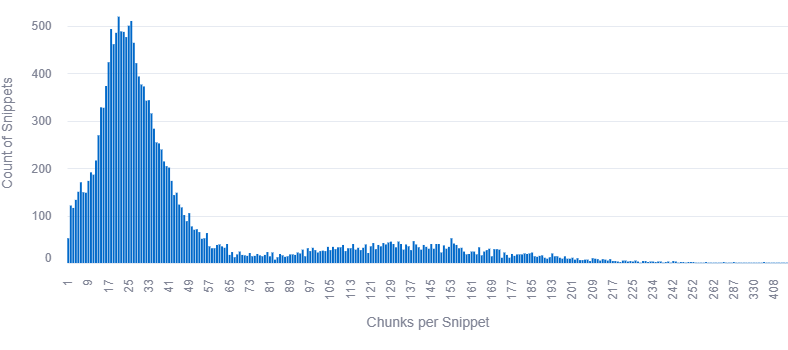
We analysed 7,060 queries with 3+ sources, comparing grounding snippets against full page content for 2,275 tokenized pages.

MetricValue
Queries Analysed7,060
Pages Tokenized2,275
Total Snippets883,262
Avg Words / Chunk15.5

The ~2,000 Word Budget

Each query has a fixed grounding budget of approximately 2,000 words total, distributed across sources by relevance rank.
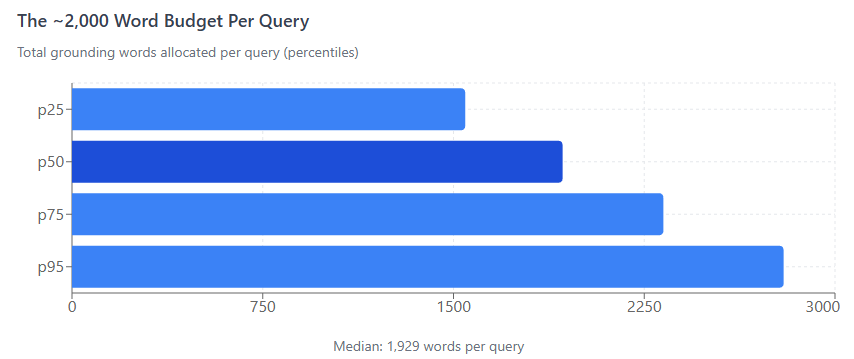
PercentileTotal Words Per Query
p251,546
p50 (median)1,929
p752,325
p952,798

This budget is remarkably consistent regardless of how many sources are used or how long the individual pages are.

Rank Determines Your Share

The total budget is divided among sources based on their relevance ranking:
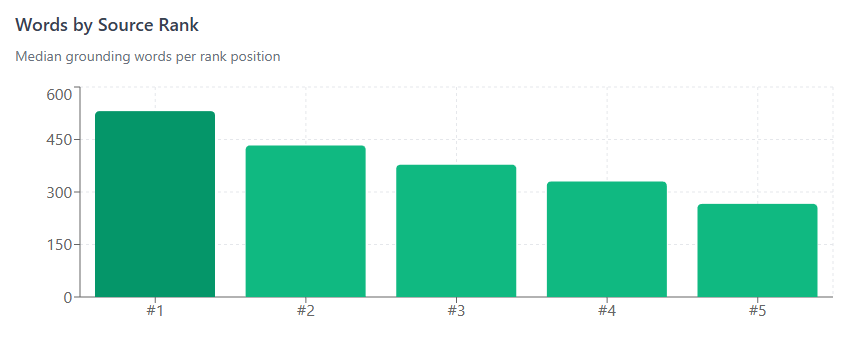
RankMedian WordsShare of Total
#153128%
#243323%
#337820%
#433017%
#526613%

Being the #1 ranked source gets you 2x the grounding compared to being #5. You’re competing for share of a fixed pie, not expanding the pie.

Per-Source Selection

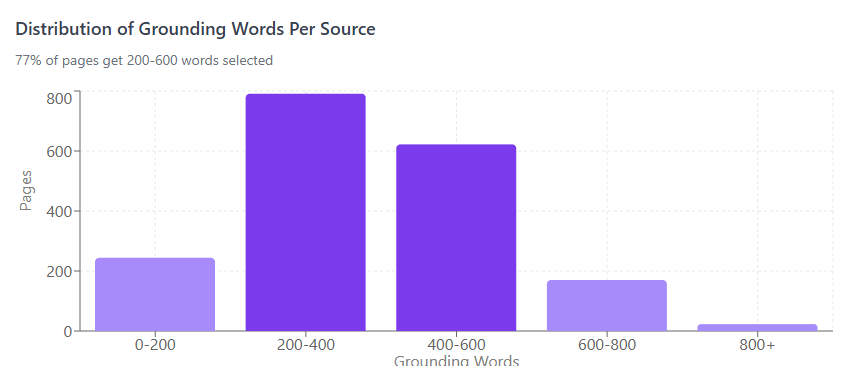
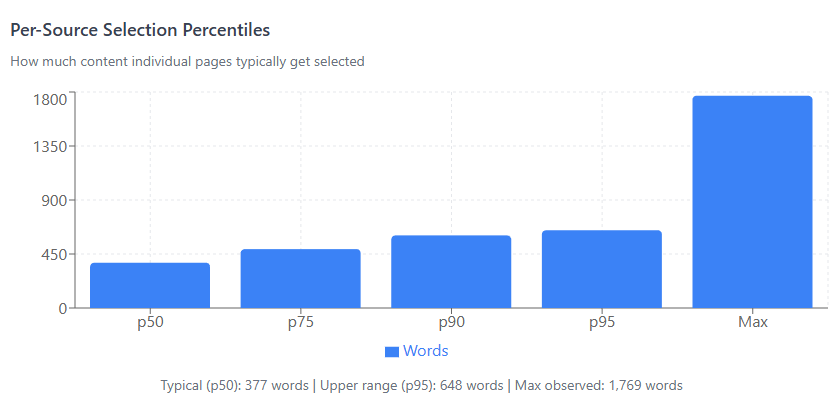
For individual sources, the grounding selection follows this distribution:
PercentileWordsCharacters
p50 (median)3772,427
p754913,182
p906053,863
p956484,202
Max1,76911,541

77% of pages get 200-600 words selected. The typical page gets ~377 words.

Coverage Drops as Page Size Increases

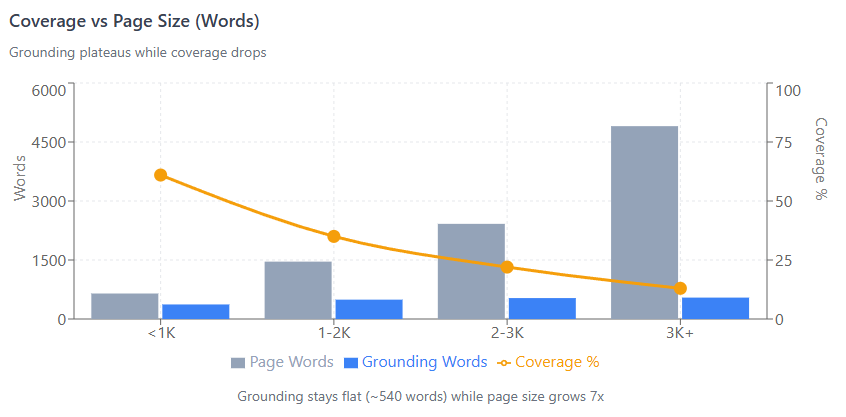
We compared grounding selection against original page size:
Page WordsAvg Grounding WordsCoverage
<1K37061%
1-2K49235%
2-3K53222%
3K+54413%
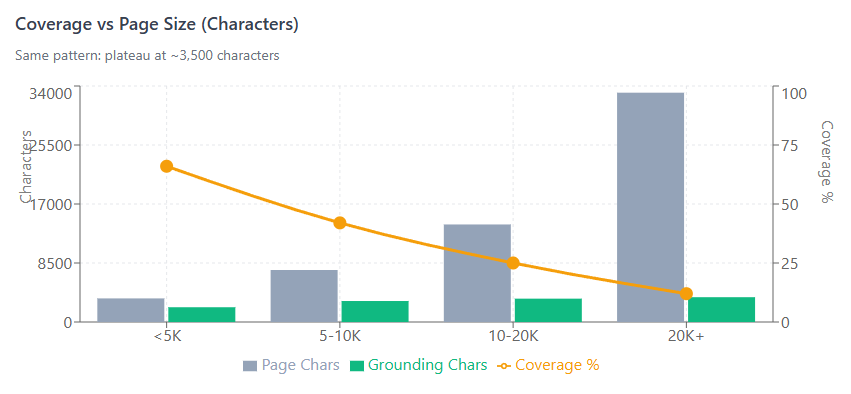
Page CharsAvg Grounding CharsCoverage
<5K2,12766%
5-10K3,02442%
10-20K3,36325%
20K+3,57412%

Grounding plateaus at ~540 words / ~3,500 characters. Pages over 2,000 words see diminishing returns—adding more content dilutes your coverage percentage without increasing what gets selected.
Key Takeaways

  1. Fixed budget per query: ~2,000 words total, split among sources
  2. Rank matters most: #1 source gets 531 words, #5 gets 266 words
  3. Diminishing returns: Pages over 1,500 words don’t get more selected
  4. Concise wins: A tight 800-word page gets 50%+ coverage; a 4,000-word page gets 13%

The implication for content strategy is clear: density beats length. Focus on being the most relevant source for a query, not the longest.


Comments

4 responses to “How big are Google’s grounding chunks?”

  1. You’re quickly becoming my favorite person in the SEO space. Can you share more about your methodology?

    1. I did a pretty detailed reply on LinkedIn so I’ll copy paste it here for full context:

      From: Rohit Singh
      Daniel Cheung few problems here – dataset not shared neither anything on approach. Only results are shared to make a claim.
      I am not saying claim by Dan Petrovic is incorrect. But if a claim is made it, it should get independently verified.
      I am not saying by me, anyone can do it.
      Few questions to ask –
      1) How were the 7,060 queries selected? If queries were hand-picked or concentrated in specific domains (e.g., technical, news, e-commerce, etc.), the findings may not generalize to all search types .
      2) How were “grounding words” matched to original page content? Whether exact string matching, fuzzy matching, or semantic similarity was used significantly affects measurement accuracy .
      3) Were confounding variables controlled (page authority, freshness, structure)? The “density beats length” conclusion assumes content length is the primary variable, but other factors like domain trust or formatting could drive the results.
      4) Why no confidence intervals or significance tests for the “~2,000 word budget” claim? The data shows substantial variance but no statistical testing validates whether this represents a true fixed budget or random variation.

      Dan Petrovic

      1. Several clients: health, travel, finance, marketing, sports, b2b, marketplace, gambling… perhaps a few industries I forgot. First I define primary entities and then expand them to an arbitrary number of prompts, each prompt is mined via google search enabled grounding tool API call, all metadata collected and saved (fanouts, grounded chunks, grounding urls, confidence scores…etc).

      2. I observe actual grounding snippets supplied to the model as context before it synthesizes its answers. No fuzzy matching the segments are exact with some minor goofs. They map cleanly to page source text as it’s extractive and not abstractive summarization.

      3. No.

      4. ~2,000 is a median. p95: 2,798 it goes up to ~5,000 and one sample with ~30,000 but I think that’s a bug in my pipeline.

      I can’t share the data in public for two reasons:

      1. client data
      2. (can’t tell the 2nd reason or I’d be revealing it)

      If you’re interested in peer-review analysis I’ll share with you directly.

  2. Great study thanks for sharing this Dan! This suggests a move a way from long form content, which is seen as important for traditional SEO (obviously EEAT takes precedence over length). Do you foresee a future where we are creating “AI dictionaries” as part of a site where there is lots of detailed, focussed, shorter content designed to only be read by AI’s alongside the more in-depth content? Or an evolution where content actually starts to become shorter overall?

    1. Great thinking! I’m going to test small modular content pieces that can be assembled into different content units like lego blocks and take charge of completeness of context. Avoid undesirable narrative fragmentation.

Leave a Reply to Ben Foster Cancel reply

Your email address will not be published. Required fields are marked *