
Carried by the inertia of “search query” mentality, AI SEO professionals often oversimplify how people interact with their AI assistants in chat sessions. Our analysis of ~1M real user chat sessions reveals a more complex picture.
Key Findings
The dataset contains 4.4 billion characters across 613 million words and 3.9 million conversation turns. The average conversation is 4.7 turns, with a median of 2 turns, suggesting many users ask a single question and receive a single response.
Overall Session Statistics
| Metric | Total | Mean | Median | Std Dev | Min | Max |
|---|---|---|---|---|---|---|
| Characters | 4,359,458,324 | 5,202 | 2,981 | 10,464 | 1 | 613,244 |
| Words | 613,033,362 | 732 | 430 | 1,529 | 1 | 102,362 |
| Turns | 3,920,148 | 4.7 | 2 | 6.0 | 2 | 498 |
The large gap between mean and median word counts (732 vs 430) indicates a right-skewed distribution, most conversations are relatively short, but a long tail of verbose sessions pulls the average up.
User vs Assistant Breakdown
| Role | Characters | Words | Turns |
|---|---|---|---|
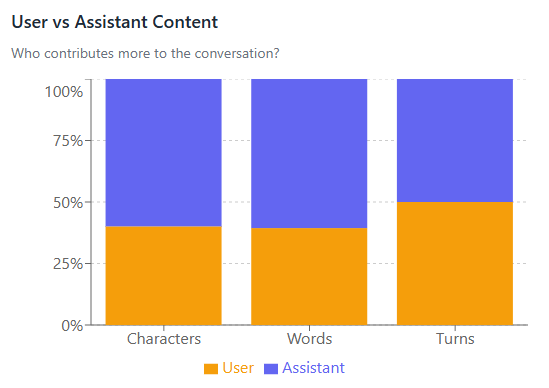
| User | 1,750,088,358 | 241,265,153 | 1,960,074 |
| Assistant | 2,609,369,966 | 371,768,209 | 1,960,074 |
| Total | 4,359,458,324 | 613,033,362 | 3,920,148 |
Assistants produce roughly 1.5x more content than users, unsurprising given that users ask questions and assistants provide detailed answers.
Per-Message Statistics
| Role | Mean Chars | Median Chars | Mean Words | Median Words |
|---|---|---|---|---|
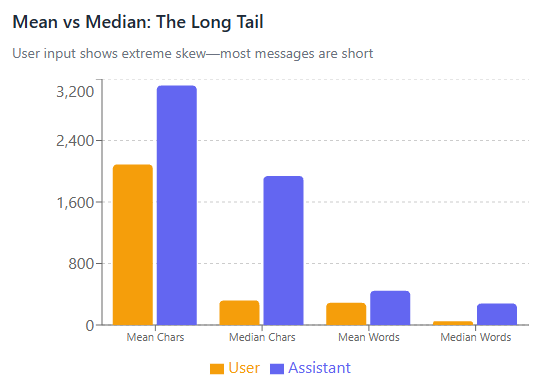
| User | 2,088 | 320 | 288 | 48 |
| Assistant | 3,114 | 1,937 | 444 | 280 |
The stark difference between user mean (2,088 chars) and median (320 chars) reveals an important pattern: most user messages are short prompts, but some users paste long documents for summarization or analysis, dramatically inflating the average.
Content Ratio Analysis
| Metric | User Share (Mean) | User Share (Median) |
|---|---|---|
| Characters | 28.7% | 15.8% |
| Words | 29.2% | 17.2% |
| Turns | 50.0% | 50.0% |
The median user contributes only 16-17% of the conversation’s content while receiving 83-84% from the assistant. This aligns with the typical pattern: short question in, long answer out.
Totals Summary
| Metric | Total | User | Assistant | User % |
|---|---|---|---|---|
| Characters | 4.36B | 1.75B | 2.61B | 40.1% |
| Words | 613M | 241M | 372M | 39.4% |
| Turns | 3.92M | 1.96M | 1.96M | 50.0% |
At the aggregate level, users contribute about 40% of total content, higher than the per-session median because heavy users (those pasting long documents) contribute disproportionately to the total character count.
Session Length Distribution
| Word Count | Sessions | Percentage | |
|---|---|---|---|
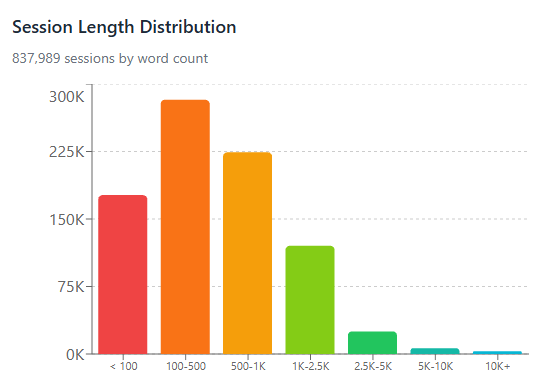
| < 100 | 176,528 | 21.1% | ██████████ |
| 100-500 | 282,447 | 33.7% | ████████████████ |
| 500-1K | 224,030 | 26.7% | █████████████ |
| 1K-2.5K | 120,207 | 14.3% | ███████ |
| 2.5K-5K | 25,098 | 3.0% | █ |
| 5K-10K | 6,520 | 0.8% | |
| 10K+ | 3,159 | 0.4% |
Over 80% of conversations contain fewer than 1,000 words. The sweet spot is 100-500 words (33.7%), representing a typical “question and answer” exchange. Only 4.2% of sessions exceed 2,500 words—these likely represent complex tasks like document editing, code review, or extended tutoring sessions.
Implications
- Most interactions are transactional: Median of 2 turns suggests users get what they need quickly
- Assistants do the heavy lifting: 60% of content comes from the AI
- Long-tail complexity: The 4% of sessions over 2,500 words likely represent the highest-value use cases
- Document processing is common: The gap between mean and median user input suggests frequent paste-and-process workflows
Chat Classification by Intent
To help us define the primary interaction types we surveyed the major AI platforms and compiled the following list AI chat type list:
In Funnel
- Awareness
- General category exploration (“what types of project management tools exist?”)
- Problem identification (“my back hurts when I sit at my desk all day”)
- Trend and market research (“what’s popular for home gyms right now?”)
- Discovery
- Product and service search (“what are good CRMs for small business?”)
- Brand discovery (“who makes sustainable running shoes?”)
- Professional/provider search (“find a tax accountant in Brisbane”)
- Feature exploration (“what should I look for in a vacuum cleaner?”)
- Consideration
- Comparison and evaluation (“Slack vs Teams vs Discord for a small team”)
- Review and reputation inquiry (“is Dyson worth the price?”)
- Spec and compatibility checking (“will this RAM work with my motherboard?”)
- Price and value assessment (“is $2,000 reasonable for a used 2019 Honda Civic?”)
- Decision support
- Opinion and advice seeking (“should I get the Pro or the base model?”)
- Use case validation (“is Notion overkill for personal to-do lists?”)
- Risk and trade-off analysis (“fixed vs variable rate mortgage right now?”)
- Timing decisions (“should I buy now or wait for Black Friday?”)
- Transaction support
- How-to-buy guidance (“how do I purchase from this overseas site?”)
- Deal and discount finding (“are there student discounts for Adobe?”)
- Verification and legitimacy checking (“is this website legit?”)
- Post-purchase
- Setup and onboarding (“how do I configure my new router?”)
- Troubleshooting and diagnostics (“my new espresso machine is leaking”)
- Returns and warranty queries (“how do I start a return with Amazon?”)
- Maximizing value (“what features of Notion am I probably not using?”)
Outside Funnel
- Creation
- Writing (drafting, editing, creative)
- Documents and files (spreadsheets, presentations, templates)
- Code (writing, debugging, architecture)
- Transformation
- Summarization and extraction
- Translation and language conversion
- Reformatting and tone adjustment
- Analysis and reasoning
- Data interpretation
- Math and calculations
- Non-commercial decision support (personal, ethical, philosophical)
- Learning
- Concept explanations and tutoring
- Skill practice and exam prep
- Planning and organization
- Schedules, itineraries, routines
- Project and goal planning
- Brainstorming and ideation
- Idea generation
- Creative problem-solving
- Naming (non-commercial)
- Conversation
- Emotional support and reflection
- Casual chat and companionship
- Roleplay and entertainment
The Analysis
We classified 24,259 conversations from the same dataset to understand what users are actually trying to accomplish when they interact with AI assistants and how much of this activity signals commercial intent.
Most AI Usage Is Non-Commercial
| Funnel Status | Sessions | Percentage |
|---|---|---|
| Outside Funnel | 15,667 | 64.6% |
| In Funnel | 8,592 | 35.4% |
Nearly two-thirds of conversations have no commercial intent whatsoever. Users are writing, brainstorming, learning, and chatting, not researching products or making purchase decisions.
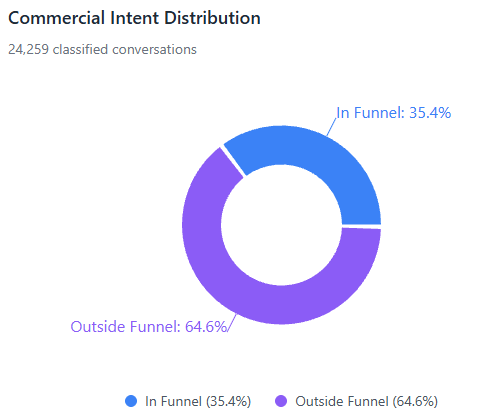
The remaining 35% show some commercial signal, ranging from early-stage awareness (“what types of X exist?”) to active transaction support (“how do I buy Y?”).
In-Funnel Breakdown
| Stage | Sessions | % of Total | Description |
|---|---|---|---|
| Awareness | 2,437 | 10.0% | Exploring categories, identifying problems, researching trends |
| Consideration | 2,067 | 8.5% | Comparing options, reading reviews, checking specs and prices |
| Post-purchase | 1,248 | 5.1% | Setup, troubleshooting, returns, maximizing value |
| Transaction support | 1,169 | 4.8% | How-to-buy guidance, finding deals, verifying legitimacy |
| Discovery | 990 | 4.1% | Searching for products, brands, or service providers |
| Decision support | 681 | 2.8% | Seeking opinions, validating use cases, analyzing trade-offs |
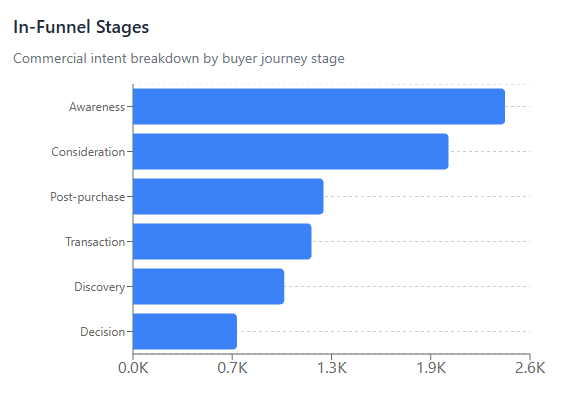
Awareness dominates the commercial funnel at 10% of all sessions. Users frequently ask AI to help them understand a problem space before they even know what product category might solve it.
Consideration is the second-largest stage (8.5%), representing users actively comparing and evaluating options. This is prime territory for affiliate content and product recommendations.
Post-purchase outpaces transaction support suggesting users turn to AI more for help after buying (setup, troubleshooting) than during the purchase itself.
Outside-Funnel Breakdown
| Category | Sessions | % of Total | Description |
|---|---|---|---|
| Other/Unclassified | 6,131 | 25.3% | Sessions that don’t fit defined categories |
| Brainstorming | 1,863 | 7.7% | Idea generation, creative problem-solving, naming |
| Planning | 1,565 | 6.5% | Schedules, itineraries, project planning |
| Conversation | 1,516 | 6.2% | Emotional support, casual chat, roleplay |
| Analysis | 1,387 | 5.7% | Data interpretation, math, non-commercial decisions |
| Learning | 1,130 | 4.7% | Tutoring, concept explanations, exam prep |
| Transformation | 1,126 | 4.6% | Summarization, translation, reformatting |
| Creation | 949 | 3.9% | Writing, documents, code |
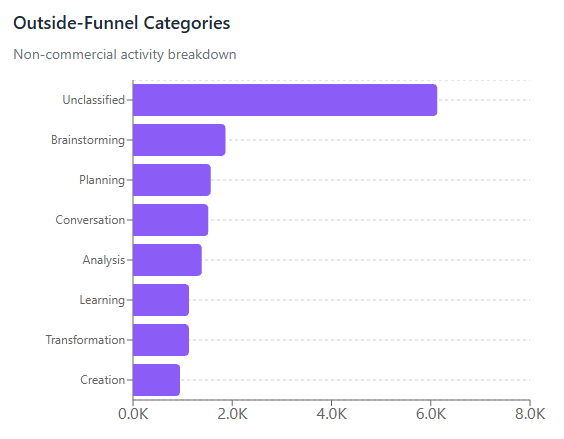
The 25% “Other” category warrants attention—these are sessions that don’t cleanly fit our taxonomy. Many may be jailbreak attempts, roleplay scenarios, or highly specialized requests.
Brainstorming and Planning together account for 14% of all conversations. Users treat AI as a thinking partner for creative and organizational tasks.
Conversation at 6.2% represents pure social/emotional interaction—people chatting with AI for companionship, venting, or entertainment.
Implications for Product & Content Strategy
For Affiliate and Commerce Sites
- 35% of AI conversations have commercial potential—but most are early-funnel
- Awareness + Consideration = 18.5% of sessions where product content could add value
- Post-purchase content is underserved—5% of users need help after buying
For AI Product Builders
- 64.6% of usage is non-commercial productivity and creativity
- Core use cases: brainstorming (7.7%), planning (6.5%), analysis (5.7%), learning (4.7%)
- Creation is surprisingly low at 3.9%—users ask for help more than finished outputs
For Researchers
- The 25% “Unclassified” bucket suggests current taxonomies miss significant user behaviors
- Conversation/companionship (6.2%) represents a distinct use case worth deeper study
Methodology Note
Sessions were classified using Gemma 3 12B into 42 categories across a two-level taxonomy:
- In Funnel: Commercial intent stages from Awareness → Discovery → Consideration → Decision → Transaction → Post-purchase
- Outside Funnel: Non-commercial activities including Creation, Transformation, Analysis, Learning, Planning, Brainstorming, and Conversation
This analysis represents 24,259 classified sessions (~3% of the full 837,989 dataset). Classification is ongoing.


Leave a Reply to Preslav Atanasov Cancel reply