A 2016 study of 2000 respondents in Australia and the USA found most people believe the main reason one page links to another is marketing, advertising or revenue, not relevance.
New research shows that organic links on the web often exist for explicitly promotional reasons.
A study of linking behaviour on the web was conducted between May and June 2016 in the hope of understanding two things:
Why web publishers link out to other websites.
What regular web users think about links.
The quantitative study involved over 2000 respondents from Australia and the USA. A surprising number of users consider promotional and commercially driven reasons to be the primary purpose of external links on the web.
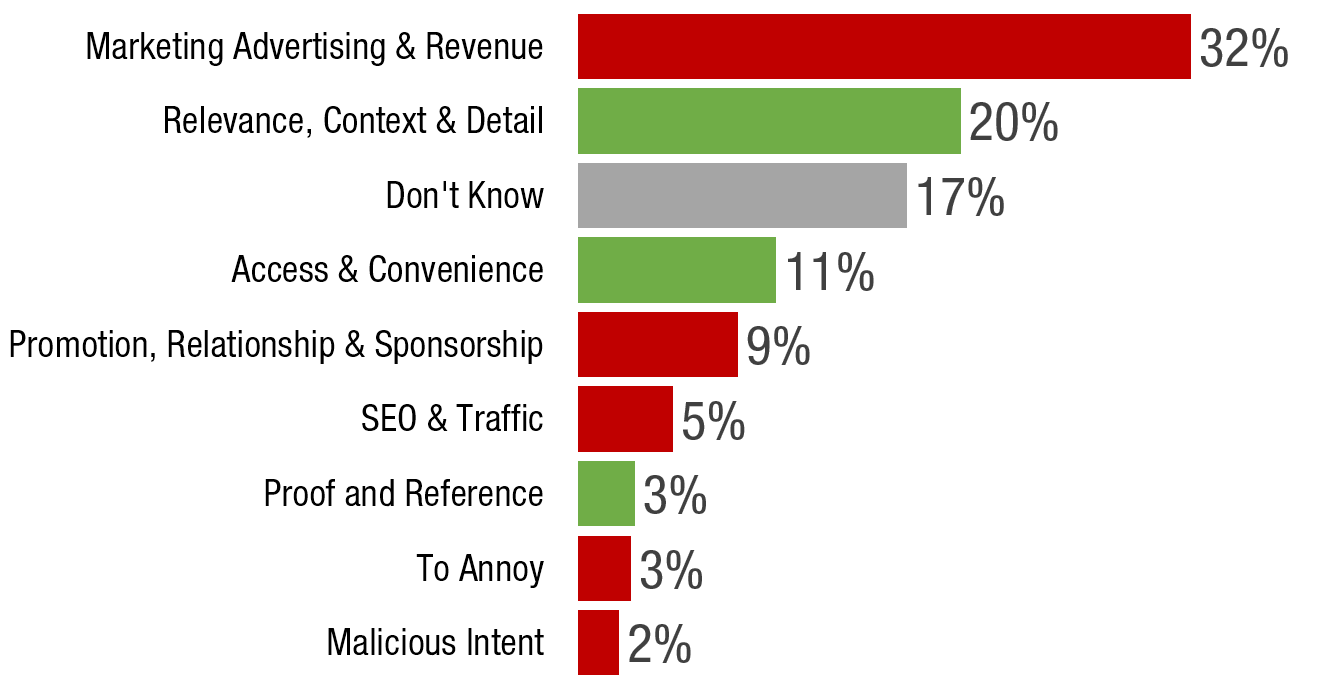
Question: What do you think is the main reason for a page on one website to link to a page on another website?
Most of us in the SEO industry consider relevance and context the hallmark of a true "natural link". Only one in five respondents sees links that way.
Analysis of the open-ended answers highlighted several prominent categories, created by clustering related answers. "Marketing, Advertising & Revenue" surfaced as the strongest theme, with one in three web users treating links as mainly promotional. Even if we merge "Access and Convenience" (11%) with "Relevance, Context & Detail" (20%), it still does not beat the top reason, especially once we add "Promotion, Relationship & Sponsorship" (9%) and "SEO & Traffic" (5%).
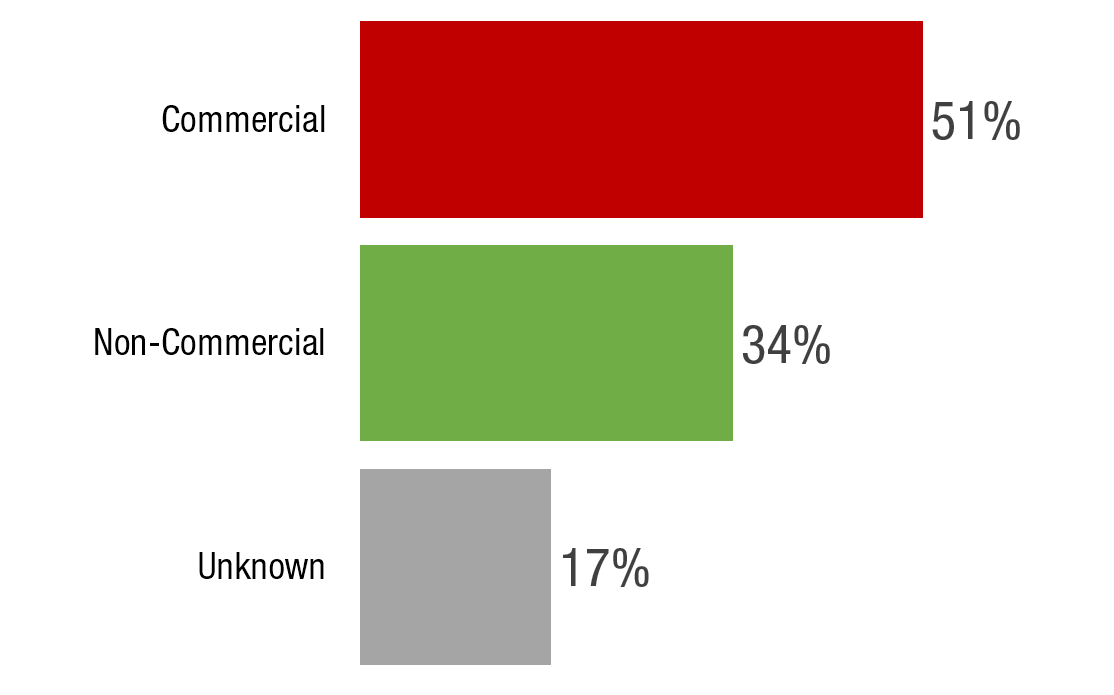
Commercial vs Noncommercial
Merging the commercial and noncommercial reasons behind external links shows that most web users consider links to be explicitly promotional, including personal gain and deliberate promotion of third parties:
Updated Link Classification
Back in 2013 we ran a similar study and found eight primary reasons why links exist on the web. Since then I added "Proof" as a category, and today I am introducing "Promotion".
Attribution
Citation
Definition
Expansion
Identification
Example
Action
Relationship
Proof
Promotion
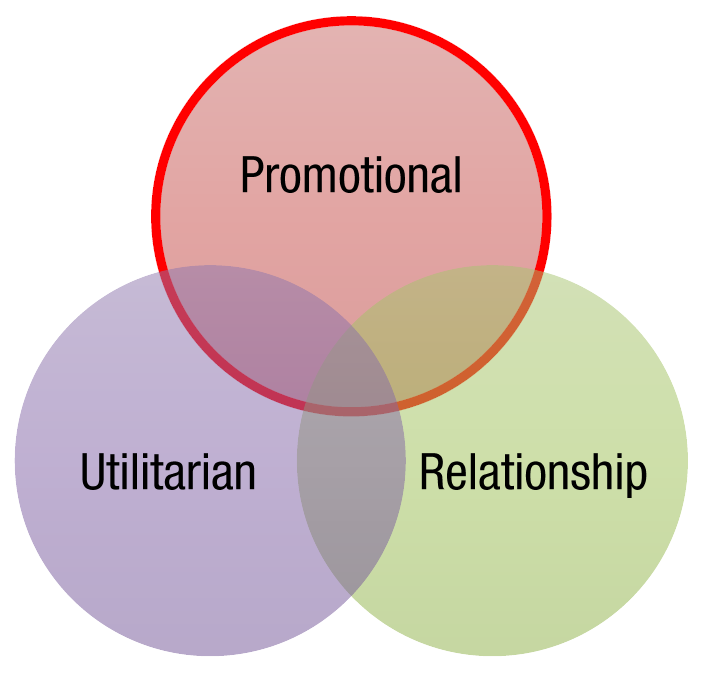
These reasons overlap and can combine in any number of ways. Linking to a page to show "Proof" and back your statements can also imply "Expansion", where readers are not only checking the validity of your statements but expanding the subject matter and going deeper into the research.
What Does This Mean?
This creates an interesting problem when you evaluate links on the web, whether you sit on Google's search quality team or work SEO-side. We are often led to believe that "commercial anchor text" is a bad thing and an open invitation for penalties. During link clean-ups, webmasters are advised to remove, nofollow or disavow commercial links from their link profile. Guest posts, sponsorship and business partnerships all fall under this category.
Yes, there is abuse in all of these categories, but there are also many legitimate cases. So who has the right to decide that a link is "inorganic" because it is promotional, when we know that organic links exist to promote things?
Consider a post on the AlchemyAPI blog and its natural looking anchor text "in May, 2015". A link of this type will never trigger a penalty. It is utilitarian and obviously useful to readers:
It supplies context and background information.
It expands the topic by providing additional detail.
It gives readers optional access to further information.
It enables leaner, more digestible content.
Here is the catch. AlchemyAPI (the linking site) and IBM Watson (the linked site) are in a business relationship, and the link is promotional. On top of that, the two authors could be friends who wanted to promote each other's product or story for popularity, traffic and sales. And this is normal.
I see many websites nofollow links to their partner websites, sister companies and other forms of affiliation, because someone told them to, either their SEO or someone on Google's webspam team. This sort of madness has to stop. If commercially driven links exist on the web organically, then they are organic in nature and should not be treated as clean-up material, nor should those links yield a penalty.
Highlights From the Quantitative Study
Our webmaster interviews revealed fewer commercially driven reasons and more focus on value and user experience:
"To provide value to my readers is the most important reason. Depending on the site it may also help bring attention to your own blog if they are tracking their traffic." Reeva
"Mainly to provide additional information and resources for visitors and readers. Occasionally to point visitors and readers to other in-house web properties." Sasch
"Because I think there are further, useful, more holistic informations for my users." Helmut
"Credit for source material, provides my content context, provides an excellent resource for my readers." Paul
"When referencing an article, citing a contributor or author." Tim
"If the website has the full research that I have referenced within my article. If I have used an image or infographic to include in my post." Rebecca
"I see it of value to others, it resonates with me personally and it may help others, or just to make people aware of what is there. I share links to other sites because that is how we all learn and grow, and that link you shared could have a big impact on somebody." Jaaved
"Provide additional information to support my claims." Lee
"To refer the reader to a more detailed page about a topic or term mentioned in my article. To acknowledge copyrights of content used in my articles. To refer the reader to a shopping page where he can find an offer or a product I am reviewing." Giuseppe
"To provide additional high value complementary information." Panela Philpot
"We link to other websites to let the website know that we find their published content valuable and credible. It works both ways. I personally believe in value equity. Of course we want our content to be of high quality and value to our readers. Linking to other sites is one way to do that. For the sites we link to, it is a backlink, an important ranking signal. It is a win-win." Jennevie
"To promote something (affiliate link), assist a reader, prove or explain something, borrow credibility, gain the use of a service or widget, discuss, praise, criticise or review something, exchange links." Jim
"To prove post authority, improve post SEO with linking, to prove data in post." Metehan
"Because it is related to the article, I would like to introduce it." Haruka
"The main reason behind me linking to other websites is to help my readers navigate to the things I am talking about. I am an SEO and content manager by day, so I understand linking best practices. It is very rare that I work with a company or brand whose sole purpose is to gain a link. I much prefer to work with brands who are seeking exposure and audience reach. I then often link to them without them even asking, because I believe in their products and want to share them with my readers." Shannon
"When there is useful content elsewhere related to my page that I cannot replicate. When I read an article that I think deserves linking to, I will link to it to reward the writer, as a show of thanks. To YouTube clips if the videos relate to the content of my page but will not take customers away. To my own sites, for obvious reasons. Favours on a 'you scratch my back, I scratch yours' understanding, not often nowadays and only with trusted people. To sites that sell the same product or service as me but who I do not consider direct competitors, for example services covering locations far enough away, or product sellers in different countries." TJ
2023 Update
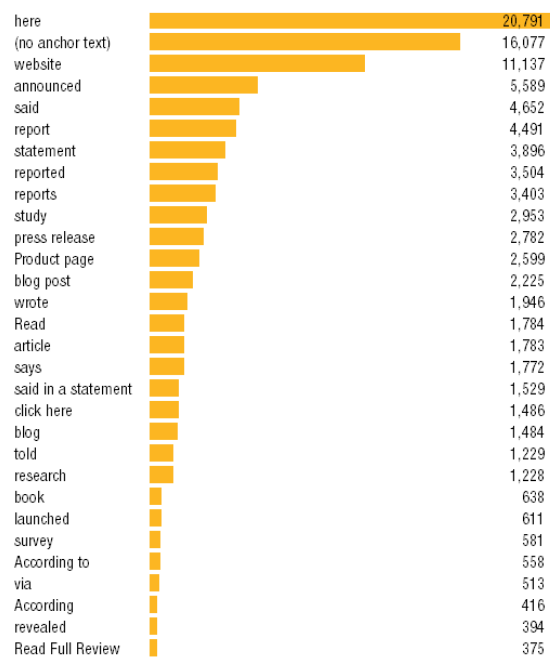
The anchor text most commonly used by the top 10 blogs on the web when they link out to other websites:
 Dan Petrovic ·
13 June 2016
Dan Petrovic ·
13 June 2016