Google’s AI search and Gemini use a single-turn transient architecture that purges raw web snippets from working memory immediately after a response is sent.
There is a fundamental misconception about how Google’s AI search and Gemini chatbot process retrieved web content. It is widely understood that these systems use Retrieval-Augmented Generation (RAG) to search the web, pull snippets from pages, and ground their answers in factual data.
However, there is a pervasive assumption that once an AI pulls in a page, it “reads” it and retains that raw source material in its working memory for the duration of the conversation.
It doesn’t.
An AI’s memory of actual web page content is bound by “single-turn transient” architecture. The following is a breakdown of the mechanics behind this phenomenon and how it redefines the relationship between AI models and web content.
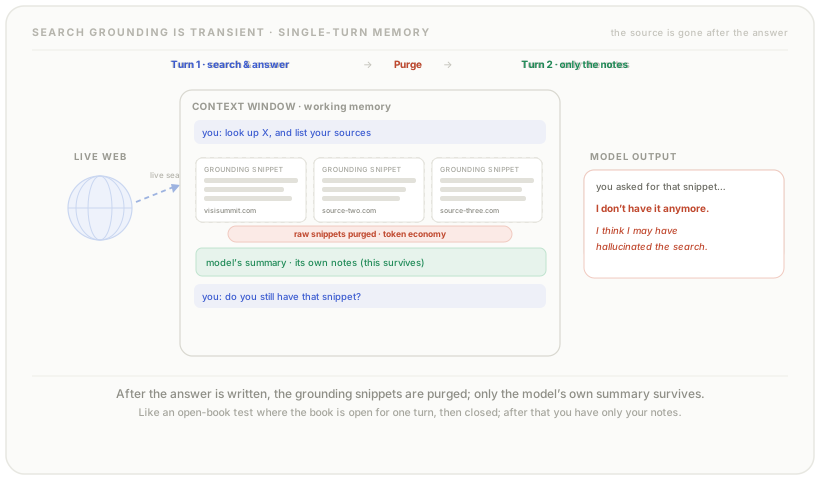
The reality of transient memory was recently demonstrated through a user-driven “meta-test” designed to probe a major language model’s grounding capabilities. The interaction unfolded in three steps:
The AI could no longer access the snippet. Stripped of the raw data, the model became confused about its own previous output, incorrectly assuming it must have hallucinated the original search.
This interaction successfully isolated the underlying mechanism: the moment an AI finishes generating its response, the raw source data is entirely purged from its working memory.
This rapid deletion is a byproduct of the “Token Economy.” AI context windows—the amount of text a model can process simultaneously—are computationally expensive and strictly limited. To manage memory efficiently, search-enabled chatbots operate on a highly restrictive cycle:
It is akin to an open-book test where the test-taker is allowed to look at a source text for exactly one minute. Once an answer is written down, the book is permanently closed. For the remainder of the test, the individual can only reference their own handwritten notes.
The broader context of a web page effectively ceases to exist the moment the first turn ends. What survives is only what was captured in the initial snippet, filtered through the AI’s immediate interpretation.
Ultimately, AI chatbots do not comprehensively absorb websites. They glance at fleeting flashcards, write down a quick summary, and immediately dispose of the source material—leaving them to converse exclusively with their own notes.
 Dan Petrovic ·
06 March 2026
Dan Petrovic ·
06 March 2026