Dan Petrovic ·
04 April 2017
Dan Petrovic ·
04 April 2017
An April 2017 survey of Australian web users on what makes a page trustworthy. URL and HTTPS together account for 40% of all answers, ahead of ads, design, brand and content. Includes the raw data.
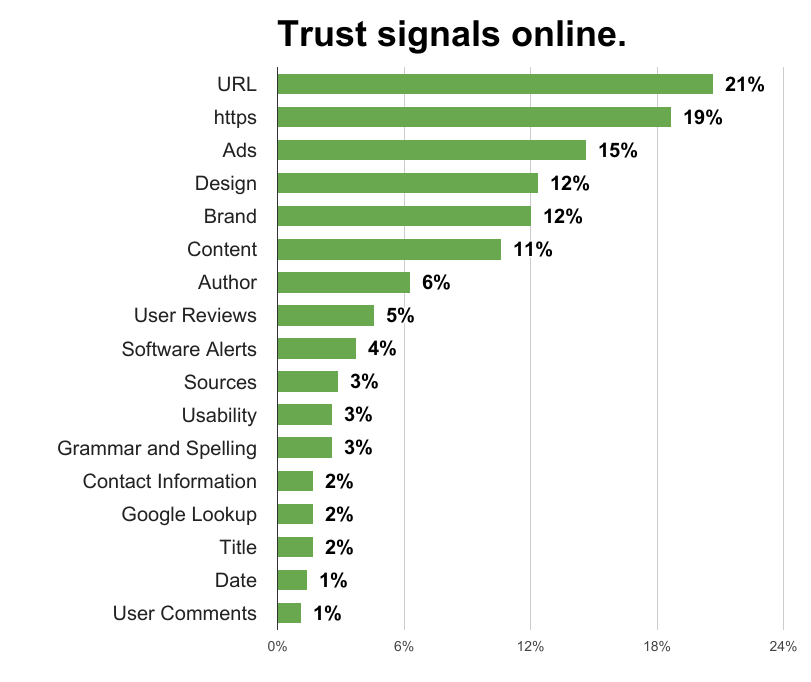
The primary trust signal on the web is the URL of the page, which readers use to establish two things:
Around 21% of surveyed users check the URL to establish whether they are on the intended domain name, and 19% look for encryption symbols in the browser address bar. Those two factors account for 40% of all answers in the survey.
Brand awareness is strongly linked to the URL as well. Users tend to check both the URL and brand instances on the page, such as logos, images and text. URL and brand alone (12%) add up to more than half of the answers.
The presence of ads, and their poor quality, is a strong negative signal for about 15% of surveyed web users, with particularly strong dislike for pop-ups and clickbait.
Around 12% of users reported clean, professional, contemporary design as their primary trust signal. As a subset of design, "images, pictures, photos" was also a common answer, although in this case attributed to design rather than content, a category that would suit it equally well.
Around 11% reported quality of content as the primary trust signal, with strong awareness of and negative sentiment towards clickbait. Six percent quote familiarity with the author as the main trust factor. Additional content-related signals include:
For a more detailed study of content-specific trust signals, see how web users decide if online content is trustworthy.
Social media signals such as shares, likes and followers did not make the list. Instead people turn to the community, via reviews and comments.
Some users place their trust in software alerts from the operating system, the browser or anti-virus notifications. Others prefer a manual lookup, mostly via Google, or look for a sign of "Google Trust" or partnership.
Other notable on-page factors include usability and functionality, the date and frequency of updating, and contact information: a physical address, phone numbers and an about us page. A small subset of that group trust pages from their own country more than international sites, particularly official government pages.
One surprise: people do look at the page footer, described by one respondent as "small text at on the bottom".
We updated the analysis by factoring in twice as many answers, including the full survey data set. Some values changed, but the main factors and their order of significance stayed the same:
| Signal | Share | Answers |
|---|---|---|
| URL | 17% | 140 |
| https | 15% | 124 |
| Ads | 13% | 108 |
| Design | 13% | 106 |
| Brand | 11% | 89 |
| Content | 7% | 56 |
| Author | 5% | 39 |
| Software Alerts | 3% | 26 |
| User Reviews | 3% | 24 |
| Sources | 2% | 20 |
| Grammar and Spelling | 2% | 18 |
| Google Lookup | 2% | 15 |
| Title | 2% | 15 |
| Usability | 1% | 12 |
| Contact Information | 1% | 9 |
| Date | 1% | 8 |
| User Comments | 1% | 6 |
Download: raw survey data (XLS, 328 KB)
Survey date: April 2017
Geography: Australia