
An analysis of Google patent US11769017B1, detailing a system that uses context and implied input engines to proactively generate and push AI summaries.
Back in 2015 I wrote about Google’s reliance of user behaviours signals for ranking purposes. In that article I already covered their use of implicit signals, but now there’s an update!
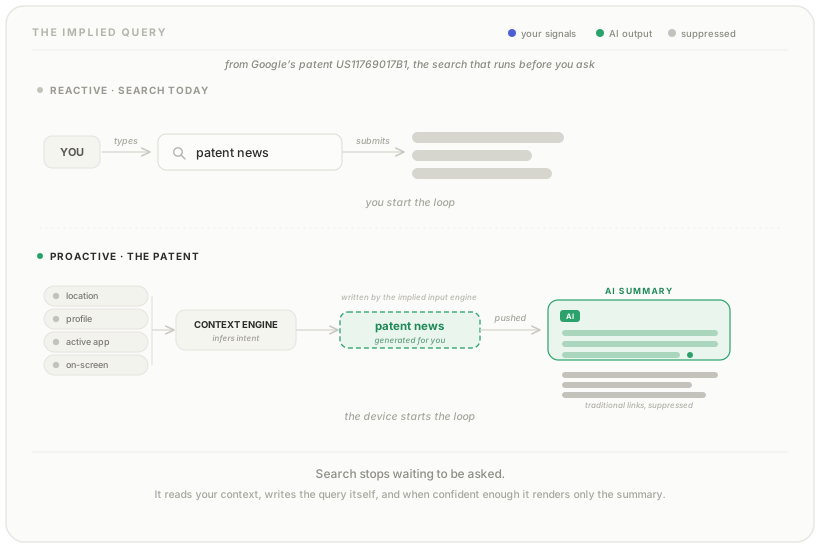
While investigating Google’s grounding pipeline (the system that feeds web content to Gemini before it generates an answer) I came across the same patent most of us already looked at (US11769017B1), titled “Generative summaries for search results”, filed March 2023 and assigned to Google LLC. Most of it describes the AI Overview pipeline we already know: select search result documents, extract content, feed it to an LLM, generate a summary, linkify portions back to sources. Standard grounding architecture.
But buried in the system description are two components that skipped my attention: the Context Engine and the Implied Input Engine.
The patent describes a client-side system architecture with named components. Here’s what it outlines, in Google’s own words:
The client device 110 can include a context engine 113 that is configured to determine a context (e.g., current or recent context) of the client device 110 and/or of a user of the client device 110.
This context engine monitors:
Then it feeds all of this into the next component:
The client device 110 can include an implied input engine 114 that is configured to: generate an implied query independent of any user input directed to formulating the implied query; to submit an implied query, optionally independent of any user input that requests submission of the implied query; and/or to cause rendering of result(s) for an implied query, optionally independent of any user input that requests rendering of the result(s).
Read that again. The system:
The patent provides a concrete example:
The implied query can be “patent news” based on profile data indicating interest in patents, the implied query periodically submitted, and a corresponding NL based summary result automatically rendered. It is noted that the provided NL based summary result can vary over time in view of e.g., presence of new/fresh search result document(s) over time.
So the system profiles your interests, generates a standing query, resubmits it at intervals, and auto-renders updated AI summaries as new content appears on the web. A personalised, recurring, AI-curated news feed, driven entirely by inferred intent.
The context engine doesn’t just know what app you’re using. It knows what you’re looking at inside the app:
The context engine 113 can determine a current context based on which application is active in the foreground of the client device 110, a current or recent state of the active application, and/or content currently or recently rendered by the active application.
And it uses this to rewrite your actual queries or generate entirely new ones:
A context determined by the context engine 113 can be utilized, for example, in supplementing or rewriting a query that is formulated based on user input, in generating an implied query (e.g., a query formulated independent of user input), and/or in determining to submit an implied query and/or to render result(s) (e.g., an NL based summary) for an implied query.
The patent even describes the push mechanism:
The implied input engine 114 can automatically push result(s) to the implied query to cause them to be automatically rendered or can automatically push a notification of the result(s), such as a selectable notification that, when selected, causes rendering of the result(s).
This isn’t a search engine anymore. It’s an anticipatory information system. The shift is fundamental:
Traditional search: User has intent → types query → receives results.
This patent: Device observes behaviour → system infers intent → generates query → retrieves results → pushes AI summary.
The user never searches. The system decides what information to deliver, when to deliver it, and how to present it, all wrapped in an LLM-generated natural language summary grounded in real search results.
For those following our grounding research, this patent describes the full architecture behind what we’ve been reverse-engineering from the API side:
This maps directly to the grounding metadata structure we’ve observed: source indices, snippets, confidence scores, and the redirect URLs through vertexaisearch.cloud.google.com.
The patent also describes the confidence annotation system:
A portion with a high confidence measure can be annotated in a first color (e.g., green), a portion with a medium confidence measure can be annotated in a second color (e.g., orange), and a portion with a low confidence measure can be annotated in a third color (e.g., red).
And it uses confidence to decide whether to even show you the AI summary at all, or fall back to traditional search results:
If confidence measure(s) for portion(s) and/or a confidence measure for the NL based summary as a whole satisfies upper threshold(s) most indicative of confidence, the NL based summary can be rendered responsive to the query and without any initial rendering of any additional search results.
When confidence is high, search results are suppressed entirely. Only the AI summary appears.
One more detail worth flagging. The patent describes a system where the AI summary evolves as you interact with search results:
The system generates a revised NL based summary based on processing revised input using the LLM or an additional LLM. The revised input reflects the occurrence of the interaction(s) with the search result document(s).
Click on a source about router IP addresses? The next version of the summary assumes you already know that and skips ahead to the next step. The LLM prompt is literally revised to include instructions like “assuming the user already knows X”.
The summary isn’t static. It’s a living document that rewrites itself based on your behaviour within the session.
Here’s what I take away from this:
 Dan Petrovic ·
24 February 2026
Dan Petrovic ·
24 February 2026
Not necessarily. Cramming too much semantic content into a sentence could actually distance it from the optimal match. It’s tricky business.
Dan Petrovic ·
Challenges · ·
28 February 2026
thank you for the detailed breakdown. few things i could not understand properly
1. “Watches what you’re doing on your device” – does this mean, it watches which youtube video i am currently watching or some instagram reel i am watching too?
2. “Formulates a search query you never typed
Submits it silently
Generates an AI summary from the results
Pushes it to search, without you asking”
i didn’t get this quite well too. can you give an example with what happens when i am watching youtube video or if i am reading a blog on “ai agents architecture”.
3. “The summary adapts to user behaviour in real-time.” about this, does this mean “ai overview citing search term, calling new summary”


Thank you for the analysis and the insights. I will surely read the full patent.
Do you think that:
“Content selection feeds through embedding distance, not keyword matching. If your content doesn’t land close to query embeddings in vector space, it won’t be selected as grounding material, regardless of how well it ranks in traditional search.”
directly correlates with the information density of an article and the amount of contextual data and facts conveyed with each sentence and that shorter more condensed pieces of content (more meaningful information, less words) will be more preffered by such systems and with time get better tolerated by the traditional search algorithms as well ?