Publishing unedited AI-generated text can leak internal GPT-5 structured output markers like turn0search21, which can lead to SEO and reputational risks.
When you populate your website with language model–generated text, you inherit a subtle but real risk: AI-specific artifacts may leak into the published content. These markers aren’t always obvious to human readers, but they can be highly visible to search engines, researchers, and competitors.
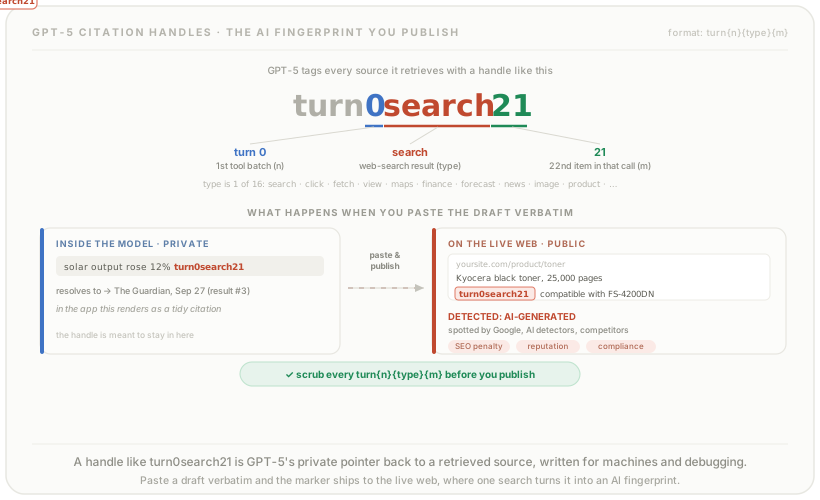
One such artifact is the structured output marker that GPT-5 (and related systems) use internally to trace their tool calls and search results. Handles like turn0search21 are intended for machine-side traceability, not for publication. But when responses are used verbatim in production content – without careful editing or filtering – these strings can surface in the final page copy.
A quick Google search for turn0search21 illustrates the problem: you’ll see multiple live websites indexed with this artifact intact. These aren’t fringe blogs either – examples include major brands such as BigW, where the marker has been accidentally published on a product page.
turn0search21 (or similar) is essentially a fingerprint pointing directly back to GPT-5’s structured reasoning.Blindly copy-pasting LLM output into production is dangerous. If you use AI for drafting, always clean and human-review content before publishing. Specifically, scrub structured markers (turnNsearchM, etc.) to avoid leaving behind tell-tale AI artifacts.
Here’s the complete set of turn{n}{type}{m} handles GPT-5 can emit:
search → Web/file search result.click → Opened (expanded) document from a search result.fetch → Fetched webpage (HTML).view → Rendered view of a doc (e.g. PDF, slide).news → News article result.image → Image search result.product → Retail product result.sports → Sports schedule/standings source.finance → Market quote source (stocks, crypto).forecast → Weather forecast source.time → Time lookup source (world clock).maps → Maps/places result (location data, addresses).calc → Calculator/math evaluation.translate → Translation result.msearch → Multi-search batch results.mclick → Multiple opened documents from a batch.Structure:
turn0search3 = 3rd search result in the 1st search batch.turn2click1 = 2nd opened doc in the 3rd batch.turn1maps0 = 1st maps result in the 2nd batch.turn4calc0 = 1st calculator evaluation in the 5th batch.turn{n}{type}{m} Citation HandlesWhen a model cites sources, you may see internal handles such as turn0search3 or turn2click1. These identifiers are structured in a consistent way to trace exactly where a piece of information came from.
turn{n} → The conversation turn (batch of tool calls).turn0 = first batchturn1 = second batch, etc.{type} → The tool or vertical that produced the source.{m} → The index of the item within that tool call’s output.0 = the first item, 1 = the second, and so on.searchturn0search3 = the 3rd search result returned in the very first search call.clickturn1click0 = the first document opened from the second batch of searches.fetchturn2fetch1 = the second webpage fetched in the third batch.viewturn0view0 = the first PDF opened in the initial batch.newsturn3news2 = the third news article in the fourth batch.imageturn1image5 = the sixth image from the second batch.productturn2product0 = the first product in the third batch.sportsturn0sports1 = the second sports result in the initial batch.financeturn4finance0 = the first finance result in the fifth batch.forecastturn1forecast2 = the third weather forecast in the second batch.timeturn0time0 = the first time lookup result in the first batch.mapsturn2maps1 = the second maps result in the third batch.calcturn1calc0 = the first calculation in the second batch.translateturn3translate0 = the first translation in the fourth batch.msearchturn0msearch4 = the 5th result in the first multi-search batch.mclickturn2mclick1 = the second doc opened from the third batch.Imagine the assistant gets asked:
“What’s the weather in Paris and the stock price of Google?”
turn0forecast0 = first forecast result (Paris weather).turn0finance0 = first finance result (GOOGL stock).turn1view0.These handles are not for end users to read directly – they’re traceability markers. They let developers (and debugging tools) map citations back to the exact retrieved item. In a UI, you would replace turn0search3 with a friendly citation like:
“Source: The Guardian, 2025-09-27 (search result #3 in turn 0).”
 Dan Petrovic ·
27 September 2025
Dan Petrovic ·
27 September 2025