
 Dan Petrovic ·
09 July 2026
Dan Petrovic ·
09 July 2026
The eCommerce Optimization Engine uses Google's multimodal embedding model to align product text with images to improve search retrieval and SEO performance.
Search is going multimodal. When an AI assistant or a modern search index decides whether your product answers a shopper's query, it increasingly compares the meaning of your product image against the meaning of your product text in a single shared space. If your title, alt text, and description drift away from what the photo actually shows, you lose alignment, and alignment is a key retrieval signal. The eCommerce Optimization Engine measures that alignment and then improves it.
Point it at a product image and a piece of text, and it returns a match score: how closely the words and the picture sit together in a multimodal embedding space. Then it goes to work, rewriting the text and re-scoring each version until the wording lines up with the image as tightly as the model allows.
Under the hood it uses Google's multimodal embedding model, which places images and text into the same vector space. The closer the two points, the stronger the match.
The engine runs in three modes, from hands-off to hands-on.
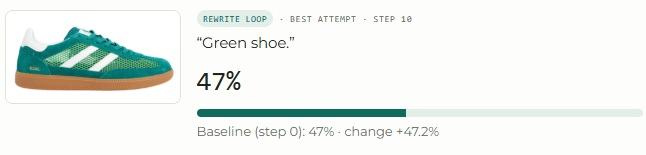
Similarity check. Score any caption against any image instantly. Tweak a word, test again, and watch the number move. It is a fast way to see which phrasings the model actually rewards.
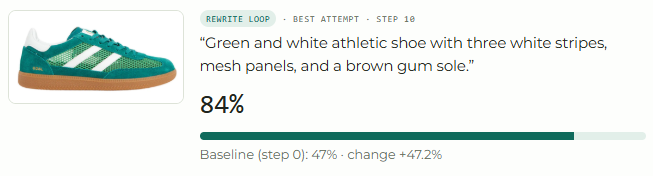 Rewrite loop. The engine drafts a rewrite, scores it, feeds the result back, and drafts again. Every attempt sees the full history and its scores, so it learns which phrasings raised the match and which dropped it. The score climbs live on a chart as it runs.
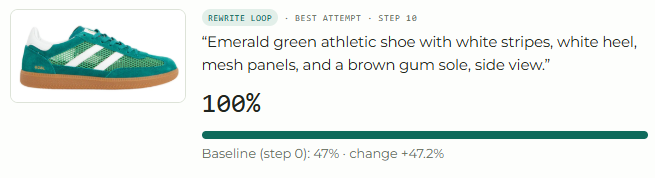
Keep going, with a human in the loop. When a run stalls, an operator can extend it by another ten steps and hand the model a tip: "mention the brown gum sole," "lead with the colour." The tip steers the next attempt, then the model explores freely from there. Human intuition and machine search, taking turns.
A few findings stood out while building it.
Concrete beats clever. Literal, visual wording wins every time. "Emerald green athletic shoe with three white stripes, white heel, mesh panels, and a brown gum sole" scores far higher than anything abstract or promotional. Comma-spliced keyword lists score worse than plain sentences.
Clean product shots reach the top. A single product on a plain background, described precisely, produced the strongest alignment we recorded. That is exactly the eCommerce case, and the model handles it best.
There is a ceiling, and it is reachable. Most strong matches plateau, but a sharp product photo with a well-built caption pushed past the top of our scale. The gains taper as you approach it, so the engine knows when to stop.
A short human nudge breaks plateaus. When automated rewriting circled the same phrasing, one operator tip was enough to jump the score again.
Product titles, alt text, image captions, and feed attributes are no longer just for human readers or keyword matching. They are the text half of a multimodal comparison that AI search runs against your imagery. Copy that genuinely describes what is in the frame will retrieve better than copy that reaches for adjectives the picture cannot back up.
The engine turns that from guesswork into a measured, repeatable loop: score, rewrite, verify, and keep the version that wins.
We are running this against real product imagery now. If you want to see how your listings score, and how much room there is to improve them, book a call.
| Step | Text | Score | Change |
|---|---|---|---|
| 0 | Green shoe. | 47% | n/a |
| 1 | Teal and white athletic shoe with a gum sole. | 72% | +25.1% |
| 2 | Teal green athletic shoe, white stripes, gum sole, mesh fabric. | 79% | +6.4% |
| 3 | Green and white athletic shoe with three white stripes and a gum sole. | 80% | +1.4% |
| 4 | Green and white athletic shoe with three white stripes, mesh panels, and a brown gum sole. | 84% | +4.1% |
| 5 | Side view of a green and white athletic shoe, with mesh panels and a brown gum sole. | 83% | -0.8% |
| 6 | Green and white athletic shoe with three white stripes, mesh panels, and a ridged brown gum sole. | 81% | -1.8% |
| 7 | A single green and white athletic shoe, with mesh panels and a brown gum sole, viewed from the side. | 81% | -0.6% |
| 8 | Green and white athletic shoe, with three white stripes, mesh sides, and a brown gum sole. | 83% | +2.4% |
| 9 | Green and white athletic shoe, three white stripes, mesh panels, and a brown gum sole. | 80% | -3.7% |
| 10 | Emerald green athletic shoe with three white stripes, white heel tab, mesh panels, and a brown gum sole. | 94% | +14.7% |
| 11 | Emerald green athletic shoe with three white stripes, white heel tab, mesh sides, and a brown gum sole. | 95% | +1.0% |
| 12 | Emerald green athletic shoe with three white stripes, white heel tab, mesh panels, and a brown gum sole, side view. | 100% | +4.4% |
| 13 | Emerald green athletic shoe with three white stripes, white heel, mesh panels, and a brown gum sole, side view. | 100% | +1.1% |
| 14 | Emerald green athletic shoe with three white stripes, white heel tab, mesh panels, and a brown gum sole. repeat of an earlier attempt | 95% | -5.7% |
| 15 | Emerald green athletic shoe with white stripes, white heel, mesh panels, and a brown gum sole, side view. | 100% | +7.9% |
| 16 | Emerald green athletic shoe with three white stripes, white heel tab, mesh panels, and a brown gum sole, side view. repeat of an earlier attempt | 100% | -3.3% |
| 17 | Emerald green athletic shoe with three white stripes, white heel tab, mesh panels, and a brown gum sole, side view. repeat of an earlier attempt | 100% | -0.0% |
| 18 | Emerald green athletic shoe with three white stripes, white heel, mesh panels, and a brown gum sole, side view. repeat of an earlier attempt | 100% | +1.1% |
| 19 | Emerald green athletic shoe with three white stripes, white heel tab, mesh panels, brown gum sole, side view. | 99% | -1.7% |
| 20 | Emerald green athletic shoe with three white stripes, white heel, mesh panels, and a brown gum sole. | 96% | -3.1% |
Image Credit: Bstore.