When an AI answers about your brand from memory, generative self-retrieval decides whether it recalls you correctly or invents a plausible wrong answer.
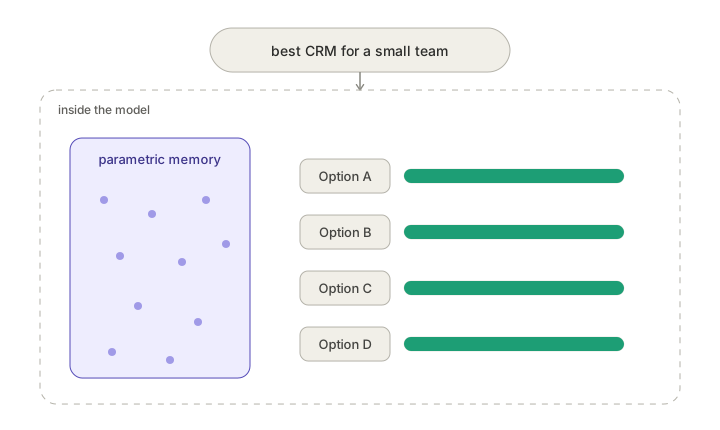 When you ask an AI assistant for the best CRM for a two-person startup, a name comes back. Maybe a short list, maybe a single recommendation. That moment is an internal ranking event. A set of candidates exists somewhere, something put them in order, and one of them rose to the top of the answer. Generative self-retrieval is a name for part of how that ordering happens inside the model itself.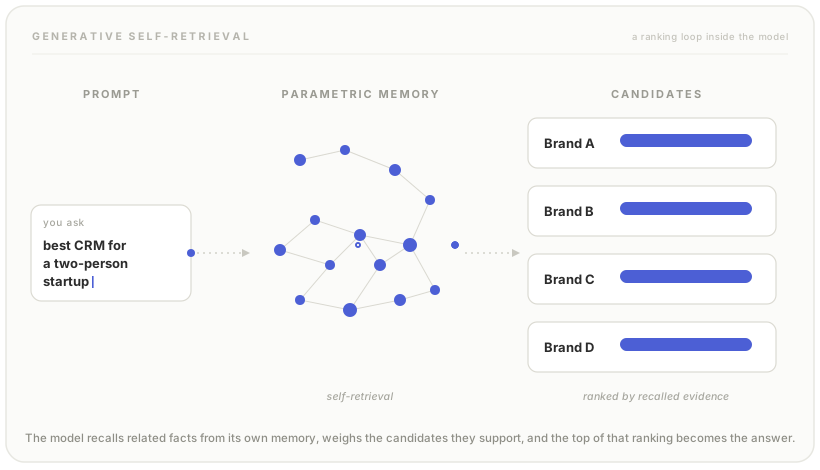
Parametric Memory is the knowledge a model holds in its own weights, learned during pre-training and recalled in a single forward pass with no lookup and no retrieval. Lewis et al. named it in the 2020 RAG paper to separate it from non-parametric memory, the external index a system searches at request time and loads into the context window.
Facts are spread across the weights rather than held in addressable records. Geva et al. (2021) showed that the feed-forward layers of a transformer work as key-value memories: each key pattern responds to a class of inputs, and the paired value shifts the output distribution toward particular tokens. Mechanistic interpretability work such as ROME (Meng et al., 2022) traces a single factual association to a small set of middle-layer MLP weights and rewrites it there, which shows the storage is localised enough to change one fact at a time.
Allen-Zhu and Li (2024) measured knowledge capacity at about 2 bits per parameter when each fact appears around 1,000 times in training, falling to about 1 bit per parameter at 100 exposures. At the 2-bit figure a 7-billion-parameter model holds roughly 14 billion bits, near 1.75 GB, of factual content. Exposure count is the binding constraint: a fact seen a few times in the training data is encoded weakly or not at all, while one repeated across many sources is recalled reliably.
Parametric memory is fixed when training stops, which is what the knowledge cutoff describes. Changing it takes fine-tuning, a further pre-training run, or targeted weight editing, and none of those run per query. Anything later reaches the model only through grounding or retrieval-augmented generation, which supply text at inference and leave the weights untouched.
A query that lands on a weakly encoded fact still returns fluent text, because generation samples the most probable continuation whether or not the knowledge is present. That is the mechanism behind hallucination: the weights carry no separate signal for "this was never stored".
A brand that appears widely and consistently across the training corpus is answered from parametric memory, with no retrieval step and no citation attached. A brand that does not exists for the model only when it can be retrieved, which puts the weight on crawlability and freshness. The two paths produce different results in an AI answer: parametric recall returns a claim with no link back to a source, while retrieved content can be cited.
The mechanism they identified works like this. While the model reasons, it writes out facts that are related to the question. The paper shows those written facts carry real weight: extract them from the trace, feed them back to the model with reasoning turned off, and most of the gain returns. Generating the related facts is itself the act of retrieving them. The model searches its own memory by writing, with no database anywhere in the loop. The authors lean on a classic idea from cognitive psychology to describe it, spreading activation: touch one concept and you lower the retrieval threshold for its neighbours. That is generative self-retrieval.
The paper reports that the traces rarely hold step-by-step logic. They list candidate answers, recall related facts, and sketch out search plans. A model working on "the 10th King of Nepal" lists the first nine monarchs, and that roster is what lets it arrive at the tenth. The first nine make the tenth easier to reach, which is the spreading-activation picture in action.
We use the pass@k metric (§2), which is widely adopted to study capability boundary (Yue et al., 2025). It aligns with our 3 Thinking to Recall: How Reasoning Unlocks Parametric Knowledge in LLMs objective of characterizing the potential of reasoning for factual recall, and not only the current models’ top-1 behavior, since it emphasizes the presence of successful reasoning paths in the model’s output distribution while being less sensitive to their exact ranking.
Source: Reasoning Expands The Model's Parametric Knowledge Boundary
The model surfaces a candidate set from its own knowledge. The related facts it recalls act as evidence. The candidate best supported by that evidence becomes the answer. Self-retrieval is the internal search, and the selection that follows is the ranking.
The paper makes the framing concrete in its closing experiment, with one detail worth getting right. The researchers generate many reasoning trajectories for a question, keep only the ones that recall explicit facts, then narrow to the subset whose recalled facts check out, and accuracy rises at each step. That selection is run by the researchers, not the model. Each recalled fact is verified with a separate search-enabled call, and the accuracy figure simulates what happens when only the trajectories that pass are kept. The model supplies the candidates, and an external check does the grading. The paper is direct that training a model to favour these trajectories on its own is non-trivial, and points to process rewards as a route to it. So the model is the ranker within a single trace, surfacing and weighing candidates as it writes. Re-ranking across its own attempts is a further step, shown here with an outside judge standing in, and a marker of what a model trained to grade its own reasoning could one day do.
What is being ranked?
The reasoning paths / candidate answers are what is being ranked. They are ordered based on the model's internal statistical probability or confidence score during text generation.
Under traditional top-1 grading: The evaluation looks exclusively at the absolute highest-ranked (most probable) token sequence on the model's first try. If the correct answer is sitting at rank #2 or #5 because a hallucination had a slightly higher probability score, the model gets a flat zero.Under pass@k grading: The evaluation rolls the dice $k$ times to look deeper into the output distribution. It doesn't care about the exact ranking of the correct path (e.g., whether it was the model's 1st choice or 50th choice), as long as that successful pathway surfaces somewhere within those $k$ attempts.Reasoning is the switch that turns the loop on. With thinking enabled, the model gets room to surface low-probability candidates and recall the facts that back them, reaching precise details about a brand that a fast, no-thinking pass would miss. The paper shows it plainly: reasoning on unlocks correct answers the model could not produce otherwise.
The catch for visibility is who gets that switch. It rides on subscription tier and personal settings, which puts it largely outside the brand's control and often outside the user's. The same query can return sharp, well-supported facts about your product for someone on a premium plan, and a thin picture for someone on a free tier. Fact recall about your brand ends up uneven across an audience split by what people can pay for, a quiet socio-economic slant where the users least able to afford premium assistants may never see the most accurate version of your brand at all.
The study ran with search disabled, so its evidence speaks to the parametric core, the model ranking candidates drawn from its weights. The systems an SEO audience deals with wrap an external layer around that core. Placed in the fuller pipeline, the sequence looks like this:
The grounding snippets feed the model, and the model still runs its own internal search and ranking over the candidates it can recall and support. External retrieval narrows the field. The model's generative self-retrieval orders what remains and picks.
Grounding is often described as the fix for hallucination, since it hands the model correct information to work from. It does add evidence, and stronger evidence makes a correct answer more likely to win. It also helps to see what grounding is from the model's side. The snippets arrive as context tokens, the same form a longer prompt takes, or a multi-turn exchange, or any other text placed in the window. The model attends over them as input.
The paper offers a clean demonstration of context working this way. Its facts experiment placed recalled facts into the context with reasoning switched off, and the answer shifted. Grounding snippets play the same structural role, as external facts sitting in the context pool. Because they enter as input, the model still runs its generative self-retrieval over the candidates it can assemble, and it still ranks them before it answers. Models are trained to lean on provided context, so grounding tends to weigh heavily in that ranking, and the final recommendation is still the top of a ranking the model performed, now with the grounding snippets in the pool of evidence alongside whatever the model recalled on its own.
The final answer to a commercial prompt is a ranked pick. Ask for the best running shoe for flat feet, and the candidates are brands, the answer is a recommendation, and that recommendation is the output of a ranking the model carried out. Part of that ranking happens in the external retrieval layer that SEO discussion already studies closely. A meaningful share happens inside the model, in the generative self-retrieval step, where it draws candidate brands and supporting facts from its parameters and orders them. The brand that ends up named is the candidate the model surfaced and could best support with what it recalled. The supporting facts are the lever, which is why a brand wired tightly to the concepts in a query has an edge before any ranking is run.
There are verifiable facts: a shoe has a wide toe box, a CRM integrates with a given tool, a product was built for a particular use. And there is the preference verdict, the claim that something is the best pick, which has no factual answer to be right or wrong about. The audit in the paper measures the first kind.
Because the model generates its own supporting facts, those facts can be wrong, and traces that carry a hallucinated fact are markedly more likely to end on a wrong answer. Pooled across questions the split is stark: correct answers fall from about 41% to 26% on one benchmark and from about 71% to 32% on the other. Those raw figures do not separate fact quality from question difficulty, so the paper also runs the comparison within each question, and the gap holds. Across both benchmarks the fitted line sits below the no-effect diagonal, at slopes of 0.84 and 0.86, meaning a trace carrying a hallucinated fact lands correct less often even against its own question's baseline.
In the ranking frame, a candidate can climb on supporting facts the model invented. For a brand, that puts the factual substrate front and centre. The attributes a model associates with your product are recall that can be accurate or fabricated, and the fabricated kind can carry a recommendation it should not. The verdict itself has no truth value for an audit to catch, which is exactly why the facts feeding it are the place to watch.
Generative self-retrieval is the model running a search over its own knowledge and sorting what it finds. The reasoning trace is where the candidates appear and get weighed, and the answer is what that internal ordering surfaces. For anyone tracking how AI systems land on a particular brand or product, that internal ranking is a real part of the machinery, sitting alongside the external retrieval layer, and this is the term for it.
 Dan Petrovic ·
27 June 2026
Dan Petrovic ·
27 June 2026
Technically, what’s happening is closer to: each generated token updates the context window, attention mechanisms reweight latent associations, that changes probability distributions over future tokens. So yes - writing intermediate facts can unlock latent knowledge. But the model is not literally searching a database or discrete memory store. I’d phrase it more as: reasoning alters the activation landscape, making some facts more reachable.
 Alex Petrovic ·
SuggestsExpands · ·
01 July 2026
Alex Petrovic ·
SuggestsExpands · ·
01 July 2026
Has anyone tested whether this spreading-activation effect varies across model architectures (for example... dense vs. mixture-of-experts)? Since MoE models route different tokens through different expert subnetworks, I'd guess the.. 'write a fact, lower the retrieval threshold for the next' chain could behave differently than in a dense model where everything passes through the same weights every step.
 Elle Vys ·
QuestionsSuggests · ·
30 June 2026
·
Elle Vys ·
QuestionsSuggests · ·
30 June 2026
·
Sounds like a nice follow-up test but isn't Gemini already an MoE?
Dan Petrovic ·
QuestionsExpands · ·
01 July 2026
Even if context contains five good CRM options, the model may still prefer HubSpot or Salesforce because those brands have stronger representation in training data.
Alex Petrovic ·
Suggests · ·
01 July 2026
Yup, this: https://dejan.ai/concepts/primary-bias
Dan Petrovic ·
SupportsExpands · ·
01 July 2026
Commercial prompts often ask: “What’s the best CRM?” “Best running shoe?” “Best AI assistant?” Those are not factual questions - they’re preference aggregation problems. A model can retrieve facts perfectly and still recommend poorly because the weighting function is subjective.
Alex Petrovic ·
Suggests · ·
01 July 2026
·


This is a crucial takeaway. Many assume that if a brand or product is successfully fetched via an external search API and injected into the prompt context, the AI will automatically recommend it. RAG is not a silver bullet. The external text is still filtered through the model's internal, parametric biases and self-retrieval loops. If a model’s core weights have a negative or weak association with a brand, it might still down-rank that brand in the final output, despite it being present in the grounding snippets.