
Google bolds salient phrases and links to extracted passages on keyword-free site: queries
 Dan Petrovic ·
· AI SEO DEJAN 0293
Across 19 organic results from two keyword-free site: queries, Google bolded salient spans with on 16 results and appended a #:~:text= Read more link (ved type 269679) on 15.

Across 19 organic results inspected from two keyword-free site: queries (site:https://marketingfanatic.com/people/ and site:https://dejan.ai/blog/), Google wrapped salient entity or claim phrases in <em> bold tags on 16 results (8 of 9 profiles on MarketingFanatic; 8 of 10 posts on DEJAN) despite zero keywords in the query, and appended an underlined Read more link (a.vzmbzf, ved protobuf type ID 269679) carrying a #:~:text= scroll-to-text-fragment URL on 15 results (9 of 9 on MarketingFanatic; 6 of 10 on DEJAN). Comparing the SERP HTML against the live source pages and our own database shows two independent mechanisms: Read more fires whenever Google extracts a visible on-page DOM passage instead of <meta name="description">, while query-free <em> bolding fires independently on body passages and meta descriptions alike.
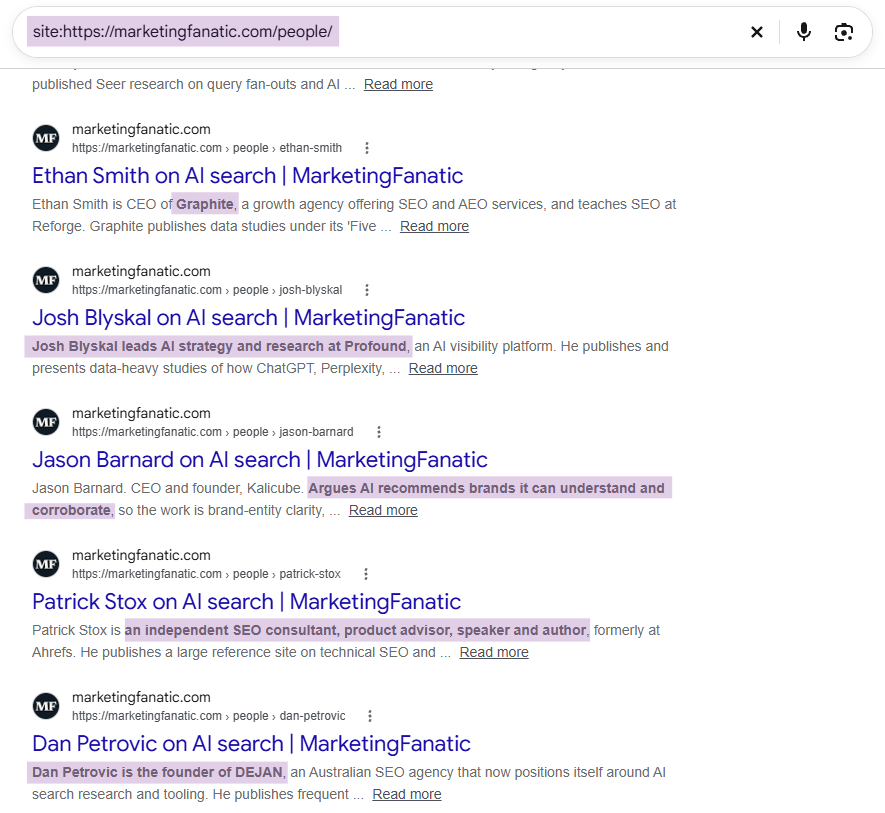 Figure 1: Organic SERP for
site:https://marketingfanatic.com/people/ showing query-free bolded phrases and underlined Read more links.
The two independent mechanisms
In standard keyword searches, Google bolds words that match or closely relate to the user's query. On a bare site: query with no keywords, any <em> bolding inside the snippet comes solely from Google's own snippet and salience selection.
Inspecting the SERP DOM and testing all 19 results separated the behaviour into two distinct components that operate independently:
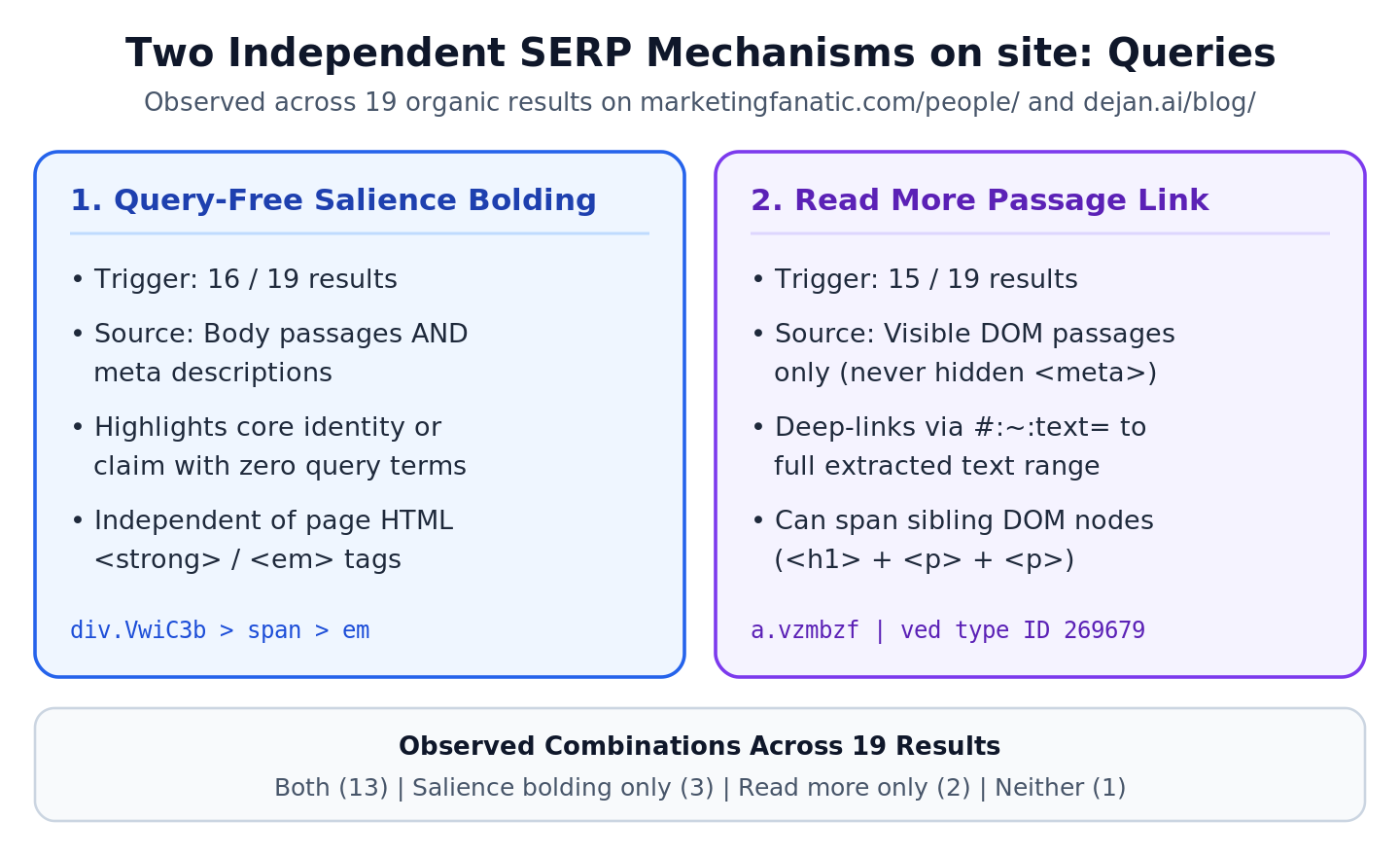 Figure 2: Distribution of query-free
<em> bolding and Read more (ved=269679) passage links across the 19 inspected results.
| SERP Element | Selector / Attribute | Observed Value |
|---|---|---|
| Snippet wrapper | div.kb0PBd.A9Y9g |
data-snf="nke7rc", data-sncf="1" |
| Snippet text | div.VwiC3b.yXK7lf.p4wth.Hdw6tb |
-webkit-line-clamp:2; salient span inside <em> |
| Organic title link | a > h3 |
ved protobuf field 2 = 22 (standard web result) |
Read more link |
a.vzmbzf > span |
ved protobuf field 2 = 269679; href carries #:~:text=<start>,<end> |
Evidence 1: Identical templates on marketingfanatic.com/people/
Five profile pages on marketingfanatic.com/people/ (aleyda-solis, chris-long, kevin-indig, jason-barnard, and dan-petrovic) were fetched and inspected directly. All five share the exact same HTML template, identical ProfilePage JSON-LD, and zero <strong>, <em>, or <b> tags anywhere in the document.
Despite identical markup, Google extracted different DOM regions per person and bolded different spans:
| Profile | DOM section targeted by Read more |
Google <em> bold span |
|---|---|---|
aleyda-solis |
Body paragraph under Current thinking (skipping header bio and thesis) | AI search expands discovery rather than killing SEO |
jason-barnard |
Three sibling header nodes (<h1> + role <p> + thesis <p>) |
Argues AI recommends brands it can understand and corroborate |
kevin-indig |
Header bio paragraph | growth advisor |
dan-petrovic |
Header bio paragraph | Dan Petrovic is the founder of DEJAN |
chris-long |
Header bio paragraph | (none) |
Clicking Read more on Jason Barnard's result opens marketingfanatic.com/people/jason-barnard#:~:text=Jason%20Barnard,brand%2Dentity%20clarity%2C%20not%20page%20tactics. Chrome highlights across three separate sibling elements inside <div class="min-w-0">, confirming that Google's passage boundary crosses element tags and that the SERP <em> bolding does not mirror on-page HTML emphasis.
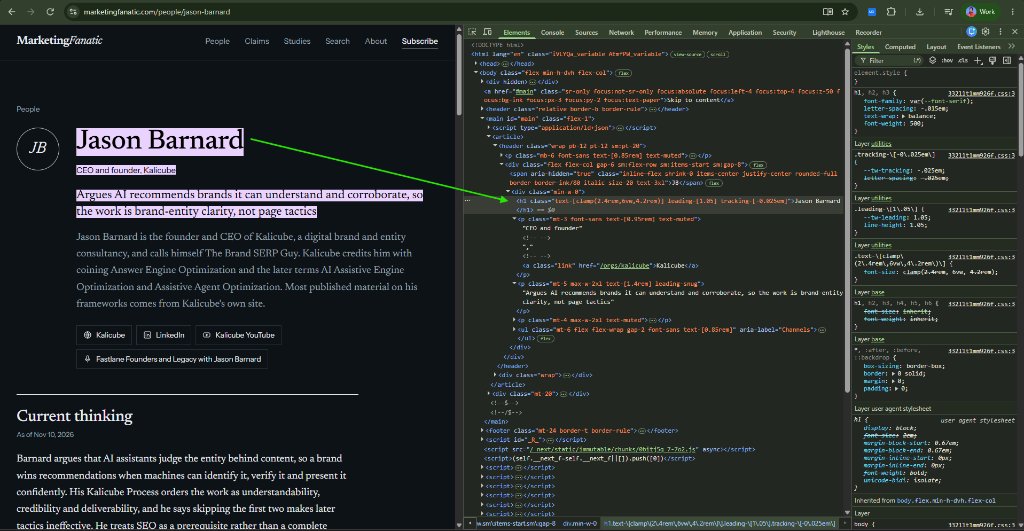 Figure 3: Clicking
Read more on Jason Barnard's SERP result highlights across three unstyled sibling DOM nodes (<h1> + <p> + <p>).
Evidence 2: Meta descriptions vs. body passages on dejan.ai/blog/
To verify when Read more appears, we captured the full Google SERP HTML for site:https://dejan.ai/blog/ (10 results) and matched every snippet against our posts database (comparing each post's <meta name="description"> against its rendered body text).
| Post | Snippet source | Read more (269679) |
Google <em> bold span |
|---|---|---|---|
expert-users |
<meta> |
No | (none) |
latent-skills |
Visible standfirst (matches <meta>) |
Yes | AI models hold skills no prompt can unlock |
/blog/ |
Body | Yes | quantitative metric-based link spam detection |
cas |
Body (not <meta>) |
Yes | CAS is a new user behaviour model developed by Google |
ctr |
<meta> (untruncated) |
No | expected click-through rates for any website |
turboquant |
Body (not <meta>) |
Yes | TurboQuant |
rexbert |
Body (not <meta>) |
Yes | RexBERT embeddings improve semantic matching |
ablation |
<meta> (untruncated) |
No | measures how many rank places each sentence of an AI-cited source is worth |
newtail |
Body (not <meta>) |
Yes | (none) |
outreach |
<meta> |
No | deep |
Two edge cases confirm the exact split between the two mechanisms:
- Visible standfirst vs. hidden meta tag (
latent-skills): Our blog template renders the post description as a visible standfirst paragraph under the byline on newer posts. ClickingRead moreonlatent-skillshighlights that visible standfirst in purple, while posts whose snippet existed only in<meta name="description">(expert-users,ctr,ablation,outreach) received noRead morelink. - Passage link without bolding (
newtail): Google skipped the numberedTL;DR Versionlist at the top of/blog/newtail/, extracted the opening sentence under You don't know what you don't know., applied zero<em>bolding in the SERP, and still attached aRead more#:~:text=link that highlights that sentence on the page.
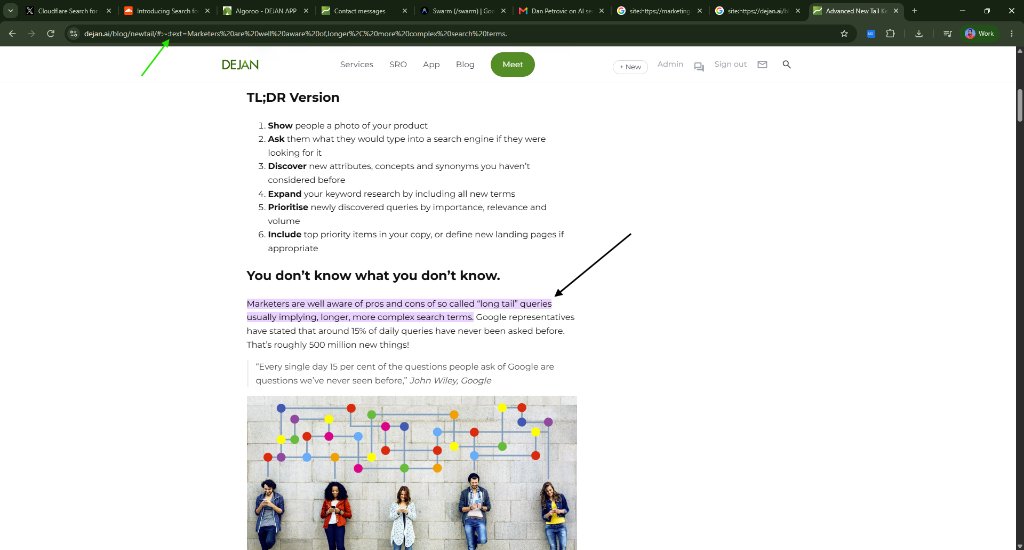 Figure 4: Clicking
Read more on /blog/newtail/ bypasses the top TL;DR list and highlights the extracted body sentence via #:~:text= despite having no bolding in the SERP snippet.
Practical diagnostic signals from a site: query
Because a bare site: query introduces zero keyword bias, inspecting the resulting SERP HTML exposes four observable properties of how Google indexes a folder or template:
- Query-free salience spans (
<em>): Shows the exact entity, role, or claim Google highlights as the snippet's primary phrase, and identifies pages where Google highlights nothing (chris-long,newtail,expert-users) or a single generic token (deeponoutreach). - Canonical passage boundaries (
#:~:text=): Shows the exact start and end tokens of the passage Google chose to represent the page, including cases where Google skips an opening summary or list in favour of a lower section. - Meta description vs. DOM passage rate (
a.vzmbzf/ved=269679): Presence of theRead moreanchor indicates Google served a visible on-page DOM passage; absence indicates Google served<meta name="description">. - Cross-template comparison: Running
site:on a directory such as/people/,/blog/, or/products/displays Google's extracted passage and bolded span for every indexed page on the same template side by side.
Related concepts
- Search Engine Optimization (SEO)
- Technical SEO
- Entity
- Semantic Search
- AI Search
- Retrieval-Augmented Generation
Comments
Sign in with Google to comment and annotate this content.