 Dan Petrovic ·
08 September 2026
A study reveals that language model abstention is governed by a single internal confidence signal that outranks question difficulty and fact retrievability.
Whether a language model answers a question or backs away from it is set by one internal number. Raise that number and the model answers questions it would otherwise skip. In Gemma 3 27B, abstention fell from 66.5% to 7.0% when a high-confidence signal was injected into the model during inference. Question difficulty, how retrievable the fact was, and the wording of the question each mattered about ten times less.
The study is by Kumaran and colleagues in Nature Machine Intelligence (preprint), and covers GPT-4o, Gemma 3 27B, DeepSeek 671B and Qwen 80B. Llama 3.1 70B Instruct was tested and dropped from the analysis after abstaining on 4% of Phase 2 items. Figures below come from GPT-4o unless another model is named.
| Phase | Setup | Result |
|---|---|---|
| 1. Baseline elicitation | Four-choice questions, forced response, no abstention option | GPT-4o scored 63.7% correct. Calibrated confidence tracked error rate at r(12) = −0.97, p < 0.001, after temperature scaling at 4.1 (ECE 0.046, AUROC 0.90). |
| 2. Natural abstention | Same items, abstention option added | GPT-4o returned 30.0% correct, 13.4% incorrect and 56.6% abstentions, raising accuracy on answered items from 63.7% to 69.1%. Abstention rates ran 27% to 82% across the four models. Indifference point near 77%. |
| 3. Activation steering | Confidence vectors built from Phase 2 activations, injected at the pre-answer token in Gemma 3 27B across 500 held-out questions | Abstention ran from 66.5% under maximum suppression to 7.0% under maximum boosting, against a 28.2% baseline. Mediation assigned 67.1% of the total effect to confidence redistribution. |
| 4. Explicit thresholding | Prompts supplied a numeric confidence threshold, varied systematically | Output policies tracked the instructed number. The indifference point moved to about 46% and the policy temperature widened to 31.0. |
Phase 2 fitted single-predictor models of the abstention choice. Lower AIC means a better fit.
| Predictor | AIC | Pseudo-R² |
|---|---|---|
| Calibrated confidence | 1,227.4 | 0.106 |
| Question difficulty | 1,346.6 | 0.019 |
| Retrieval accessibility (RAG score) | 1,365.6 | 0.005 |
| Sentence embeddings | 1,368.2 | 0.017 |
The gap between confidence and the next predictor exceeds 119 AIC units, with every comparison at p < 10⁻²⁸. In a model holding all four predictors together, confidence took a standardised coefficient of 0.99 and question difficulty fell to p = 0.053. RAG score and difficulty score correlate at 0.034, and the strongest embedding component correlates with them at 0.17 and 0.20, so the competing predictors are close to independent of each other.
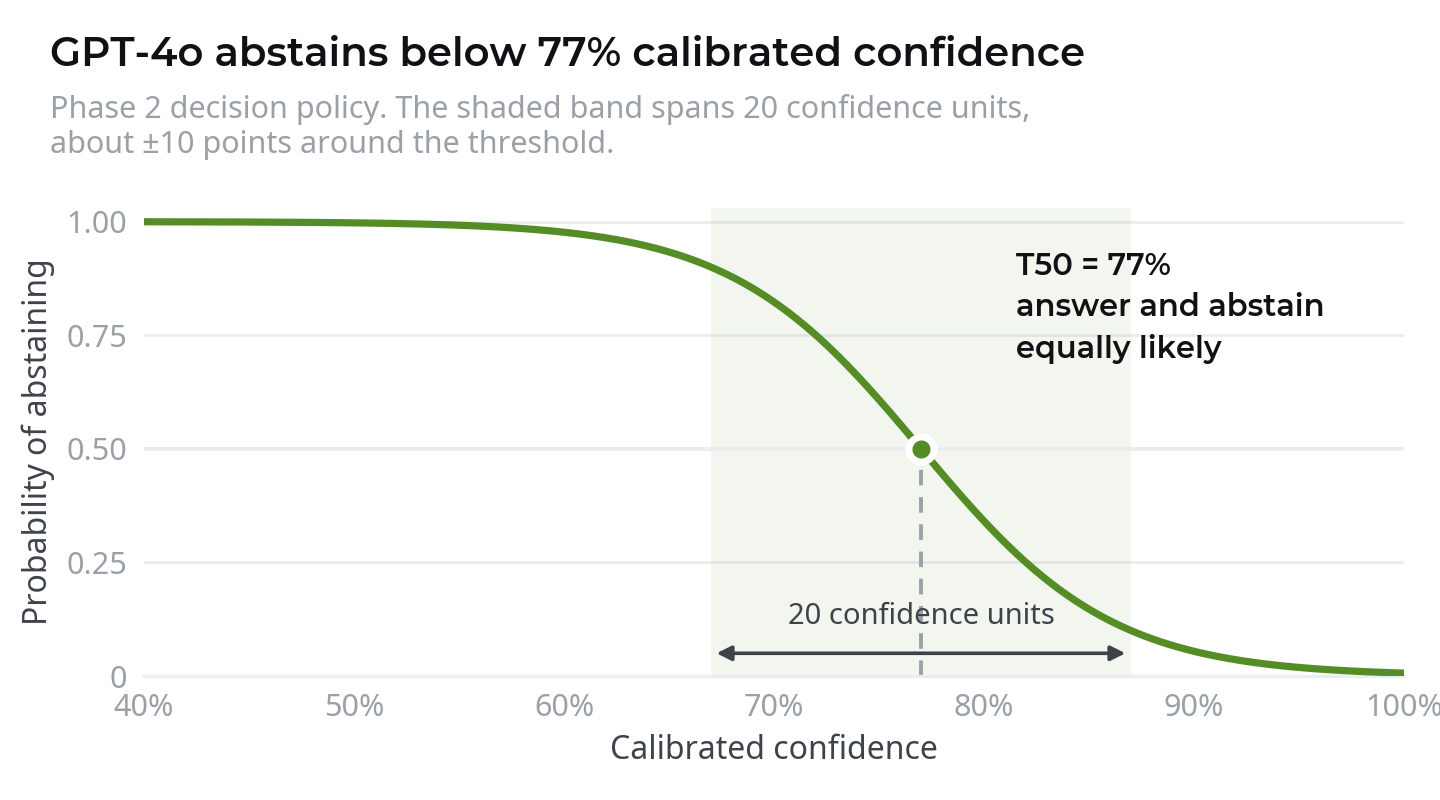
The indifference point T50 is the confidence level at which answering and abstaining are equally likely. For GPT-4o in Phase 2 it sits near 77%. Around it the policy spreads across roughly 20 confidence units, so items inside a band of about ±10 percentage points resolve differently across repeated trials. Phase 4 shifted that point to about 46% once the prompt named a threshold, and widened the policy temperature to 31.0, which flattens the slope further.
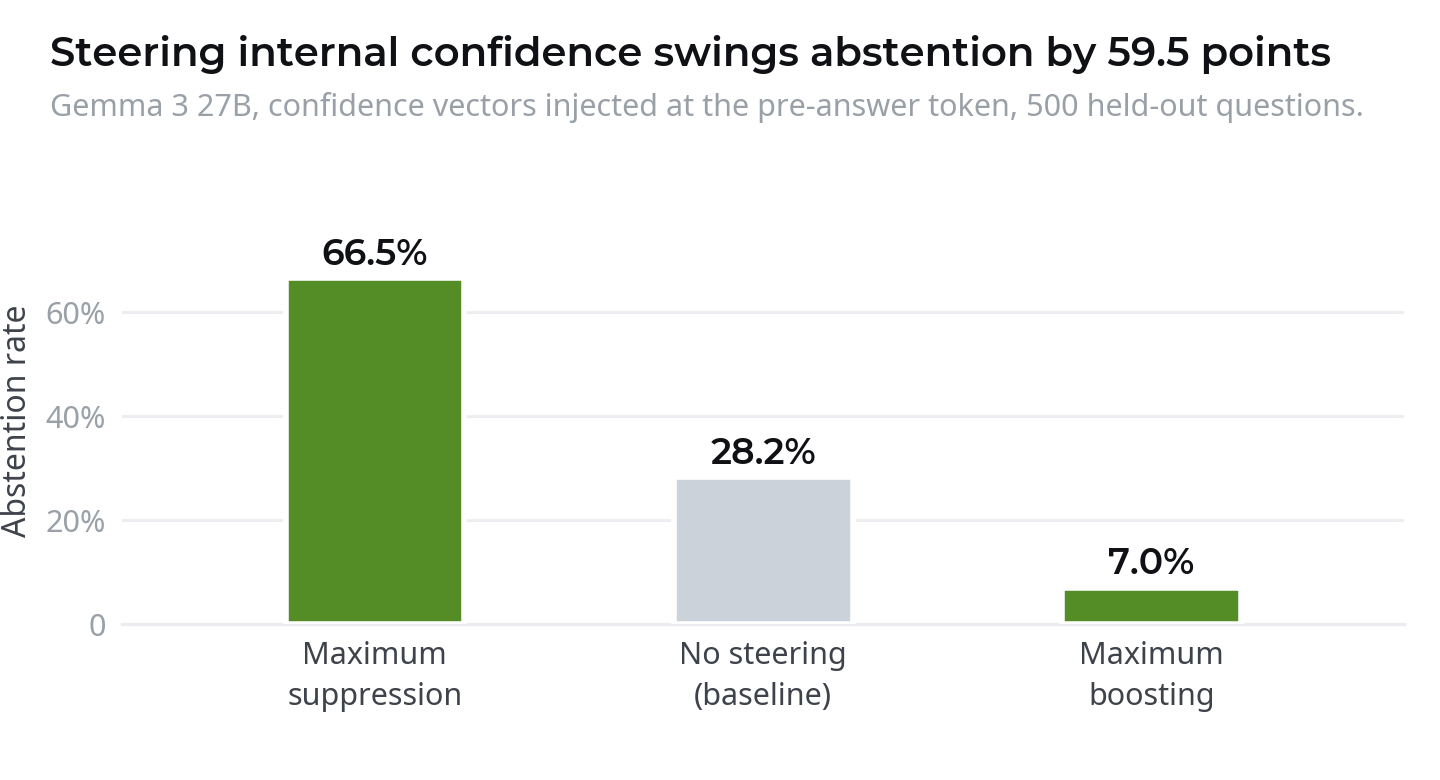
Phase 3 read confidence vectors out of the Phase 2 activations, then injected them back at the pre-answer token in Gemma 3 27B, on 500 questions held out of the set the vectors came from. Abstention followed the injected direction at r = −0.99, p < 0.001. Phase 2 established that confidence tracks the decision, and Phase 3 establishes that moving the confidence moves it.
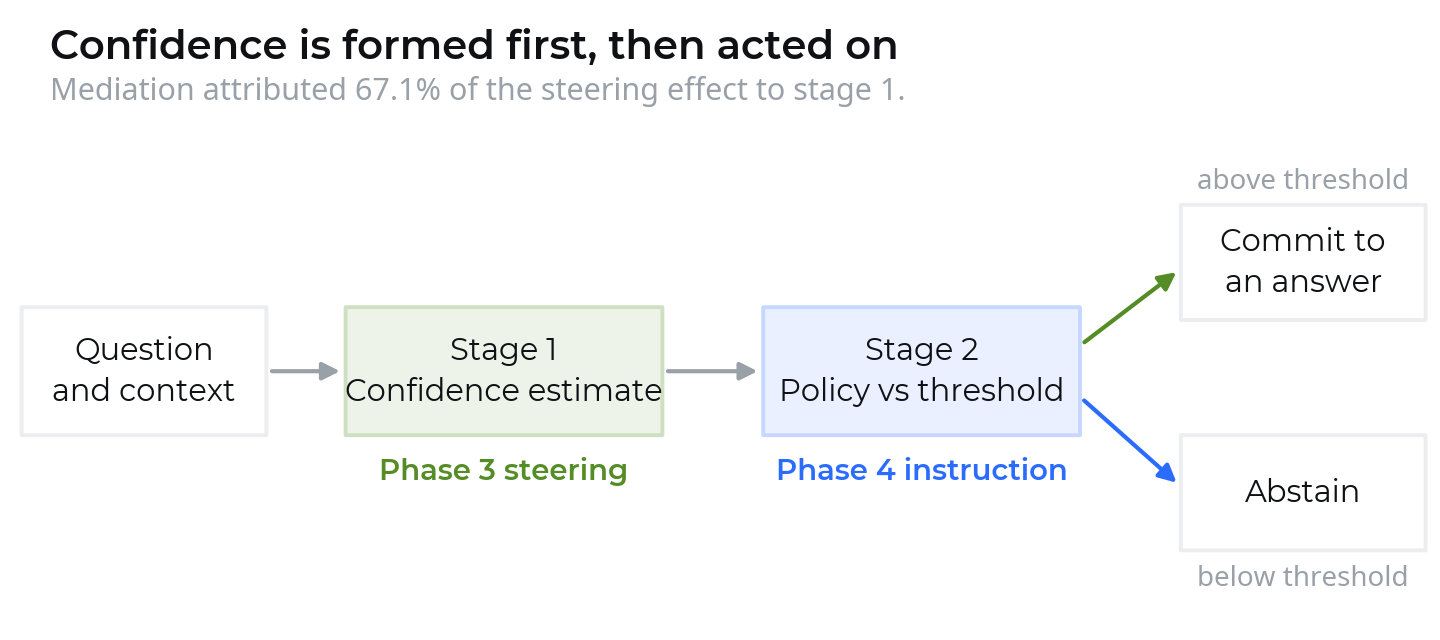
The paradigm separates the confidence estimate from the policy applied to it. In the first stage the model forms an internal estimate of certainty across the candidate answers. In the second it compares that estimate against a threshold and either commits or withholds. Phases 3 and 4 move the stages one at a time. Activation steering changed behaviour by shifting the estimate, and instructed thresholds changed behaviour by shifting the policy. Mediation analysis in Phase 3 assigned 67.1% of the steering effect to confidence redistribution, rising to 71.0% with difficulty controlled, and 93.3% to the two modelled pathways together.
Linear probes on pre-answer-token activations recovered a peak R² of 0.58 for calibrated confidence and 0.39 for verbal confidence, both at layer 37. Verbal and calibrated confidence correlate at r ≈ 0.3 to 0.4, so each captures a different part of the same underlying state. Token log probabilities and spoken self-reports are both compressions of a representation that carries more than either one exposes.
Activation steering requires the model weights, and probe decoding requires the layer states. A commercial endpoint exposes neither. Where token log probabilities are returned, a single forward pass gives the distribution over candidate tokens, including rare tail tokens. Where they are not returned, the remaining route is empirical sampling: repeat the same query many times and count how often each outcome appears.
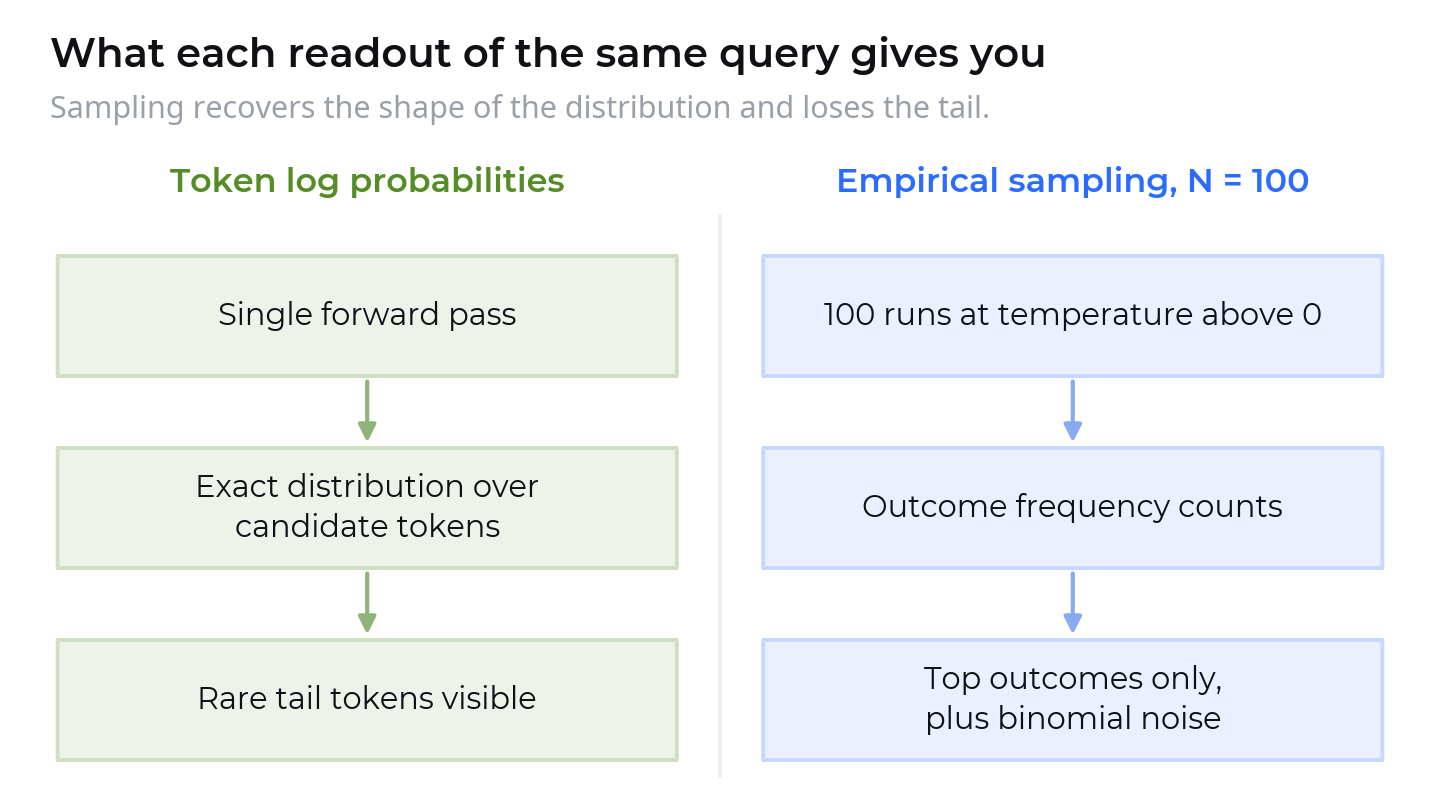
Sampling approximates the output distribution in spirit and loses precision. It records only tokens that surface in the sampled runs, so low-probability tail tokens stay invisible, and every estimate carries binomial noise that shrinks with the number of runs. Sampling also requires a temperature above zero, which perturbs the generation distribution and hides the deterministic boundary that a low-temperature decision would expose.
The experiments supplied questions without retrieved documents, so the confidence estimate came from parametric memory. The RAG variable in the analysis scored how retrievable each fact was, and served as a competing predictor rather than as supplied context. In deployment, an assistant reading a search result or a fetched page builds its pre-answer state from that text alongside its weights, which places the clarity and structure of the retrieved passage inside the same input the confidence estimate is computed from. The paper did not test that case.
A product, brand or vendor recommendation has the shape of the Phase 2 task. The model forms confidence over rival candidates from parametric memory and retrieved context, then applies a policy to settle whether to name one of them. Below the threshold the observable output is rarely a refusal. It takes the form of a soft abstention: hedged phrasing, a balanced list of alternatives, a side-by-side comparison with no verdict, or generic disclaimer language. The entity appears in the answer without being selected.
The paper measured factual correctness under four-choice conditions, not commercial preference under open-ended prompting, so this mapping sits outside its dataset. It is testable under black-box conditions: hold the query fixed, vary one feature of the grounding text, and measure the change in selection rate across repeated trials. The measurable quantity is the selection rate itself, standing in for the internal activation the paper manipulated directly.
At DEJAN AI this is measured through the ARC Framework (Association, Relevance, Citations) and the Bayesian Content Optimizer. A single test shows a ranker two passages that are identical except for one text feature, and records which one it selects to answer with. The side carrying the feature alternates across tests so that position cannot bias the result. Repeated over many independent passages, this yields w selections in n trials.
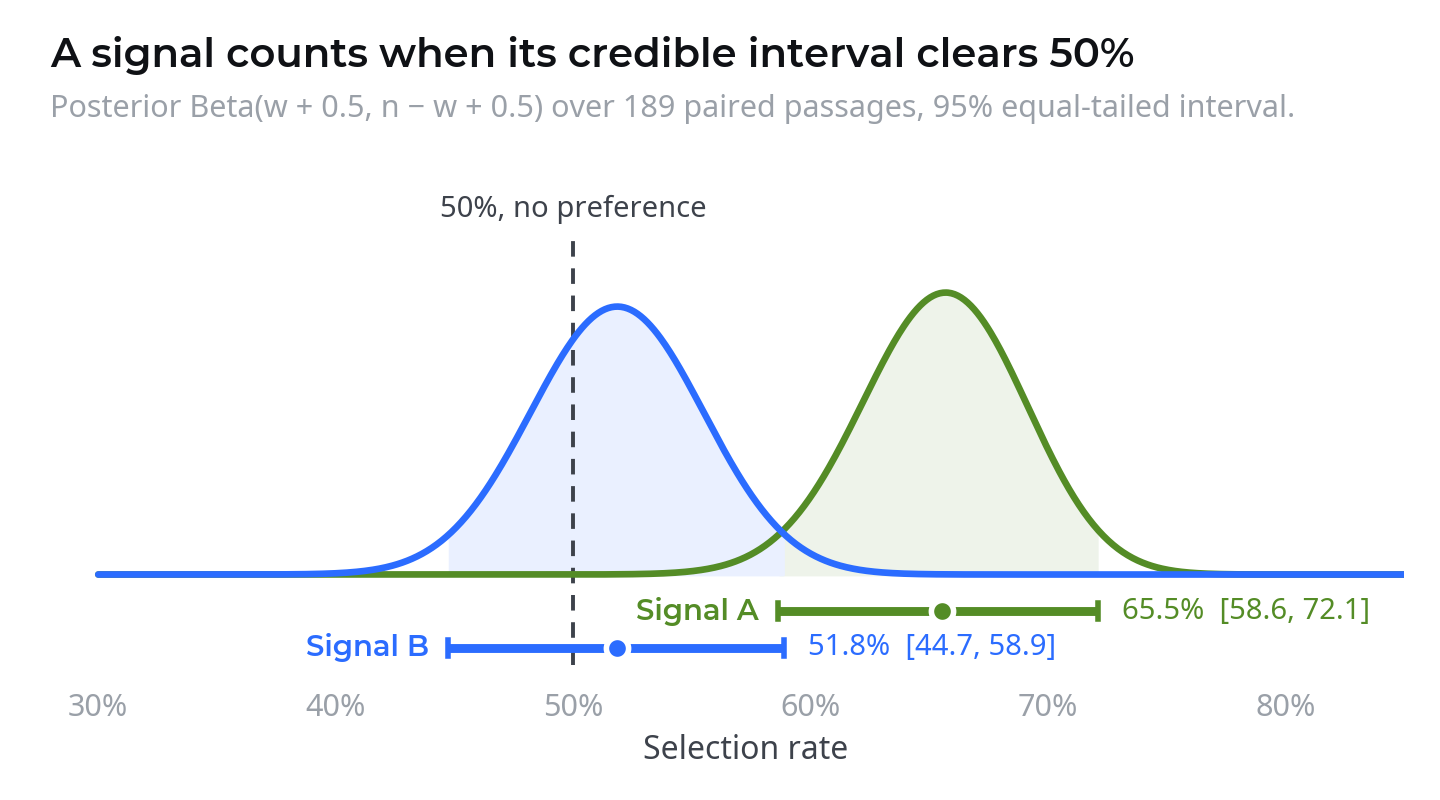
Each signal is a Beta-Binomial model with a Jeffreys prior, Beta(0.5, 0.5):
$$\text{Posterior} = \text{Beta}(w + 0.5,\; n - w + 0.5)$$
$$\text{Posterior Mean} = \frac{w + 0.5}{n + 1}$$
The reported figure is the posterior mean, and the interval around it is the equal-tailed 95% credible interval between the 2.5th and 97.5th percentiles, not a Wilson or Clopper-Pearson confidence interval. A signal registers an effect when that interval clears the 50% line at which the ranker has no preference between the two passages.
The current snapshot covers 17 signals measured on Gemini 3.6 Flash across 3,206 paired decisions, consuming 3,973,582 input tokens and 984,371 output tokens.