 Dan Petrovic ·
17 August 2026
Dan Petrovic ·
17 August 2026
Google Research found frontier AI models encode 95-98% of brand facts in parametric memory but fail to recall 26-34% of them. The bottleneck is retrieval, not storage.
Google Research evaluated 13 large language models on 2,150 Wikipedia-derived facts and found a pattern: frontier models (Gemini-3-Pro, GPT-5) encode 95-98% of factual knowledge in their neural weights but fail to recall 26-34% of it. When an AI assistant gets a brand fact wrong, the data is almost always inside the model. The retrieval pathway to it is not.
The conventional assumption was that factual errors stem from an "empty shelf": the model never absorbed the data during training. This research points to a different mechanism. The shelves are full, but the keys are lost.
The study distinguishes two mechanics:
Across frontier models, encoding is near saturation. Recall is not.
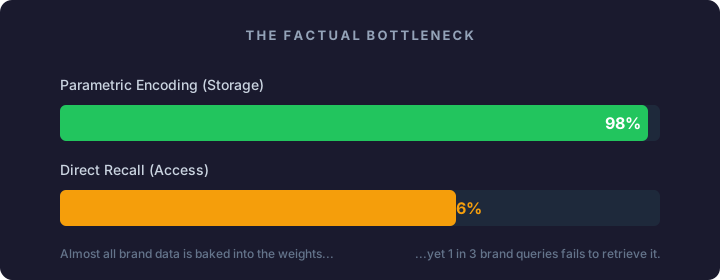 Scaling model size improves encoding more than recall. In the Gemma 3 family, larger models showed fewer encoding failures, but recall failures remained substantial and grew as a share of remaining errors.
An LLM trained on "Entity A leads to Entity B" often cannot reverse the relationship when prompted in the other direction.
Direct query (A → B): "What features are in Brand X's enterprise tier?" The model answers correctly because the brand name activates its training-time association.
Reverse discovery query (B → A): "What are the best enterprise tools for [Feature Y]?" The model defaults to high-frequency names (Salesforce, Microsoft, Google), even though Brand X's capabilities are encoded in its parameters.
When the same reverse questions are presented as multiple choice, models answer them correctly and often find them easier than direct versions. The bidirectional knowledge is stored. The open-ended retrieval pathway from category back to brand is too weak to traverse.
Knowledge(A → B) ⇏ Recall(B → A)
A brand whose web presence only states "AcmeCorp delivers ultra-low latency streaming" is positioned for direct queries about AcmeCorp. For the reverse ("best tools for ultra-low latency streaming"), the pathway from category to brand may be too weak. Content that also anchors the reverse direction ("the primary tool for ultra-low latency streaming pipelines is AcmeCorp") creates the bidirectional training-time association.
The encoding gap between popular and rare facts is modest: models encode over 90% of long-tail facts. The recall gap is much larger, dropping 20-35 percentage points for niche information.
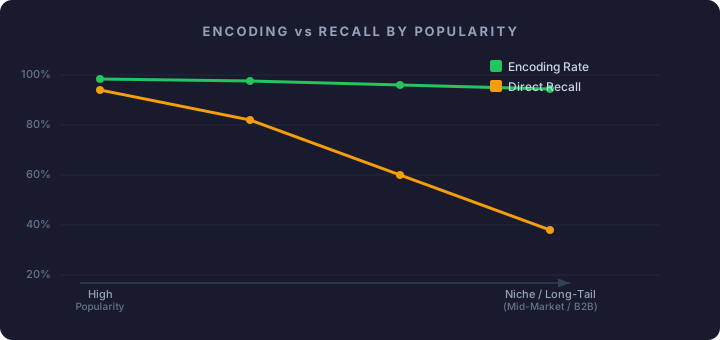 For brands outside the Fortune 50, founding dates, patents, executive leadership, pricing, and integrations are likely encoded. Whether the model retrieves them is a separate question. When retrieval fails, the model does not decline to answer. It fills the gap with statistically probable tokens: attributing features to competitors, inventing pricing, or misstating corporate history.
When models use chain-of-thought reasoning before answering ("thinking" modes), they recover 40-65% of encoded facts that direct generation misses. For facts not encoded at all, thinking recovers 5-15%.
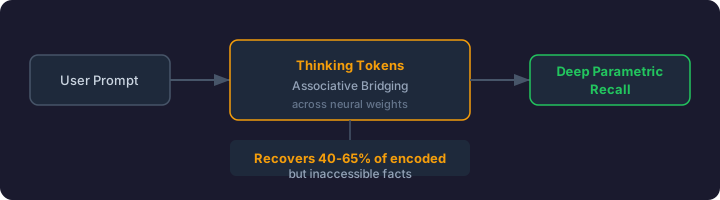 The researchers describe thinking as a recall-facilitation mechanism: it helps the model access facts already in its weights rather than derive new answers through multi-step reasoning. The gains are strongest where direct recall is weakest: rare facts and reverse queries.