
Modern search engines use a hybrid structure consisting of a strategic Agentic Layer for decision-making and an Interpretative Layer for generative synthesis.
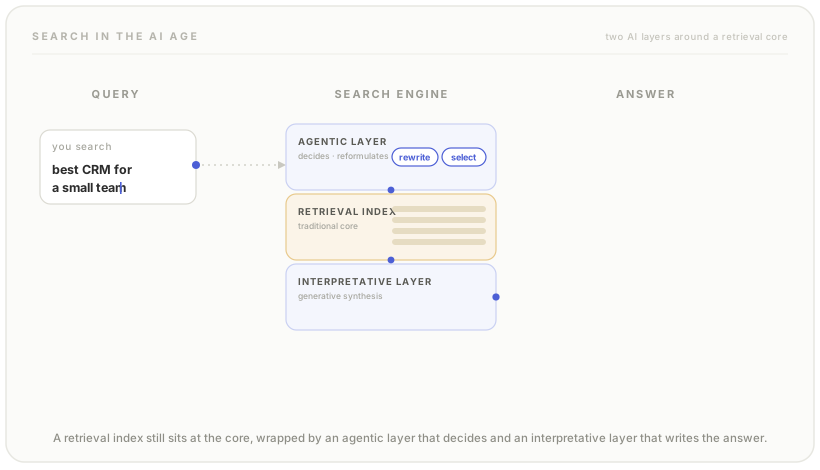
The Agentic Layer acts as the engine’s strategic decision-maker. This layer, which involves multiple systems and models, determines how to best fulfill a query. Its responsibilities include:
You can expect this layer to evolve rapidly in the next five years. By 2030, the decision making process will fully extend into a personal assistant mode where Google will act as a personal shopper, researcher and be able to take action. Examples include making bookings, sending emails, reminders, creating calendar entries, doing independent research and more.
This is an old prediction about evolution of search from 2013 that’s still very much on track.
The Interpretative Layer is the presentation layer, powered by a generative model. It takes the search results, user query, and metadata as a grounding context and synthesizes this information into a single, presentable unit for the user.
Ultimately, this hybrid structure is why the popular term “generative engine” is a bit off—the core is still a retrieval engine. Furthermore, we don’t yet have search engines that are wholly based on neural networks; they still rely on traditional indexes and retrieval algorithms for speed and efficiency.
 Dan Petrovic ·
19 August 2025
Dan Petrovic ·
19 August 2025