
Generative Engine Optimisation (GEO) is a term used to describe SEO for AI assistants and generative search engines, often based on a single research paper.
GEO stands for Generative Engine Optimisation, an acronym easily confused with, the well-established “geo-” prefix commonly associated with Geosciences.
Generative engine is recently made up term by the marketing community in an attempt to rename Chatbots, more recently known as AI Assistants including ChatGPT, Claude, Grok, Gemini and Perplexity.
Basically “Generative Engine” is meant to be a “Search Engine” powered by a generative model. A place where you search for information and get answers in a conversational manner, where the output is not a list of results but a generated text.
But there are already established names for all that.
1. Search Engines can now be augmented by AI Assistants (AI Mode).
2. AI Assistants can now be augmented by search engine results (RAG) and allowed tool use via function calling and code execution.
AI Agents. AI Assistants which agentic capabilities (Operator and Manus).
*Formerly “chatbots”.
It’s wobbly. A recently deleted Wikipedia article has been providing the term GEO most of its legitimacy on the basis of a 2023 preprint “by researchers Gao, Liu, Si, Meng, Xiong, and Lin”.
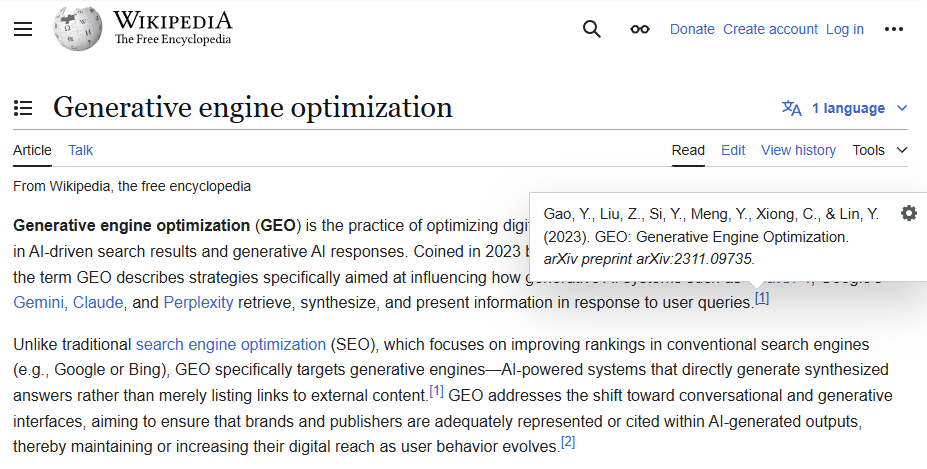
But if you look it up Gao, Liu, Si, Meng, Xiong, and Lin don’t appear to be associated with this paper at all. Instead we’re looking at an Indian team of authors Pranjal Aggarwal, Vishvak Murahari, Tanmay Rajpurohit, Ashwin Kalyan, Karthik Narasimhan and Ameet Deshpande.
The rest of the Wikipedia article are simply promotional, commercial links to various SEO blogs, providers and tools. The references are cyclical and loopy in nature as all these blogs borrow the term from this supposed Gao et al. paper.
Here’s another sneaky tactic used to attempt to legitimize the term:
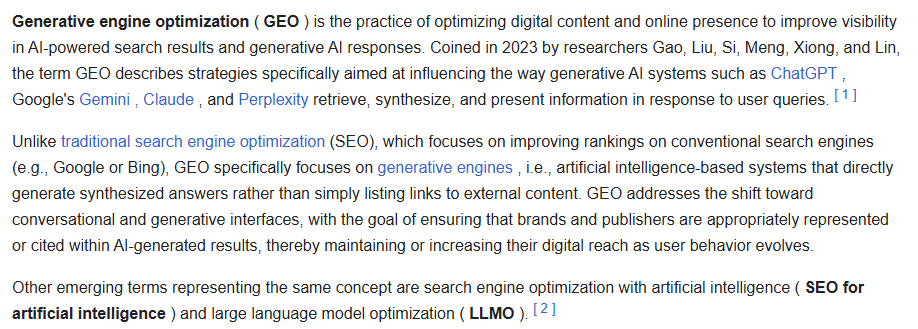
Notice how the word “generative engines” links to another article?
Yeah, it just links to Generative AI which uses the word “engines” precisely twice and to describe “search engines”.
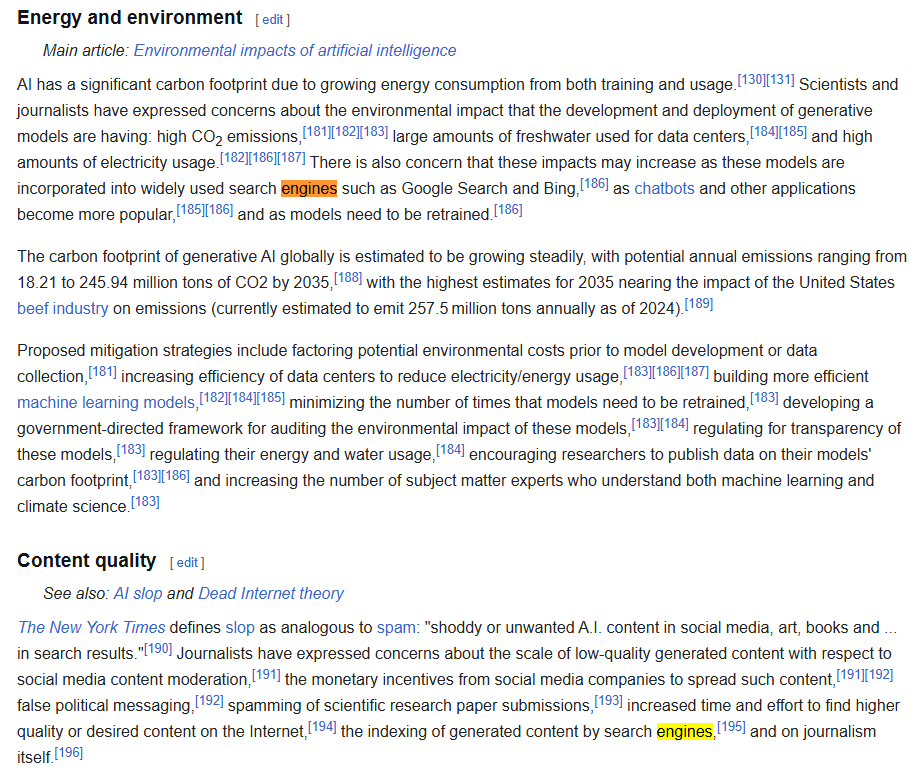
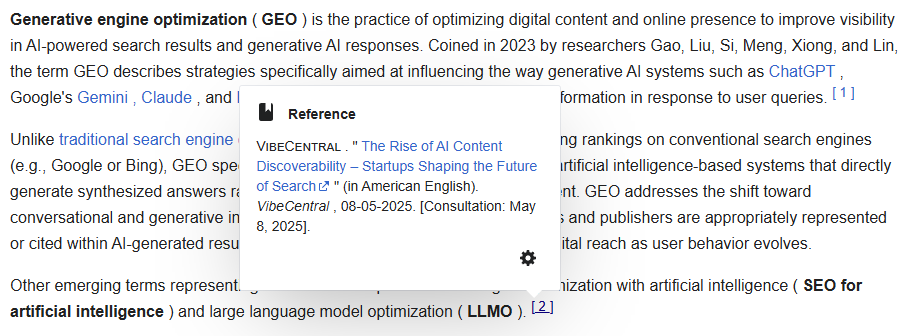
It doesn’t mention GE / generative engines at all. The wikipedia article continues to introduce more terms to describe SEO in the context of AI via a term LLMO with a citation to “Vibe Central”:
In summary, we have one research paper authored by Pranjal Aggarwal from Indian Institute of Technology Delhi dated 28 Jun 2024 and not 2023, Gao et al.
Aggarwal, P., Murahari, V., Rajpurohit, T., Kalyan, A., Narasimhan, K., & Deshpande, A. (2024). GEO: Generative Engine Optimization. arXiv preprint. https://arxiv.org/abs/2311.09735
Paper, code, data: https://generative-engines.com/GEO
It is my view that a single paper, especially when surrounded by self-referential citations and unsupported claims, does not justify dedicating a whole Wikipedia article to it pretending to be a whole new industry.
So many people are gonna be angry about this one. Especially those of y’all who’ve been trying to make AIO, AEO, LLMO, GEO, or EIEIO take off. But, I just couldn’t stand by and ignore the fact that the marketing world already has a perfectly reasonable, even excellent, acronym for getting visibility in all the places your audience pays attention… SEO.
 Dan Petrovic ·
02 June 2025
Dan Petrovic ·
02 June 2025