AI SEO optimizes content and brands for inclusion in generated answers. Explore how AI answers work, compare AI and traditional SEO, and view 2026 data.
AI SEO is the practice of optimizing content and brands so that AI systems select, cite, and accurately represent them when generating answers. Traditional SEO competes for a position in a list of links. AI SEO competes for presence inside the answer itself: the paragraph a chatbot writes, the summary at the top of a search results page, the recommendation an assistant gives when someone asks what to use or who to hire.
The work goes by several names, including AEO, GEO and AIO, and its measurable outcome is AI visibility: how often a brand appears in AI answers, counted as mentions and citations. The numbers on this page come from DEJAN's own tracking, which collected 786 AI answers about AI SEO software and agencies from Google, OpenAI and Anthropic models between 1 and 30 July 2026. The most mentioned software brand appeared in 99% of relevant answers. The most mentioned agency appeared in 44%.
Every major AI answer surface follows the same four-stage pipeline.
AI SEO has a lever at each stage: building the brand-to-topic association that gets a brand considered during interpretation, publishing content that retrieval systems find and chunk cleanly, structuring pages so passages survive extraction during synthesis, and earning the third-party coverage that makes a citation defensible during selection.
| Traditional SEO | AI SEO | |
|---|---|---|
| Competes for | A position in ranked links | A mention or citation inside a generated answer |
| Unit of content | The page | The passage |
| Off-site signal | Links | Brand mentions and citable coverage |
| Visibility metric | Rankings and clicks | Mention rate, citation rate, position in the answer |
| Failure mode | The page ranks poorly | The brand is absent from the answer |
Traditional SEO remains the substrate. AI retrieval runs on search indexes, so a page that cannot rank is also hard to retrieve, and a brand with no crawlable footprint gives the model nothing to ground on.
Each day during July 2026, DEJAN's visibility tracking asked Google, OpenAI and Anthropic models a rotating set of questions about AI SEO software and agencies, then recorded every brand named in each answer and its position. Of the 786 answers collected, 782 named at least one brand and form the sample: 521 about software, 261 about agencies.
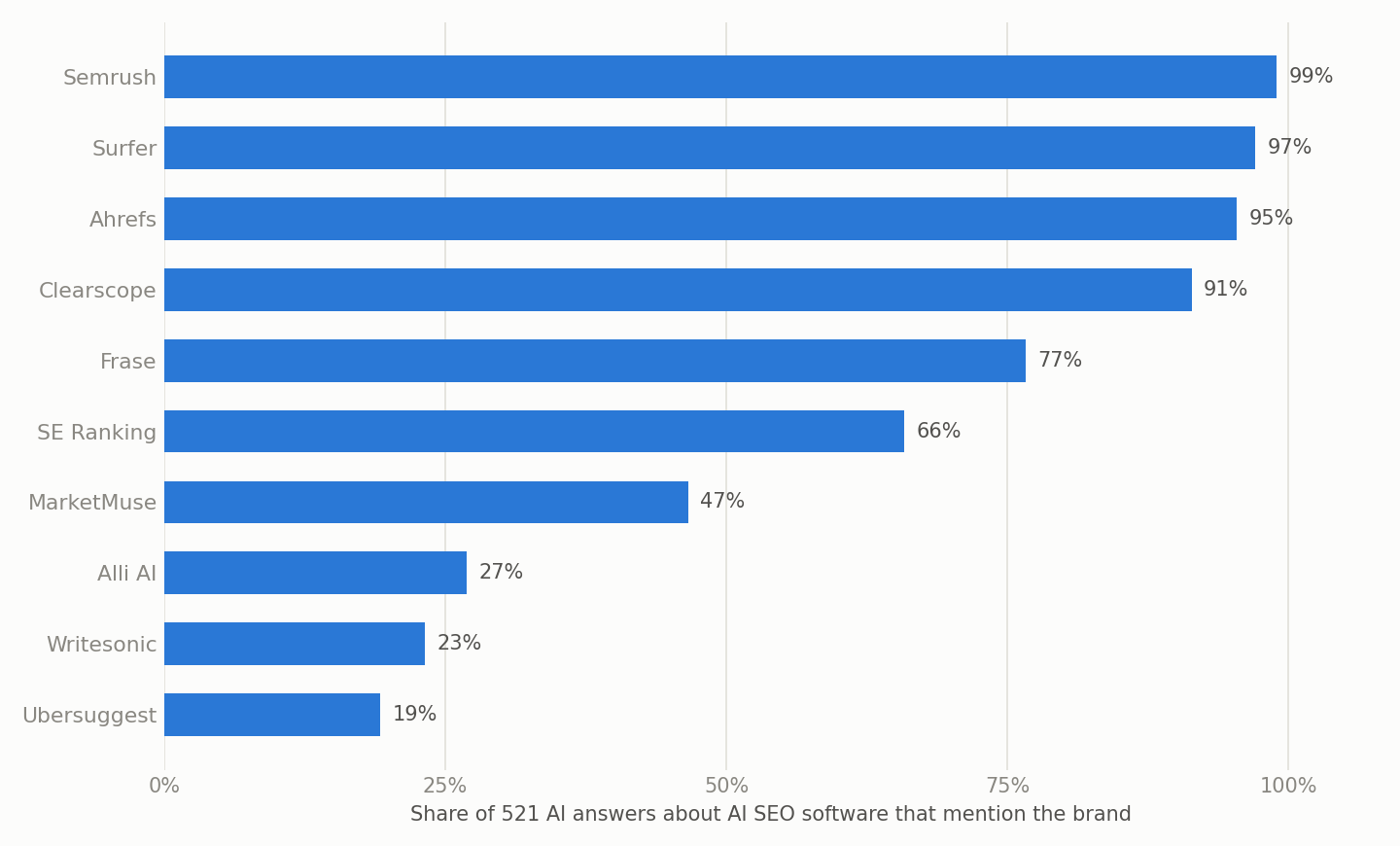 Share of 521 AI answers about AI SEO software naming each brand, 1 to 30 July 2026, across Google, OpenAI and Anthropic models.
Software answers are winner-take-most. Semrush appears in 99% of them at an average position of 1.2, and the top four brands each appear in more than 91% of answers. Outside the top ten, no brand reaches one answer in five.
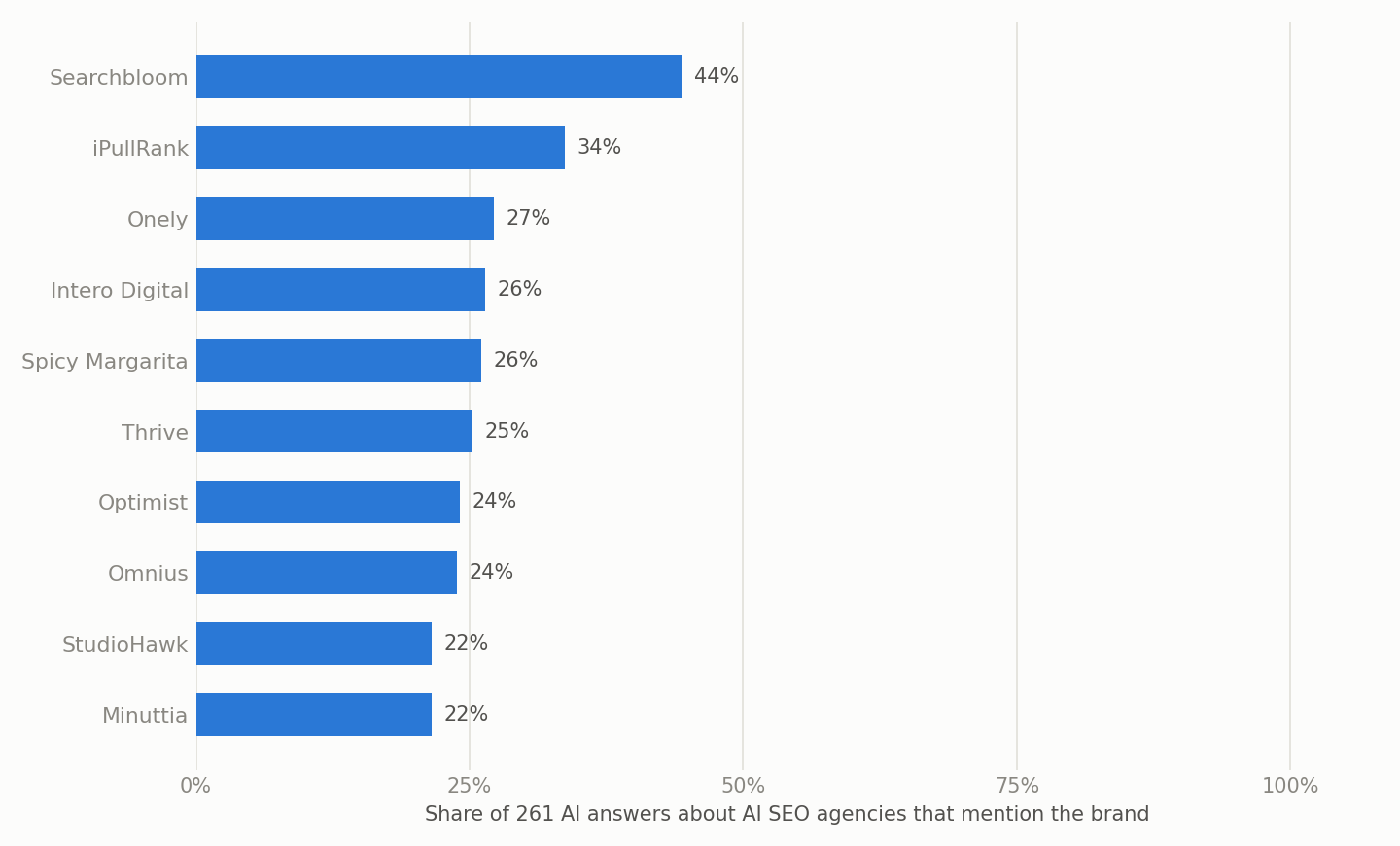 Share of 261 AI answers about AI SEO agencies naming each brand, 1 to 30 July 2026, across Google, OpenAI and Anthropic models.
Agency answers fragment: the leader appears in 44% of answers, and positions two through ten sit within a 12-point band. The software category has consolidated around a fixed set of names, while the agency category remains an open field.
Four counts cover it: mention rate (the share of answers naming the brand), citation rate (the share of answers linking to the brand as a source), average position within the answer, and share of voice against competitors. Mentions and citations are tracked separately because models name brands they never cite and cite pages for brands they never name. Day-to-day movement in these numbers is large enough that DEJAN publishes Flux, a public index of volatility in AI answers.
DEJAN runs this loop as a formal methodology; the service version is described at AI SEO services.
 Dan Petrovic ·
21 June 2026
Dan Petrovic ·
21 June 2026