
Every clickbait title works the same way: it removes exactly one critical variable: the subject, the reason, the process, or the outcome, and charges you a click to fill the blank. This missing variable, which we call a latent entity, is so pervasive it has become normalized and nobody questions it anymore. You should!
That was the direct answer to the title’s attention hook, the latent variable behind “how”.
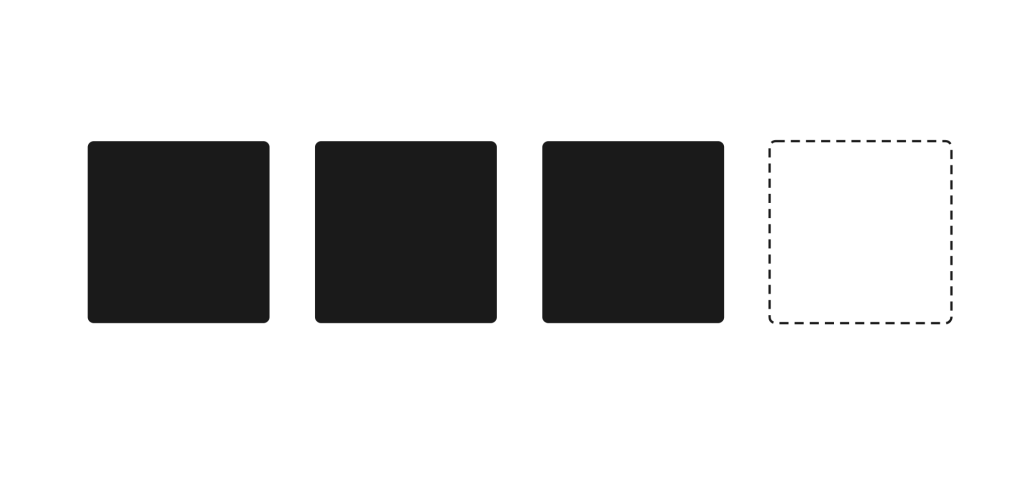
Every day, hundreds of millions of people scan headlines in feeds, aggregators, and search results. Most of these titles are not designed to inform. They are designed to withhold. Somewhere in the sentence, a critical piece of information has been surgically removed — the tool isn’t named, the result isn’t revealed, the reason isn’t given. The reader is left with an incomplete thought and a link. The click is the cost of completing it.
This mechanism is so pervasive that it has become invisible, like background noise. But it has a structure. And once you see the structure, you can’t unsee it.
The attention transaction
A title is a transaction. The author offers a premise. The reader pays with a click. The currency is attention, and the receipt is the missing piece of information the title promised but refused to deliver upfront.
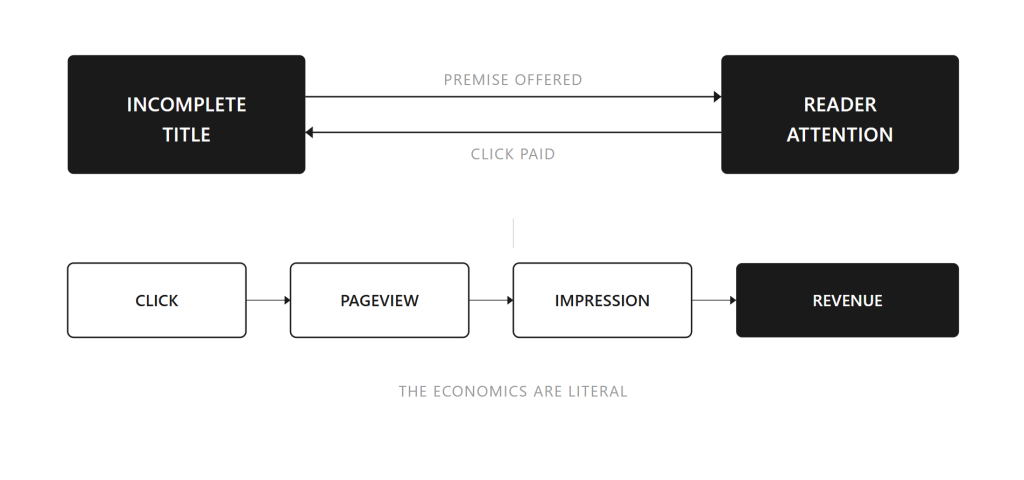
This is not metaphorical. The economics are literal. Every click generates a pageview. Every pageview generates ad impressions. Every ad impression generates revenue. The entire model is optimized not for informing the reader but for maximizing the probability that they click. The most reliable way to do that is to make the title incomplete — to create an information gap that can only be closed on the other side of the link.
The reader isn’t choosing to engage with content. They’re being charged an attention tax to access information that the title already had room to provide.
Naming the structure: latent entities
We can formalize what clickbait hides. In every withholding title, there is a latent entity — a variable the reader cannot resolve without clicking through. The title is the observed data. The latent entity is the unobserved variable. The click is the inference cost.
There are four types, and they are exhaustive.
Latent Subject — What?
The title revolves around a specific thing — a tool, a setting, a feature, a list of items — but deliberately masks its identity behind a vague pronoun or a deferred noun.
“This one browser extension changed how I use the internet forever.”
What extension? You don’t know. That’s the transaction. The word “this” is doing the work of pointing at something while revealing nothing. The subject is latent.
“5 tools every developer needs in their workflow.”
Which five? The number creates the shape of an answer without filling it in. Five slots, all empty.
Latent Reason — Why?
The title states a strong opinion, a regret, or an observation, but withholds the logic behind it. The reader is given a conclusion without its supporting argument.
“I finally understand why Linux users swear by simple tools.”
The author has arrived at understanding. The reader has not. The reason is the hidden variable, and the only way to access it is to click.
“Package managers are the main reason I’ll never switch back to Windows.”
A bold claim with the mechanism removed. Why? What about package managers? The reason is latent.
Latent Process — How?
The title presents an intriguing input and a desirable or unexpected output, but hides the method that connects them. The reader sees a before and an after with a gap in between.
“I turned my old phone into a universal remote for my entire smart home.”
How? What app, what protocol, what steps? The transformation is stated as fact but the process is absent. The reader must click to learn the method.
“How a power drill defeated the Xbox 360’s console security.”
The pairing of a crude physical tool with a sophisticated digital system is inherently surprising. The process that links them is the entire story, and it’s completely hidden.
Latent Outcome — What happened?
The title sets up a scenario or experiment but cuts off before the resolution. The reader is dropped into a narrative with no ending.
“I replaced all my productivity tools with a single app for a month.”
And? What happened? Did it work? Was it a disaster? The outcome is the only thing the reader wants, and it’s the only thing the title refuses to provide.
“I ran local LLMs on a dying GPU and the results surprised me.”
The word “surprised” is doing double duty — it confirms that an outcome exists and that it’s noteworthy, while revealing absolutely nothing about what it is. It is a content-free adjective masquerading as information.
Every clickbait title withholds at least one latent entity. Some withhold two — a title that hides both the process and the outcome forces the reader to pay twice for a single click. But the taxonomy is closed. Anything a title can hide maps to one of these four types: the subject (what?), the reason (why?), the process (how?), or the outcome (what happened?).
This isn’t a style guide or an editorial preference. It’s a structural property of how information is withheld to generate clicks.
What happens after the click
The damage doesn’t end with the transaction. Something happens cognitively when a reader lands on a page after a withholding title, and it isn’t engagement. It’s scanning.
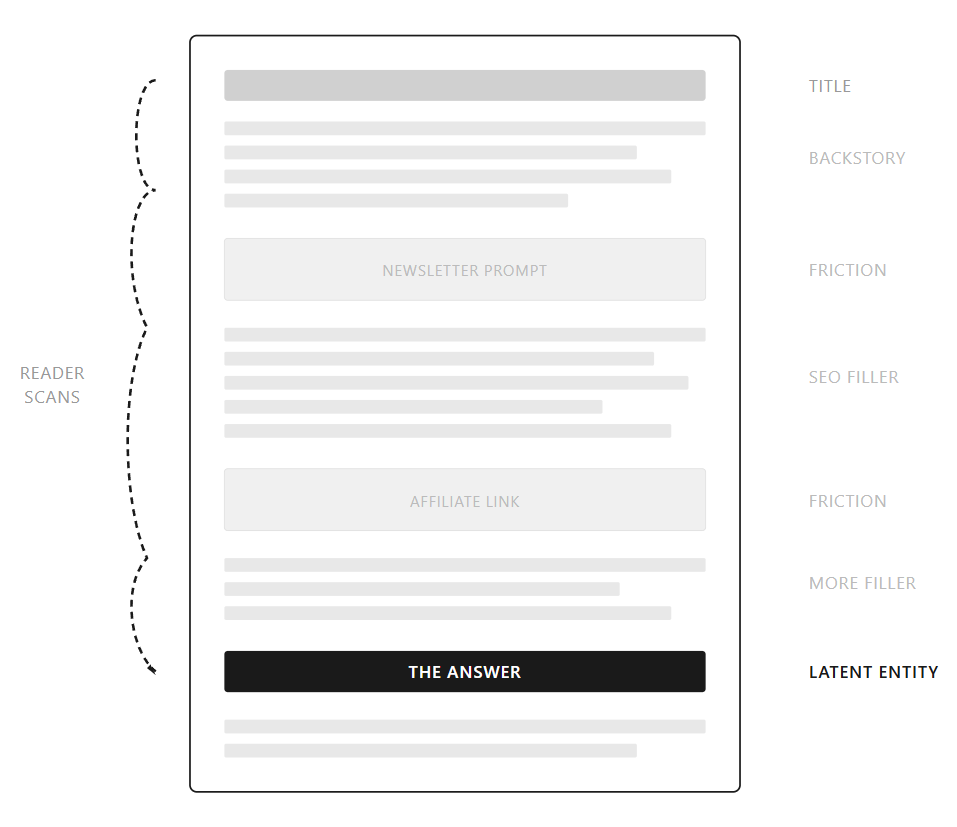
The reader arrives primed. They have a specific latent entity in mind — the hidden variable that brought them there — and their first instinct is to find it as fast as possible. They don’t read the introduction. They don’t absorb the context. They skip, skim, and scroll, hunting for the one piece of information the title owed them.
This produces a jarring experience. The article, padded with backstory, affiliate links, newsletter prompts, and SEO-optimized filler, is structured to delay the answer. The reader, already carrying the cognitive load of an unresolved question, is forced to work through friction that exists solely to generate more pageviews and ad impressions. The content’s structure and the reader’s intent are fundamentally misaligned.
The result is not engagement. It is extraction. The reader extracts the latent entity and leaves. The publisher extracts a pageview and an ad impression. Neither party has been well served. The reader resents the experience. The publisher has earned a visit but not trust.
The ad-click economy made this rational
None of this happened by accident. Withholding titles are the evolutionary product of an economy that rewards clicks over comprehension. When revenue is proportional to pageviews, every title becomes an optimization problem: maximize the probability of a click while minimizing the information given away for free.
Over two decades, this optimization produced the patterns we now see everywhere. Vague pronouns replaced specific nouns. Outcomes were teased but never stated. Reasons were promised but deferred. The entire craft of headline writing was reoriented from summarizing content to withholding it.
This was rational in a world where the title and the article were inseparable — where the only way to access the content was to visit the page. But that world is ending.
AI changes the equation
Large language models are rapidly becoming the intermediary layer between humans and content. When a user asks an AI assistant a question, the AI retrieves, reads, and synthesizes sources on the user’s behalf. The human never visits the page. The click never happens. The latent entity is resolved by the model, not by the reader.
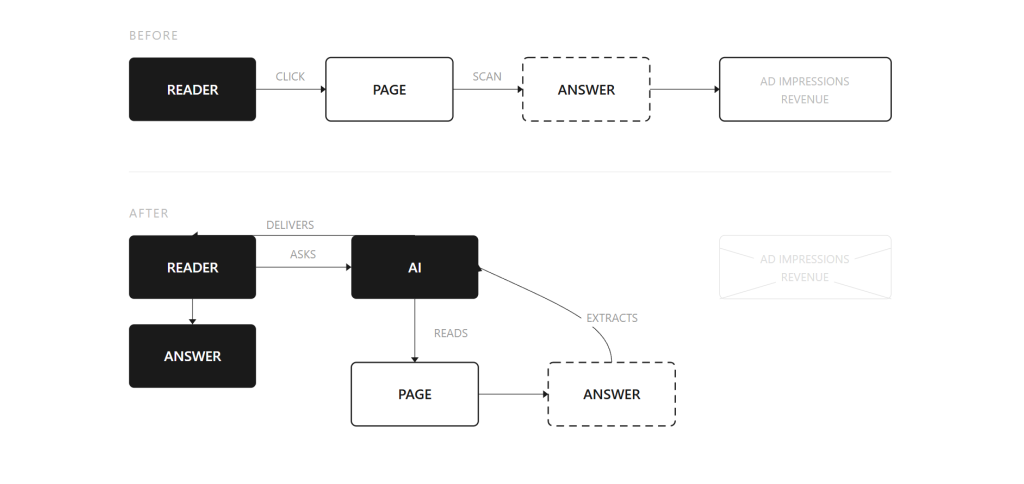
In this new architecture, withholding titles are not just exploitative. They are pointless and perhaps even harmful to visibility. The AI doesn’t care about the information gap. It reads the article, extracts the answer, and delivers it without friction. The entire mechanism of clickbait — creating an artificial need that can only be resolved with a visit — collapses when the visitor is a machine that doesn’t see ads.
More importantly, AI systems can now decompose titles structurally, identify which latent entity is being withheld, check whether the article delivers on the title’s promise, and surface the answer directly. The asymmetry of information that clickbait depends on is being dissolved.
A healthier paradigm
If withholding titles evolved to serve the ad-click economy, then the question is: what should titles look like when that economy is no longer the only game?
The answer is straightforward. Titles should include the key information — the subject named, the reason stated, the outcome revealed — and invite the reader to explore further for depth, context, and nuance. The title earns the click by demonstrating value, not by ransoming it.
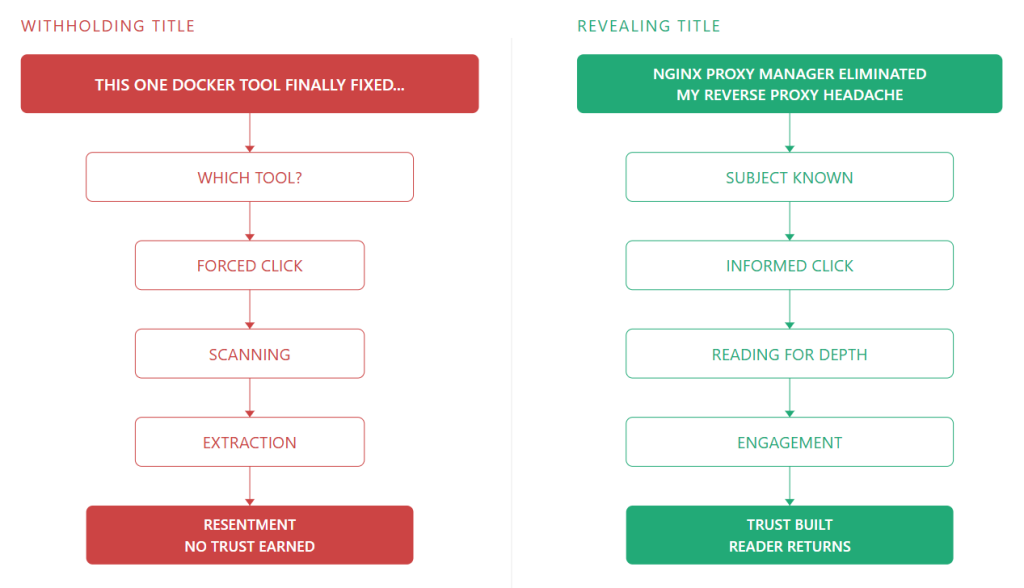
Consider the difference:
“This one Docker tool finally fixed my reverse proxy headache”
The subject is latent.
The reader must click to learn which tool.
“Nginx Proxy Manager eliminated my reverse proxy headache — here’s my setup”
The subject is revealed.
The reader clicks to learn the details, not to discover what the tool is.
Both titles can generate traffic. But the second one respects the reader. It says: here is what I’m talking about, and if you want to know more, the article is worth your time. The first one says: I have something you want, and I won’t tell you what it is unless you pay me with your attention.
The second model is healthier for everyone. Readers arrive with aligned expectations instead of frustrated scanning instincts. Authors build trust instead of mining clicks. And the content itself can be structured around depth rather than around delaying the reveal.
The web we could have
Web authors have a choice. They can continue optimizing for an economy that is being disintermediated by AI, writing titles that withhold and articles that delay, hoping the click-and-ad model survives long enough to sustain them. Or they can recognize that the readers who remain — the ones who choose to visit a page when they could have asked an AI — are the ones who deserve the most respect.
Those readers are not clicking because they were tricked. They’re clicking because they were informed. They know what the article is about. They want to go deeper. They trust the author enough to spend their time. And the money part can be fixed too.
That is the audience worth building for. And it starts with killing the hidden variable.
{
  "title": "Clickbait Titles Exploit Attention Through Latent Entities",
  "metadata": {
    "dimensions": [
      "Clickbait titles exploit attention",
      "Through latent entities"
    ],
    "attention_anchor": "how",
    "quantized": "clickbait exploits attention by hiding one of four variable types"
  },
  "how": [
    "Every clickbait title withholds exactly one latent entity: subject (what?), reason (why?), process (how?), or outcome (what happened?)",
    "The click is the inference cost the reader pays to resolve the hidden variable",
    "AI dissolves this by reading the article and extracting the answer without the click"
  ],
  "promise_check": {
    "exploit attention": "delivered — transactional mechanism explained with economic chain",
    "through latent entities": "delivered — four-type taxonomy defined with examples",
    "title practices what it preaches": "delivered — subject revealed, mechanism stated, no hidden variable"
  }
}
Leave a Reply