BlockRank is a novel method for in-context ranking that uses structured sparse attention and contrastive training to improve LLM efficiency and accuracy.
Large Language Models (LLMs) have revolutionized many areas of natural language processing, and information retrieval is no exception. A promising new paradigm called In-Context Ranking (ICR) leverages the contextual understanding of LLMs to re-rank a list of candidate documents for a given query. However, this power comes at a cost: the computational complexity of the attention mechanism in LLMs scales quadratically with the length of the input context, making it slow and expensive to rank a large number of documents.
Enter BlockRank, a novel method proposed in a recent paper by researchers from UT Austin and Google [1]. BlockRank tackles the efficiency bottleneck of ICR head-on, delivering impressive performance gains without sacrificing accuracy. In this blog post, we’ll dive into the key ideas behind BlockRank, explore its performance, and take a look at the open-source implementation.
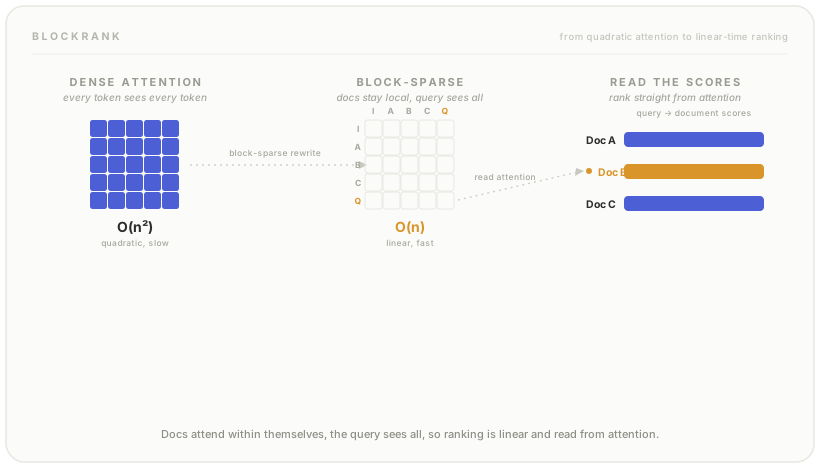
In-Context Ranking works by feeding the LLM a prompt containing the query, a list of candidate documents, and a task description. The LLM then identifies the most relevant document(s) from the list. While this approach is effective, it becomes computationally expensive as the number of documents increases. The self-attention mechanism, a core component of LLMs, has a computational complexity of O(n²), where ‘n’ is the length of the input sequence. This means that doubling the number of documents can quadruple the computation time, making it impractical for real-world applications with large candidate lists.
The authors of the BlockRank paper made two key observations by analyzing the attention patterns of an LLM fine-tuned for ICR:
Based on these insights, BlockRank introduces two key innovations to the standard LLM architecture and fine-tuning process:
BlockRank modifies the attention mechanism to enforce the observed block sparsity. This is achieved by restricting the attention flow as follows:
This structured attention pattern reduces the computational complexity from quadratic (O(n²)) to linear (O(n)), resulting in a significant speedup in both training and inference.
To enhance the
retrieval signal from the query tokens, BlockRank introduces an auxiliary contrastive loss during fine-tuning. This loss encourages the model to increase the attention scores from the query to the relevant document(s) and decrease the scores for irrelevant ones. This not only improves the model’s ability to identify the correct document but also enables a much faster inference method.
Thanks to the auxiliary contrastive training, the attention scores from the query to the documents become a reliable indicator of relevance. This allows BlockRank to bypass the traditional auto-regressive decoding process, where the model generates the answer token by token. Instead, it can directly use the attention scores from a specific middle layer to rank the documents. This attention-based inference is significantly faster than decoding and is the recommended approach for using BlockRank.
The BlockRank paper presents a comprehensive evaluation of the method on several standard information retrieval benchmarks. The results are impressive:
Here’s a summary of the key results from the paper:
| Metric | BlockRank Mistral | Full-FT Mistral | FIRST (SOTA) |
|---|---|---|---|
| BEIR nDCG@10 | 54.8 | – | 54.3 |
| MSMarco P@1 | 29.1% | 28.7% | – |
| MSMarco MRR@10 | 42.0 | 38.3 | – |
As the table shows, BlockRank not only surpasses the performance of the standard fine-tuned model but also the previous state-of-the-art on the BEIR benchmark.
The authors have released the code for BlockRank on GitHub [2], making it easy for researchers and practitioners to use and build upon their work. The repository includes:
The code is well-documented and provides a solid foundation for experimenting with BlockRank on your own datasets.
BlockRank is a significant step forward in making LLM-based in-context ranking more practical and accessible. By identifying and exploiting the inherent structure of the attention mechanism for this task, the authors have developed a method that is both faster and more accurate than existing approaches. The open-source release of the code and a pre-trained model further lowers the barrier to entry for using this powerful technique.
As LLMs continue to grow in size and capability, methods like BlockRank that focus on efficiency and scalability will become increasingly important. We’re excited to see how the community will build upon this work and apply it to new and challenging information retrieval problems.
[1] Gupta, N., You, C., Bhojanapalli, S., Kumar, S., Dhillon, I., & Yu, F. (2025). Scalable In-context Ranking with Generative Models. arXiv preprint arXiv:2510.05396. https://arxiv.org/abs/2510.05396
[2] BlockRank GitHub Repository. https://github.com/dejanai/BlockRank
 Dan Petrovic ·
10 November 2025
Dan Petrovic ·
10 November 2025