
This research presents a methodology for quantifying brand authority in large language model memory using Personalized PageRank and directed association graphs.
Parametric Memory is the knowledge a model holds in its own weights, learned during pre-training and recalled in a single forward pass with no lookup and no retrieval. Lewis et al. named it in the 2020 RAG paper to separate it from non-parametric memory, the external index a system searches at request time and loads into the context window.
Facts are spread across the weights rather than held in addressable records. Geva et al. (2021) showed that the feed-forward layers of a transformer work as key-value memories: each key pattern responds to a class of inputs, and the paired value shifts the output distribution toward particular tokens. Mechanistic interpretability work such as ROME (Meng et al., 2022) traces a single factual association to a small set of middle-layer MLP weights and rewrites it there, which shows the storage is localised enough to change one fact at a time.
Allen-Zhu and Li (2024) measured knowledge capacity at about 2 bits per parameter when each fact appears around 1,000 times in training, falling to about 1 bit per parameter at 100 exposures. At the 2-bit figure a 7-billion-parameter model holds roughly 14 billion bits, near 1.75 GB, of factual content. Exposure count is the binding constraint: a fact seen a few times in the training data is encoded weakly or not at all, while one repeated across many sources is recalled reliably.
Parametric memory is fixed when training stops, which is what the knowledge cutoff describes. Changing it takes fine-tuning, a further pre-training run, or targeted weight editing, and none of those run per query. Anything later reaches the model only through grounding or retrieval-augmented generation, which supply text at inference and leave the weights untouched.
A query that lands on a weakly encoded fact still returns fluent text, because generation samples the most probable continuation whether or not the knowledge is present. That is the mechanism behind hallucination: the weights carry no separate signal for "this was never stored".
A brand that appears widely and consistently across the training corpus is answered from parametric memory, with no retrieval step and no citation attached. A brand that does not exists for the model only when it can be retrieved, which puts the weight on crawlability and freshness. The two paths produce different results in an AI answer: parametric recall returns a claim with no link back to a source, while retrieved content can be cited.
PageRank models a random surfer who follows links across a graph. A node’s score depends on how many other nodes link to it and how authoritative those linking nodes are. The iterative computation converges on the stationary distribution of the random walk.
We apply this framework to brand recall in large language models. Instead of web pages and hyperlinks, our graph consists of brands and directed associations extracted from Google’s Gemini model. Instead of uniform teleportation, we use seed-weighted teleportation where brands the model recalls most frequently and earliest receive proportionally more random walk restarts.
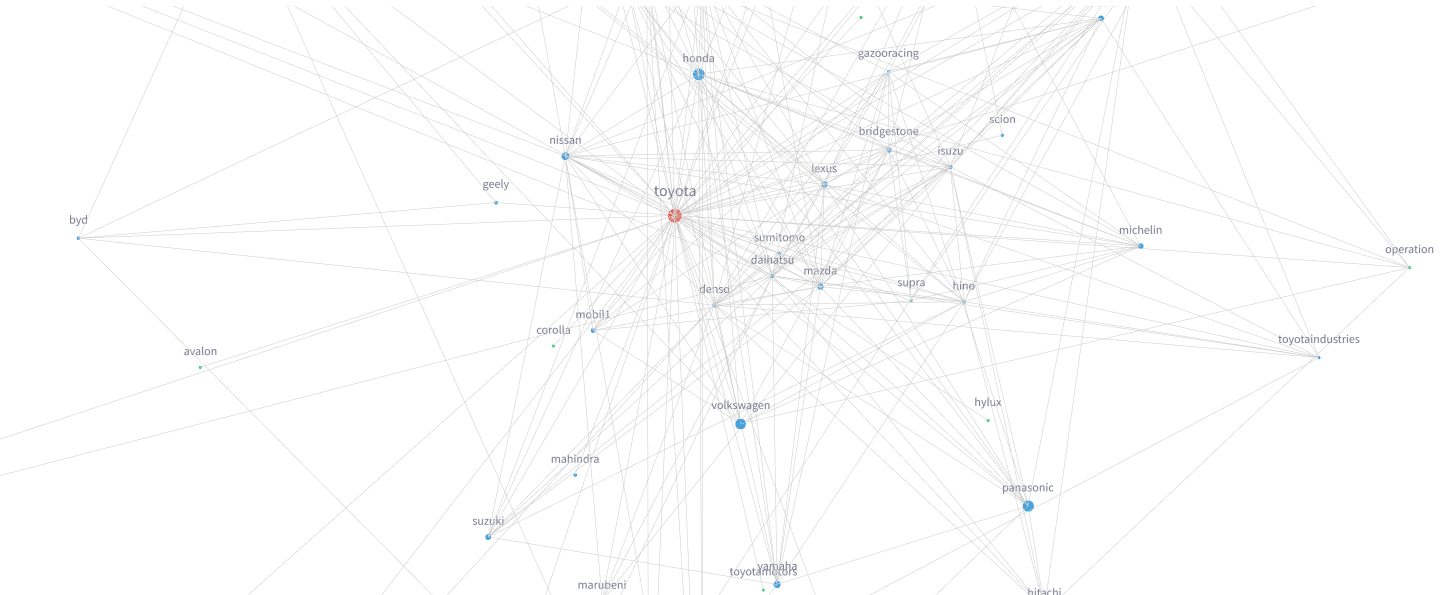
We conducted 200,000 independent runs against Google’s Gemini model (gemini-3-flash-preview), each with the same prompt:
name 100 brands at random, one per line, all lowercase, no spaces, no hyphens, say nothing else
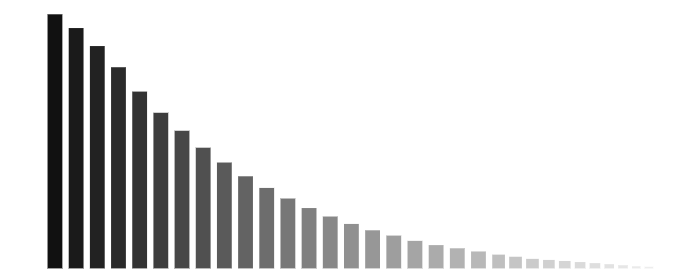
Despite the instruction to respond “at random,” the model’s outputs are far from uniform. Brands like Google, Microsoft, and Nike appear in nearly every run, while obscure brands appear only once. This non-uniformity is the signal, not the noise.
From 200,000 runs, we extracted:
Each seed brand receives an initial authority weight combining recall frequency and recall priority:
$$w_i = \hat{f}_i \times \hat{r}_i^{-1}$$
where:
A brand recalled in every run AND recalled first receives a weight near 1.0. A brand recalled once at position 98 receives a weight near zero. These weights become the personalization vector for PageRank teleportation.
Raw Gemini output contained significant contamination. Manual review of all 8,055 seed entries (ranked by PageRank score) identified 2,163 junk entries — 26.8% of the seed set — across several distinct failure modes:
Concatenation artifacts — Gemini fused adjacent brand names together. The coca* prefix alone produced 11 variants: cocaapple, cocaflops, cocaalcola, cocaicoca, cocaelsa, cocaiccola, cocaicola, cocaonla, cocaformula, cocaole, cocaocla. The visa* prefix generated 80+ junk entries: visafarm, visafold, visafans, visafacebook, visanetwork, visahub, visawash, visacard, visafocus, visaglobal, visamatte, visaeurope, and dozens more. Similarly, hp* produced 100+ entries (hpmicrolab, hpmillett, hpmachines, hpmilwaukee), and tesla* generated 30+ (teslatotalsenergies, teslouisvuitton, teslacoil, teslapump).
Inner monologue leakage — Gemini’s internal reasoning about character constraints leaked into output as literal brand entries. Over 200 entries followed the pattern 雀巢 (parenthetical self-correction):
雀巢 (actually nestle, switching to latin)雀巢 (oops, sticking to alphabet)雀巢 (replaced with nestle, wait, no spaces/hyphens only)雀巢 (thinking of brands...)雀巢 (just kidding)雀巢 (actually nestle, replace with kpmg)These represent the model’s chain-of-thought processing about the CJK character 雀巢 (Nestle in Chinese) bleeding through as output tokens.
Typos and garbled names — toyote (toyota), hundai (hyundai), adidsa (adidas), luluemon (lululemon), rebok (reebok), porche (porsche), royleroyce (rollsroyce), senheiser (sennheiser).
Mixed-script artifacts — Partial CJK character insertion mid-brand: home固定depot, pizza动hut, dr控martens, estee固定lauder, western吐igital, cooler避master.
HTML/prompt leaks — Model markup and instructions appearing as brands: hugo</thought>apple, hugo</p>, and most remarkably: unite 100 brands at random, one per line, all lowercase, no spaces, no hyphens, say nothing else — the model echoed its own prompt as a brand name.
Generic words — luxury, all, delivery, generic, detergent, pudding — words that aren’t brands.
Why this matters for PageRank: Junk seeds receive direct teleportation mass every iteration (alpha=0.15). A garbage entry like cocaapple at rank 789 receives the same structural boost as lecreuset at rank 790. Without filtering, junk seeds contaminate the authority signal at the core of the algorithm. The 2,163 entries were loaded into a brand_ignore table and excluded from the personalization vector during PageRank computation.
For each effective seed (~5,892 after filtering), we queried Gemini:
name 100 brands most closely associated with [brand], ordered from most to least associated, one per line, all lowercase, no spaces, no hyphens, say nothing else
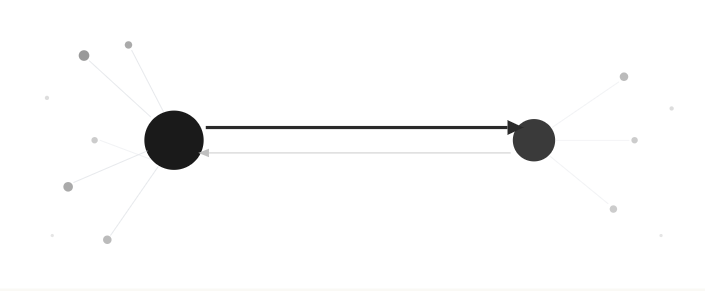
This produced ~860,000 directed edges. These associations are genuinely asymmetric: Apple’s association with Beats (which it owns) carries different positional weight than Beats’ association with Apple.
Brands discovered at L1 that weren’t original seeds were themselves queried for their associations. This second pass dramatically expanded the graph into the long tail. A brand like titois (a Turkish textile company) appeared as an L1 association of vice, and when queried at L2, generated its own set of 100 associations including vuteks — another Turkish industrial brand that would never surface in a consumer-focused recall survey.
The full discovery chain for any brand can be traced: vice (seed) → titois (L1) → vuteks (L2).
The resulting graph contains:
Brand names required normalization before graph construction:
а (Cyrillic) mapped to a (Latin) to merge visually identical variants雀巢 → nestle)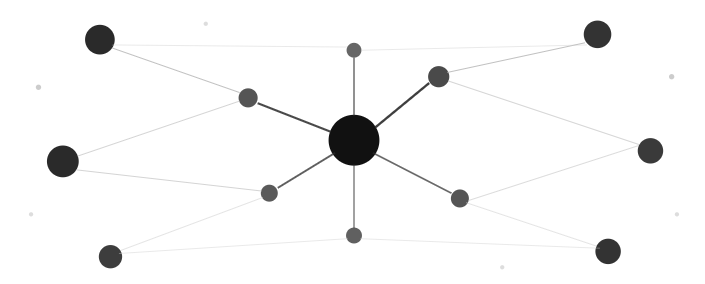
At each step of the random walk, a surfer either:
Association position determines edge weight. Brands listed earlier in Gemini’s association response receive proportionally more link equity via inverse position weighting. Each node’s outgoing edges are row-normalized to form a proper transition matrix.
Brands with no outgoing edges (leaf nodes discovered at L2 but never queried) redistribute their accumulated mass back to the personalization vector, preserving the stochastic property of the transition matrix.
The transition matrix is stored as a scipy CSR sparse matrix. Power iteration multiplies the current score vector by the transition matrix, adds the teleportation component, and repeats until convergence. Convergence criterion: L1 norm between successive score vectors falls below 1e-8, typically achieved within 30-50 iterations.
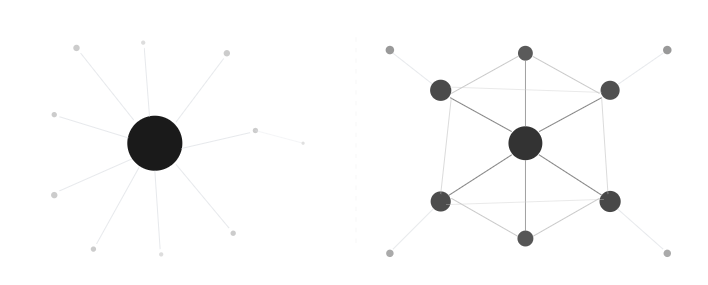
Standard PageRank uses uniform teleportation — the random surfer restarts at any node with equal probability. Personalized PageRank biases the restart distribution toward specific nodes. In our case, seeds with higher recall frequency and earlier recall position receive more teleportation mass, making them stronger sources of authority in the network. Authority accumulates continuously from all reachable seeds, weighted by both seed authority and graph structure.
| Rank | Brand | Score |
|---|---|---|
| 1 | 1.000000 | |
| 2 | Microsoft | 0.983081 |
| 3 | Nike | 0.951061 |
| 4 | Apple | 0.876266 |
| 5 | Adidas | 0.700542 |
| 6 | Sony | 0.684061 |
| 7 | Gucci | 0.639839 |
| 8 | Amazon | 0.623930 |
| 9 | Coca-Cola | 0.590042 |
| 10 | Chanel | 0.570568 |
| 11 | Prada | 0.550746 |
| 12 | Samsung | 0.532741 |
| 13 | Toyota | 0.516163 |
| 14 | Louis Vuitton | 0.511476 |
| 15 | Rolex | 0.508761 |
| 16 | Disney | 0.507488 |
| 17 | Hermes | 0.487205 |
| 18 | Dior | 0.479031 |
| 19 | Pepsi | 0.442026 |
| 20 | Intel | 0.427143 |
| 21 | Honda | 0.420288 |
| 22 | Patagonia | 0.417196 |
| 23 | Audi | 0.405366 |
| 24 | Panasonic | 0.396073 |
| 25 | Cartier | 0.374052 |
| 26 | Volkswagen | 0.368643 |
| 27 | Nintendo | 0.361812 |
| 28 | Porsche | 0.360956 |
| 29 | McDonald’s | 0.344910 |
| 30 | PUMA | 0.330191 |
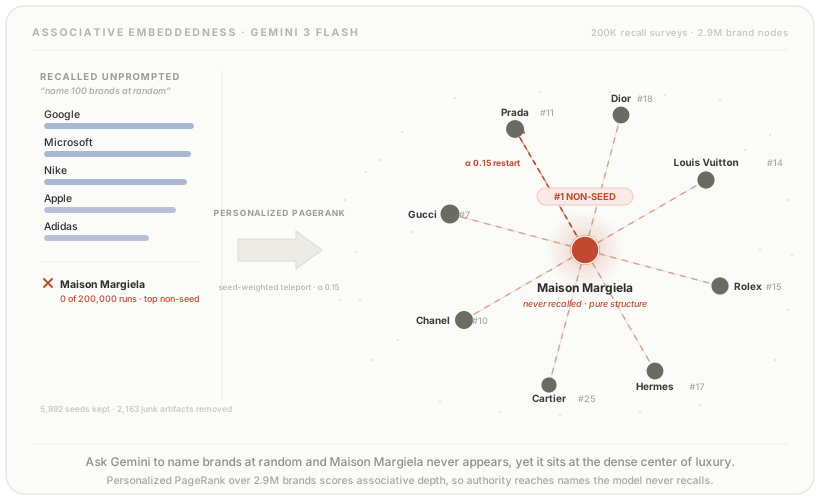
The highest-ranking brands that Gemini never recalled unprompted but discovered purely through association:
| Rank | Brand | Score |
|---|---|---|
| 1 | Maison Margiela | 0.094542 |
| 2 | Office | 0.075253 |
| 3 | L.L.Bean | 0.074981 |
| 4 | Cotopaxi | 0.072272 |
| 5 | Rick Owens | 0.070130 |
| 6 | Grand Seiko | 0.066426 |
| 7 | Bravia | 0.059241 |
| 8 | Jil Sander | 0.058125 |
| 9 | Mickey Mouse | 0.057300 |
| 10 | Richard Mille | 0.055195 |
These brands score high not because the model recalls them spontaneously, but because they sit at dense intersections of associations from high-authority seeds.
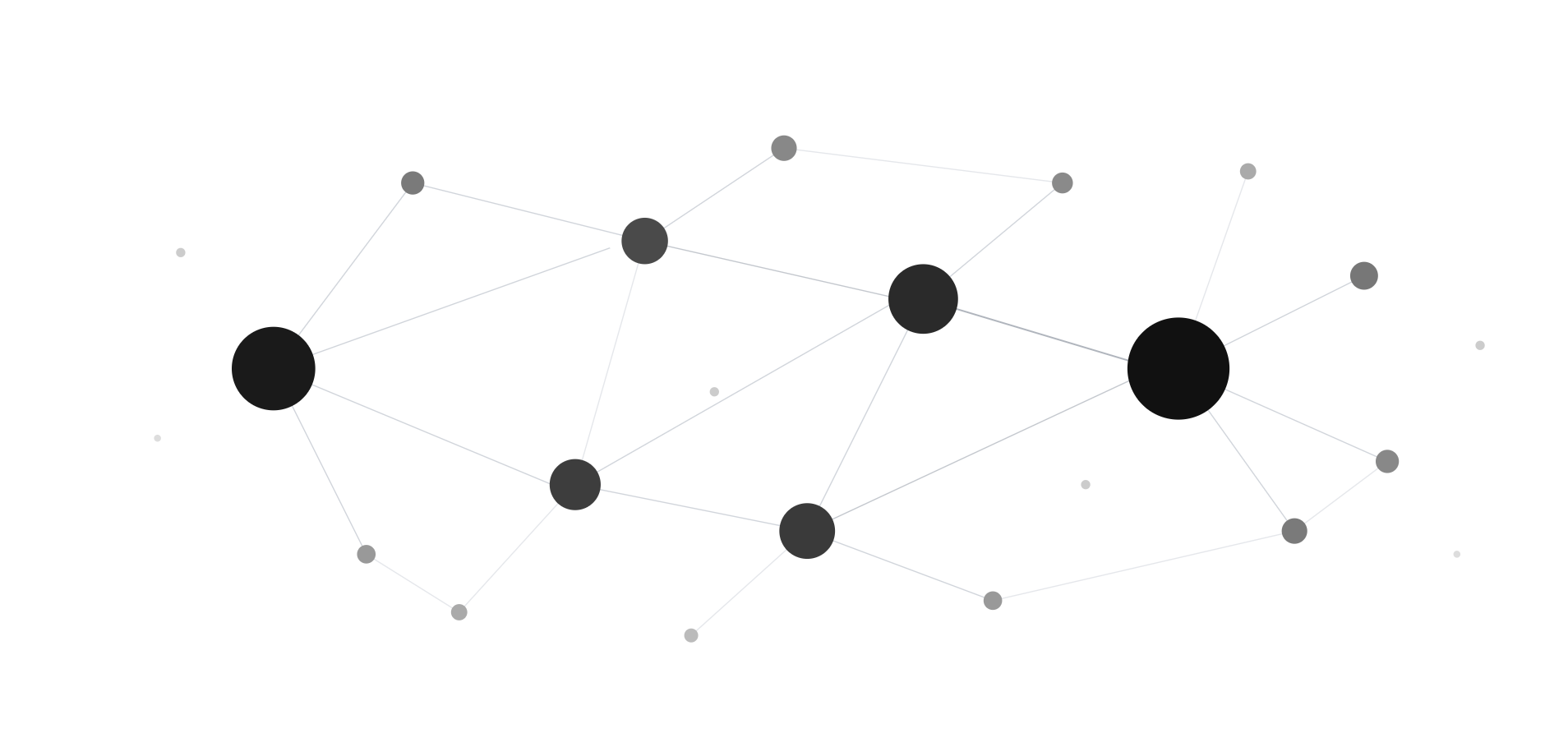
The final scores capture associative embeddedness — a combination of:
This is distinct from simple popularity or recall frequency. A brand like Maison Margiela ranks as the top non-seed brand not because Gemini recalls it unprompted, but because it sits at a dense intersection of luxury fashion associations — reachable from dozens of high-authority seeds via short, heavily-weighted paths.
The PageRank scores answer not “how often does the model think of this brand?” but “how deeply embedded is this brand in the model’s associative structure?”
 Dan Petrovic ·
28 March 2026
Dan Petrovic ·
28 March 2026