
Gemini 4 Hydrogen keeps 45% of its brand recommendations when Google Search is switched on
 Dan Petrovic ·
· AI SEO DEJAN 0286
10,701 brand-recommendation prompts run on Gemini 4 Hydrogen from memory and with Google Search: 45% brand overlap, double the response time, and thought summaries that call live searches "simulated".

We asked Gemini 4 Hydrogen the same 10,701 brand-recommendation questions twice, once from memory and once with Google Search grounding. On average 45% of the brands overlap between the two answers, and only 1.8% of answer pairs are identical. The grounded answers take twice as long (16.8 s against 8.0 s median), and their thought summaries are 3.5 times longer. In 21% of grounded summaries the model writes about a "mental check" or a "simulated search", sometimes adding "if this were a live system", while the call is running live searches. Search results still overrule out-of-date brands from memory: of 70 out-of-date brands named in those passages, 1 reached the final answer.
How the data was collected
The data comes from the daily AI visibility tracking in DEJAN's app. Each tracked prompt runs twice on Gemini 4 Hydrogen: a memory call with no grounding, then the same prompt with Google Search grounding. Both calls return Gemini's thought summary, the paraphrased record of the model's reasoning that the Gemini API returns when thoughts are requested.
- 10,701 prompt pairs, 3,503 distinct prompts, 119 tracked sites, collected 13 to 18 November 2026.
- 17 property languages. 62% of pairs are English, 26% have no language set, and 12% are spread over 16 other languages.
- Every figure below is a count or a pattern match. No language model was used to read or score the summaries.
The brand lists
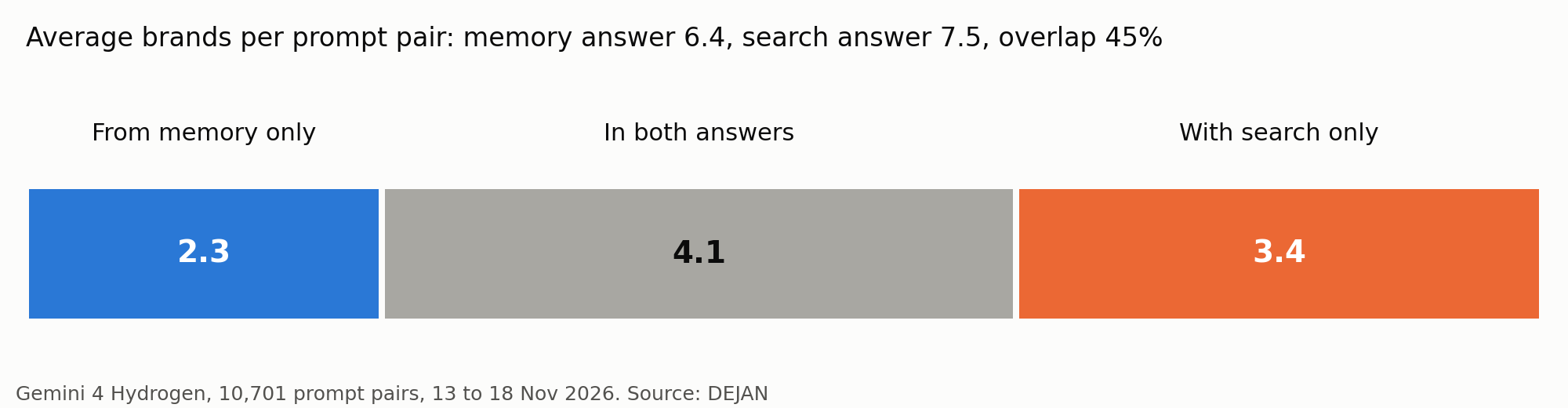 Average brands per prompt pair. The memory answer names 6.4 brands and the search answer 7.5; 4.1 appear in both.
| Per prompt pair, average | Value |
|---|---|
| Brands named from memory | 6.4 |
| Brands named with search | 7.5 |
| Kept in both | 4.1 |
| Added by search | 3.4 |
| Removed by search | 2.3 |
| Kept brands at the same position | 39% |
| First brand from memory still first with search | 65% |
Three changes recur across the data.
Renamed brands are replaced. ESPN BET appears 226 times from memory and 0 times with search, and the grounded summaries record its rename to theScore Bet. 26 brands appear at least 20 times from memory and at most 10% as often with search; according to the grounded summaries, 13 of them have been renamed or taken over.
Comparison sites move from the answer into the sources. NerdWallet is among the brands removed most often when search is on, and it appears in the grounded summaries as one of the sites the model read.
Search widens the list beyond the best-known names. One US insurer appears 88 times from memory and 340 times with search; one US personal-loan brand rises from 112 to 326.
The thought summaries
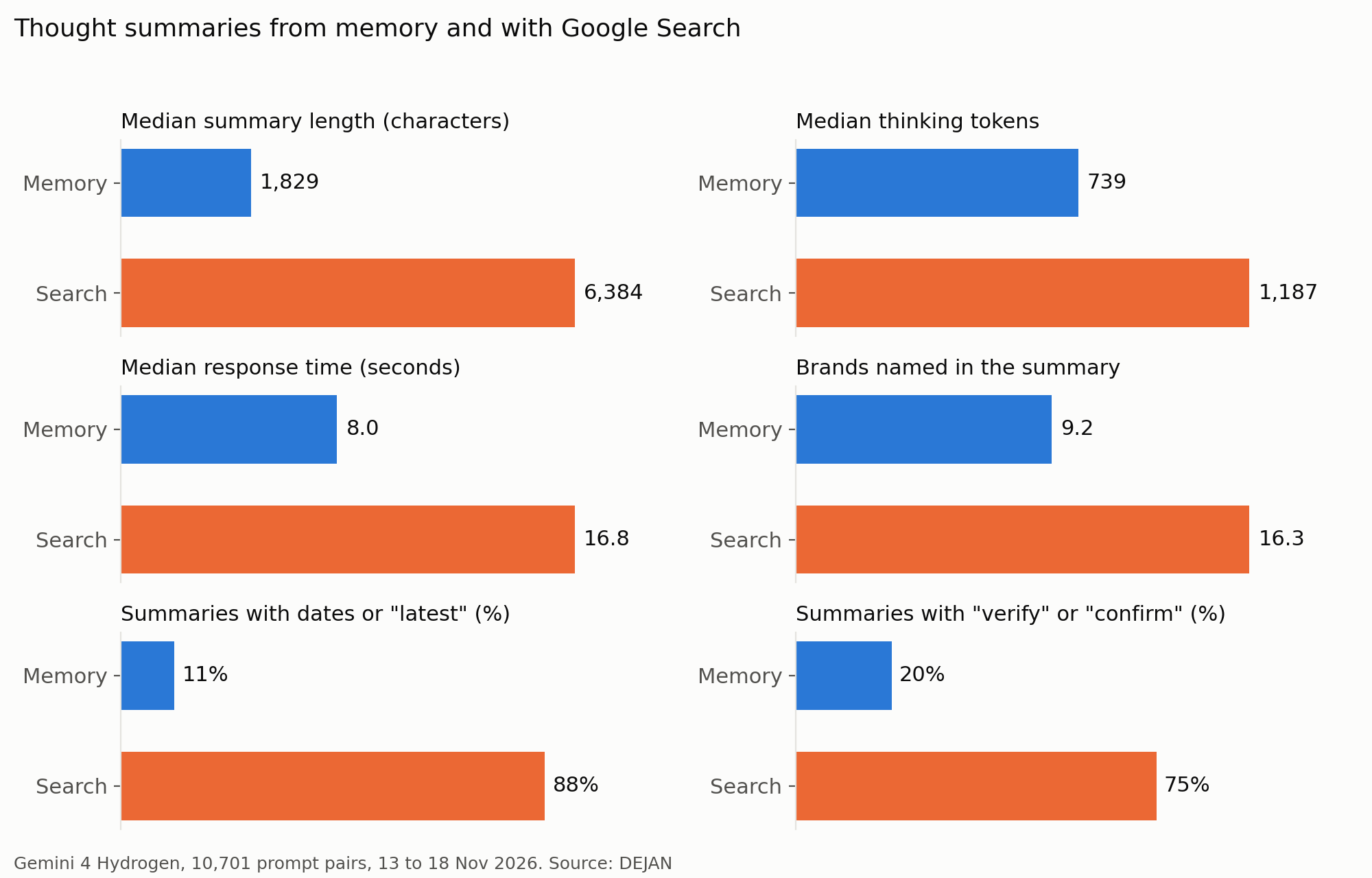 Thought summaries from memory (blue) and with Google Search (orange).
| Measure | Memory | Search |
|---|---|---|
| Median summary length | 1,829 characters | 6,384 characters |
| Median thinking tokens | 739 | 1,187 |
| Median response time | 8.0 s | 16.8 s |
| Brands named in the summary | 9.2 | 16.3 |
| Brands named in the summary but left out of the answer | 3.7 | 9.0 |
| Summaries with dates or "latest", "current" | 11% | 88% |
| Summaries with "verify", "confirm", "double-check" | 20% | 75% |
Grounded summaries are longer, so the rate per 1,000 characters is the fairer comparison. Date and recency words rise from 0.08 to 0.69 per 1,000 characters. Checking words rise from 0.12 to 0.31. Hedging words such as "likely", "I recall" and "assuming" stay level, at 0.39 from memory and 0.36 with search.
A grounded summary usually runs in stages. It lists the brands the model already associates with the topic, states the search queries it plans to run, reports what the results show, and removes or adds brands with a stated reason. One summary for custom cycling jerseys lists a brand's custom programme from memory, then reads a search snippet saying the programme ran from 2019 to 2021 and drops it.
"If this were a live system"
2,227 grounded summaries contain "mental check", "simulated", "mental search" or "hypothetical search". 2,218 of those calls ran at least one Google search.
- 788 summaries say things like "if this were a live system, I'd perform a brief search" or "a simulated quick search".
- 151 treat the current date as hypothetical, for example: "This is a simulated environment, so I'm to imagine it's 2026."
- In these passages the model confirms brands from memory. One summary reads: "While ESPN BET was a significant player, I'd do a quick mental check to see if its branding or operational status might have shifted... Assuming it's still active... ESPN BET would also be on my radar."
The final answers do not follow this wording. 3,092 brand mentions sit inside "mental check" passages. 70 of them are brands that search almost never returns (at least 20 times from memory, at most 10% as often with search), and 1 of those 70 appeared in the final grounded answer. The ESPN BET summary above ended in an answer without ESPN BET.
The cost of thought summaries
Requesting thought summaries adds time. In a separate test of 10 alternating pairs on a short yes/no prompt, Gemini 4 Hydrogen took 3.5 s median with summaries requested and 2.6 s without, and was slower with summaries in 8 of the 10 pairs.
Method notes
- A pair is the memory call and the grounded call for the same run, model, tracked topic and prompt. 1,741 further pairs could not be matched one to one, most likely because the same prompt ran in two locations, and are excluded.
- Brands are matched by the platform's normalised brand name.
- Renames are taken from the grounded summaries, which report what the model read in its search results.
- Thought summaries are Google's paraphrase of the model's reasoning, not the raw reasoning tokens.
Comments
Sign in with Google to comment and annotate this content.