RexBERT is a domain-specialized language model trained on e-commerce text to optimize product titles, descriptions, attribute extraction, and semantic search.
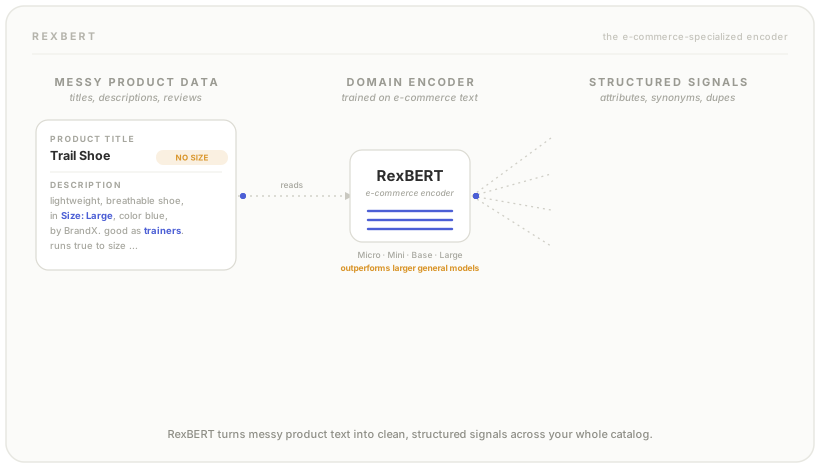
RexBERT is a domain-specialized language model trained on massive volumes of e-commerce text (product titles, descriptions, attributes, reviews, FAQs). Unlike general-purpose transformers, it is optimized to understand the quirks of product data and the way consumers phrase queries. For a technical SEO professional, this means better alignment between how search engines interpret product content and how you can optimize it.
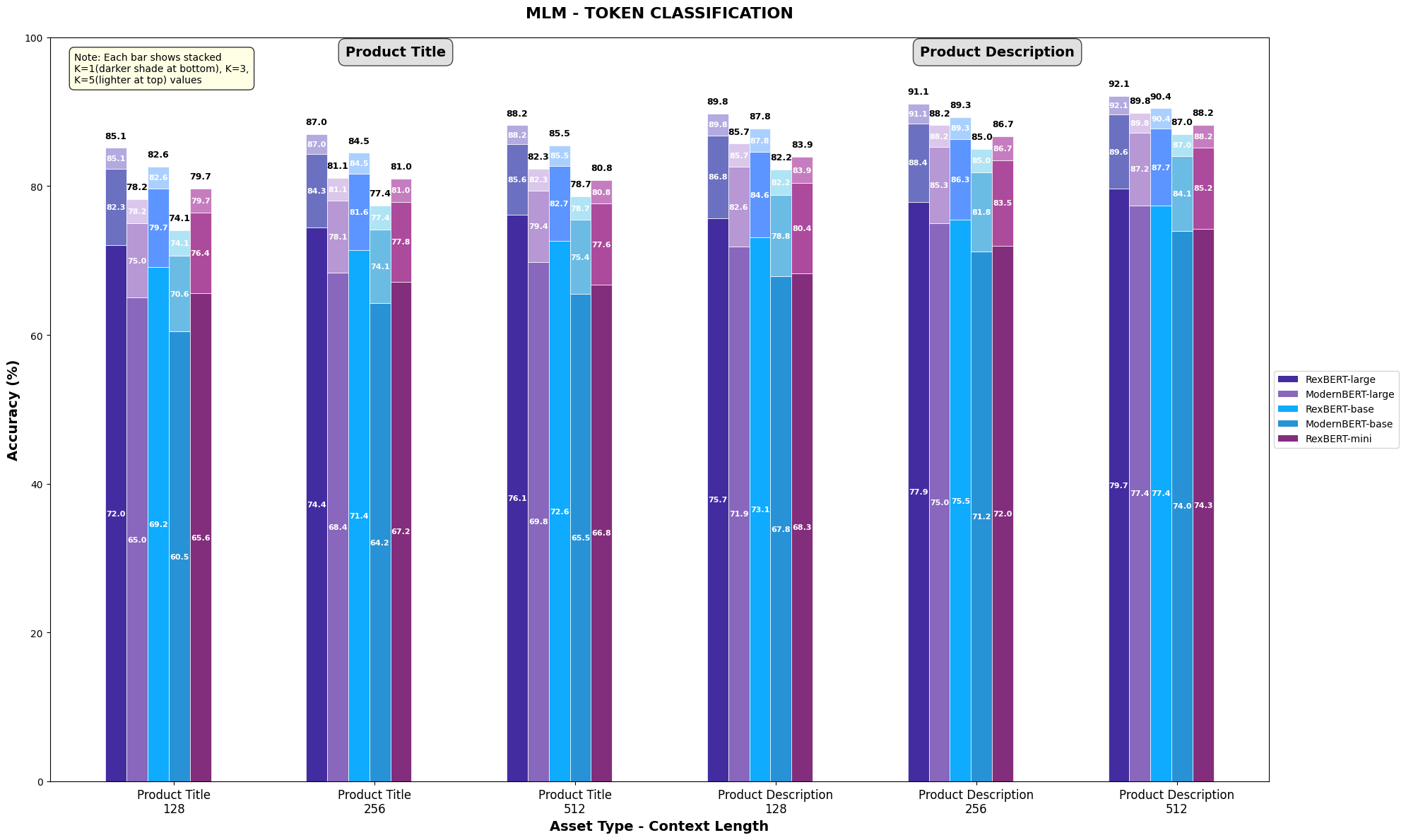 The study utilized textual data assets from the Amazon ESCI dataset to benchmark model performance. Evaluations were conducted using the ‘Product Title’ and ‘Product Description’ fields with three distinct context window sizes: 128, 256, and 512 tokens.
Key Use-Cases in SEO
1. Product Title & Description Optimization
- RexBERT can be fine-tuned to detect missing or redundant product attributes in titles and descriptions.
- Example: Identifying when “Size: Large” is present in a description but missing in the title – something that affects both CTR and SERP relevance.
2. Faceted Navigation & Attribute Extraction
- E-commerce platforms rely on structured attributes for filters (size, color, brand).
- RexBERT’s span-aware training makes it adept at pulling structured attributes from unstructured product descriptions, helping ensure faceted navigation aligns with what users search for.
3. Semantic Search & Internal Linking
- Internal search engines often struggle with synonyms (“sneakers” vs “trainers”) or product relationships (laptop stand vs laptop desk).
- RexBERT embeddings improve semantic matching, powering smarter internal search and related product suggestions – both strong signals for engagement and conversion.
4. Duplicate & Near-Duplicate Content Detection
- Large catalogs often have overlapping or boilerplate descriptions.
- RexBERT similarity scoring can detect duplicates more effectively than generic models, guiding canonicalization or content rewrites.
5. SERP Snippet Simulation
- Because RexBERT is trained with long-context MLM and e-commerce corpora, it can predict how certain phrasing will appear in search snippets.
- This can be used to A/B test meta descriptions or FAQ schema copy against model outputs before deployment.
6. Category Page Relevance
- Category pages often suffer from thin or generic content.
- RexBERT can classify which descriptions best match category intent (e.g., “men’s trail running shoes” vs “general running shoes”), improving topical alignment and internal linking strategies.
- Domain-specific embeddings: Outperform general BERT models on retail tasks.
- Latency options: Micro and Mini versions can run in production with low compute cost, making real-time SEO automation feasible.
- Future-proofing: As Google leans on large-scale embeddings for shopping and SERP features, leveraging similar architectures internally ensures your catalogue is optimized in the same “language.”
Across the English ESCI similarity task, the RexBERT series consistently outperforms other models within a similar parameter budget. Notably, RexBERT-large achieves the strongest performance, surpassing EmbeddingGemma-300M under identical training and evaluation conditions.
For a technical SEO in e-commerce, RexBERT isn’t just another NLP model – it’s a tool to operationalize SEO at scale, automating the detection of content gaps, improving site search, and ensuring structured data integrity. The payoff: cleaner catalogs, stronger SERP presence, and more frictionless buyer journeys.
Models
- thebajajra/RexBERT-large [1.58GB]
- thebajajra/RexBERT-base [599MB]
- thebajajra/RexBERT-mini [274MB]
- thebajajra/RexBERT-micro [67.7MB]
| Parameter | 17M (Micro) | 68M (Mini) | 150M (Base) | 400M (Large) |
|---|
| Layers | 7 | 19 | 22 | 28 |
| Hidden Size | 256 | 512 | 768 | 1024 |
| Intermediate Size | 384 | 768 | 1152 | 2624 |
| Attention Heads | 4 | 8 | 12 | 16 |
| Learning Rate | 3e-3 | 3e-3 | 8e-4 | 5e-4 |
| Weight Decay | 3e-4 | 3e-4 | 1e-5 | 1e-5 |
Checkpoints:
- thebajajra/RexBERT-mini-checkpoints
- thebajajra/RexBERT-base-checkpoints

 Dan Petrovic ·
23 September 2025
Dan Petrovic ·
23 September 2025