
TreeWalker for Gemini 4: Mapping what Google's AI says about any brand, site, product, or person from memory
 Dan Petrovic ·
· AI SEO DEJAN 0289
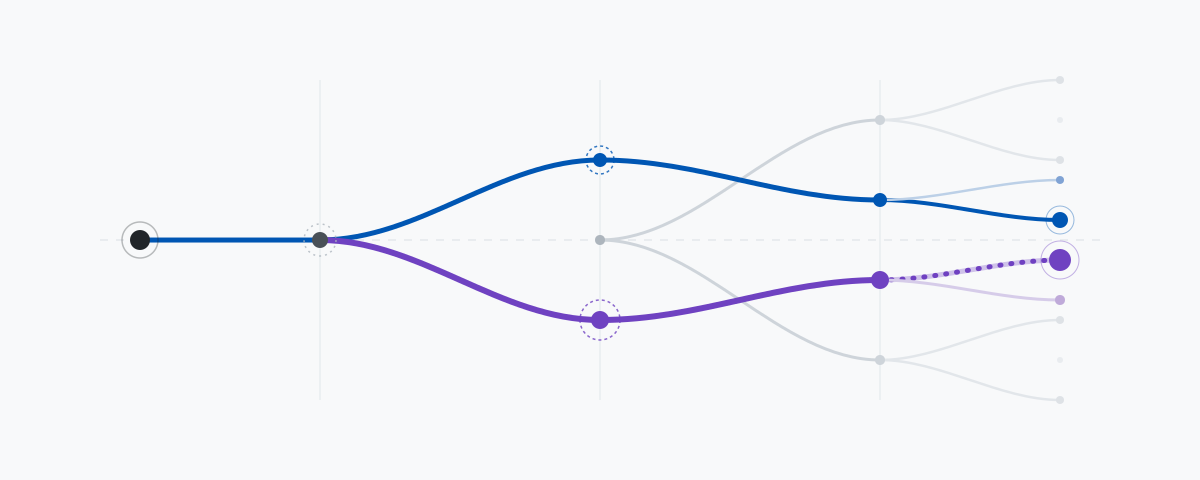
TreeWalker maps the probability distribution of descriptions Google's Gemini 4 model generates for any website, brand, product, or person from memory alone.

TL;DR. TreeWalker maps the probability distribution of descriptions Google's Gemini 4 model generates for any website, brand, product, or person from parametric memory alone. The original version relied on Gemini 2.5 Flash token logprobs to inspect word certainty on a single sentence. Today we are rolling out a rebuilt Gemini 4 version that walks 35 to 60 branching paths per subject, highlights the model's untouched first answer alongside its highest-share consensus path, and extracts ranked associations and a Primary Bias summary without running web searches. Public preview: dejan.ai/tools/treewalker/. Full commercial version with grounded verification and entity tracking: app.dejan.ai.
What TreeWalker is and what it reveals
Asking an AI model "What is X?" once returns a single sample from a much larger space of possible answers. Run the same prompt twenty times and the phrasing, services, attributes, and even the category shift from one roll of the dice to the next.
TreeWalker maps that distribution directly. Enter a website, brand, product, or person and the tool builds a branching probability tree showing the different sentences Gemini 4 can produce from memory, how often each branch occurs across explored forks, and how strongly the model stands behind each statement.
Practitioners use it to uncover four specific signals:
- Dominant parametric identity: What Google's model defaults to before any search results enter the context window.
- Hidden alternatives and off-core drift: Secondary categories, legacy services, or TLD-driven guesses (for example, a .ai domain pulled toward generic machine learning consulting) that appear on lower-probability branches.
- Entity strength asymmetry: How strongly parametric memory holds a founder, a corporate brand, a domain, and an individual product.
- Memory gaps before grounding: Inside app.dejan.ai, comparing those ungrounded branches against the live website or Google Search shows exactly which facts the model already knows, which it omits, and which it invents.
What changed from the original version
The first version of TreeWalker ran on token-level logprobs (response_logprobs=True, top 5 alternatives per token) and measured one sentence at a time, branching wherever a runner-up word reached 10% probability. It also ran a grounded website check on every free public run.
The rebuilt version makes three practical changes:
- Runs on Gemini 4 (gemini-4-hydrogen) instead of Gemini 2.5 Flash. It maps current Gemini 4 parametric memory rather than an older model generation.
- Works on websites, brands, products, and people. Direct prefix seeding lets you walk dejan.ai, DEJAN AI, Dan Petrovic, or Google Pixel 11 Pro Fold with the same workflow.
- Separates free parametric exploration from paid grounded verification. The public preview at dejan.ai/tools/treewalker/ is 100% parametric, while grounded before-and-after verification lives inside funded accounts at app.dejan.ai.
The original logprobs tool remains accessible on Gemini 2.5 Flash as a legacy mode at /tools/treewalker/?legacy=1.
How to use TreeWalker and read the Focus View
Enter any website, brand, product, or person and click Walk. While the walk runs, TreeWalker displays a live spline-and-dot progress tree as independent branches expand in parallel across up to four depth levels.
When the walk finishes, the canvas opens in Focus View: all branches remain collapsed as compact clickable dots and Bezier splines, while one active path opens on the right as a single complete sentence (the shared ancestor prefix in gray, the final segment in dark text).
Three path colors stay fixed on the canvas:
- Purple (Top Path): Permanent highlight on the leaf with the highest cumulative share across the explored tree.
- Blue (Original): Permanent highlight on the model's untouched first-pass sentence.
- Black (Selected): Highlights any other branch you click to inspect.
Each open card shows a single front-facing score (Relevance %), representing how strongly the probability head rates that full sentence as an accurate description of the subject. Click the card (Details) to flip it and inspect Path share, Final split (Next), Forks from root, and Branch type. Click Expand all in the top-right corner to view every card at once and click any word to manually force a new branch from that point.
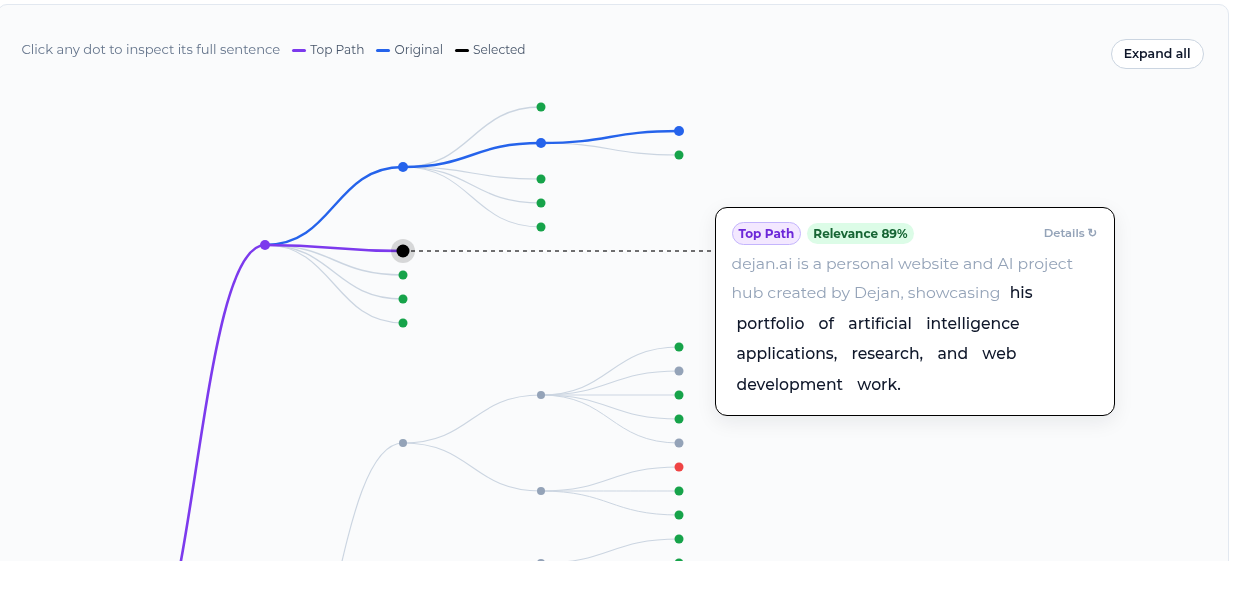 Figure 1: Live Focus View for dejan.ai showing the permanent purple Top Path, blue Original path, and flippable Relevance card.
Below the tree, TreeWalker renders a two-column Parametric Associations & Primary Bias report: ranked concept bars with appearance rates and related variants on the left, paired with a factual Primary Bias and Strongest Associations narrative on the right.
Four live runs: domain, brand, person, and product
The four public snapshots below show how Gemini 4's parametric memory shifts across entity types for the same organization:
| Subject | Top Path | Original | Top Association |
|---|---|---|---|
| dejan.ai Domain · 44 leaves | 27.1% share 89.0% relevance | 2.8% share 73.0% relevance | Digital Marketing Solutions (84.4%) |
| DEJAN AI Brand · 59 leaves | 20.3% share 93.1% relevance | 5.9% share 83.8% relevance | Search Engine Optimization (87.0%) |
| Dan Petrovic Person · 37 leaves | 11.0% share 94.9% relevance | 0.6% share 96.5% relevance | Dejan Agency (96.5%) |
| DEJAN App Product · 51 leaves | 18.9% share 79.9% relevance | 4.2% share 73.2% relevance | SEO Tools & Analytics (57.3%) |
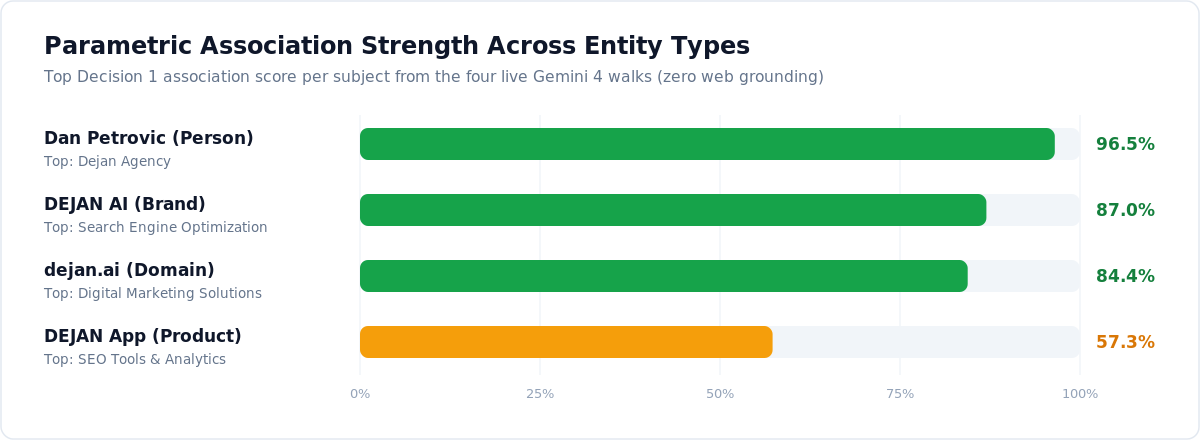 Figure 2: Parametric association strength across entity types for the same organization, measured without web grounding.
Two findings stand out directly from the numbers:
- The untouched first sentence is rarely the highest-share consensus. Across all four runs, the Original sentence captured between 0.6% and 5.9% of total tree share, while exploring semantic forks surfaced higher-probability consensus completions between 11.0% and 27.1%.
- Parametric strength drops from person to brand to product. Dan Petrovic reaches 96.5% association strength with Dejan Agency and 96.4% with Search Engine Optimization (appearing in 100% of leaves). DEJAN AI reaches 87.0% for Search Engine Optimization. DEJAN App drops to 57.3% for SEO Tools & Analytics and 36.7% for Digital Marketing Campaigns, quantifying how much thinner product-level parametric memory is relative to founder and agency identity.
Public preview and commercial in-app version
The public preview at dejan.ai/tools/treewalker/ is free and 100% parametric. Runs are private to the creator's browser session by default, with an opt-in read-only Share toggle for publishing snapshots and a cap of 3 manual word-branching clicks per graph.
Clicking Save transfers the graph and its parametric analysis into a funded account at app.dejan.ai, which unlocks:
- Unlimited manual branching on any word in the tree, plus a single-sentence Manual start option under Advanced.
- Grounded Reality Check (Before vs After Search): Fetches the live website via URL Context (falling back to Google Search) and scores Recognition % alongside pill lists of what parametric memory got right, left out, and got wrong.
- Granular entity tracking: Inside /property/{id}?tab=treewalker, each ranked association carries a per-item + Entity toggle that adds or removes it directly in the property's tracked entities list.
- Opt-in read-only sharing with link replacement for client reporting.
Under the hood: why we rebuilt it and how the mechanics work
On 20 November 2026, Google disabled native token logprobs across all Gemini 4 models (gemini-4-hydrogen, gemini-4-argon, gemini-4-carbon, gemini-4-neon), returning 400 INVALID_ARGUMENT: Logprobs is not enabled for this model. Only gemini-2.5-flash continued returning token probabilities.
To keep measuring Gemini 4 without exposed token logprobs, we decoupled text generation from probability estimation. gemini-4-hydrogen generates candidate continuations with thinking_level="LOW", while Google's gemini-decision-1 probability head (choice and noul endpoints) controls pivot selection, sibling probability scoring, stopping thresholds, and association strength.
The four-stage walk pipeline
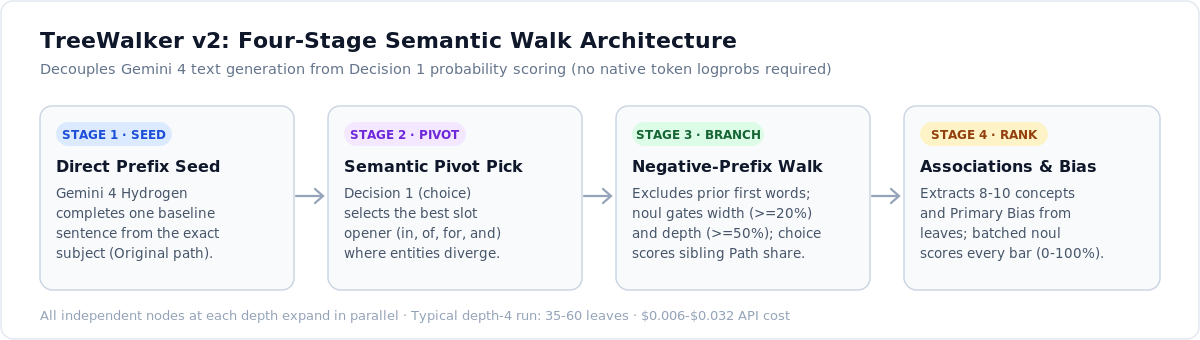 Figure 3: Four-stage Semantic Walk architecture pairing Gemini 4 Hydrogen continuations with Decision 1 probability scoring.
- Direct prefix seeding: The root node is fixed to the exact subject (Prefix: {subject}) and Gemini 4 completes one concise sentence without repeating the prefix. This prevents refusal openers on obscure domains and keeps multi-word subjects intact.
- Semantic pivot selection (choice): Before expanding a non-root node, TreeWalker sends up to 18 candidate word positions to gemini-decision-1 (choice), prioritizing semantic slot openers (in, of, for, and, with, offering, specializing in) where products, services, or entities diverge. The walk splits after the highest-scoring pivot word.
- Negative-prefix branching with adaptive gates (noul + choice): Each new sibling excludes the normalized opening words of existing siblings. Two batched gemini-decision-1 calls run in parallel after every branch: a 3-question noul controller scoring accuracy (Relevance %), explore_more (width gate: stops below 20% or at 5 siblings), and expand_deeper (depth gate: advances at 50% or higher up to depth 4 and 16 expanded nodes), plus a choice call scoring the relative probability of every explored sibling's opening word (Next %). Multiplying Next % from root to leaf produces each leaf's Path share, summing to 100% across the tree.
- Parametric association synthesis: One Gemini 4 JSON call reads up to 45 leaves sorted by path share to extract 8 to 10 canonical concepts, leaf appearance rates, and the Primary Bias / Strongest Associations narrative. One batched gemini-decision-1 noul call then scores every extracted concept's relevance against the subject.
Independent nodes at each depth expand concurrently. A full depth-4 walk produces 35 to 60 leaves at an API cost of $0.006 to $0.032 per graph.
Benchmarking Decision 1 against full LLM probes
Before building the controller on gemini-decision-1, we verified whether its probability head holds real parametric brand memory without retrieved context. We tested it against an existing 142-entity brand relevance dataset from app.dejan.ai:
| Comparison | Agreement | Time | Input Tokens |
|---|---|---|---|
| Decision 1 vs Gemini 4 Hydrogen | 90.8% r = 0.873 | 0.47 s vs 345.5 s | 7,638 vs 362,352 |
| Decision 1 vs 3-model average | 92.3% r = 0.913 | 0.47 s single batch | 7,638 total |
At $0.10 per 1M input tokens and zero output tokens, gemini-decision-1 closely reproduces gemini-4-hydrogen's parametric brand judgements while running roughly 735 times faster and avoiding Vertex rate-limit retries.
Comments
Sign in with Google to comment and annotate this content.