
How we built Search for Agents on dejan.ai without Cloudflare
 Dan Petrovic ·
· AI SEO DEJAN 0294
How dejan.ai built a self-hosted /.well-known/search API without Cloudflare: gemini-decision-1 boundary classification, gemini-embedding-2 contextual vectors, and PostgreSQL pgvector hybrid search across 5,718 chunks.

We built a self-hosted /.well-known/search endpoint and upgraded our internal /search on dejan.ai without using Cloudflare AI Search. The pipeline converts each published post, concept, page, and Codebase Explorer element to Markdown, frames semantic chunking as a binary boundary classification task in a single gemini-decision-1 call (209 to 329 ms per document, 0 output tokens, 100% verbatim text), embeds every chunk with Title > Section context using gemini-embedding-2 (768 Matryoshka dimensions), and stores both a generated PostgreSQL tsvector (GIN) and a pgvector HNSW index in one table (search_chunks). Backfilling all 2,111 live units produced 5,718 chunks with zero failures in 3 minutes 20 seconds.
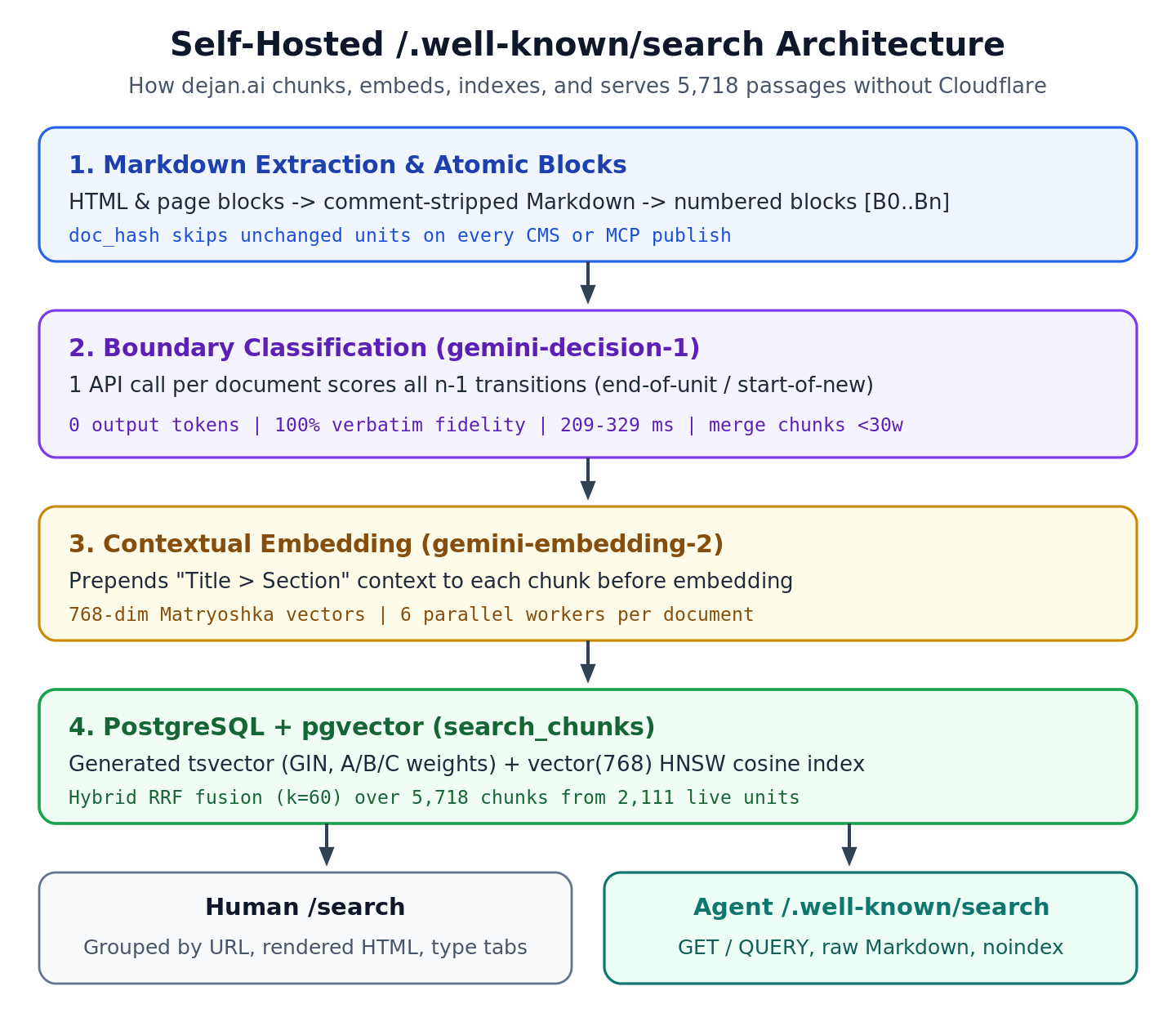 Figure 1: End-to-end indexing and retrieval pipeline on
dejan.ai.
Why we framed semantic chunking as binary classification
Fixed-size chunking (such as Cloudflare's 1,024-token default with 10% overlap) cuts across ideas and tables at arbitrary token counts. Generative LLM chunking (asking a model to echo the document back with <chunk_start> tags) solves boundary placement, while paying output-token latency for every word and risking silent text drops or rewrites.
gemini-decision-1 accepts up to 262,000 input tokens and evaluates up to 1,000 independent yes/no (noul) questions over that shared input in one pass, returning calibrated probabilities and zero output tokens. We split each Markdown document into atomic blocks [B0] through [Bn-1] (headings, paragraphs, lists, tables, fenced code blocks, blockquotes) and ask one calibrated question per adjacent pair.
Because the model never regenerates text, verbatim fidelity is guaranteed by construction. On our 3,150-word PoolDPP-MAP post (75 atomic blocks), one API call scored all 74 candidate transitions in 329 ms (15,657 input tokens, 0 output tokens). On a 759-word prose post with zero HTML headings, it scored all 34 transitions in 209 ms (5,635 input tokens, 0 output tokens).
The boundary-framing detail that eliminated orphan headings
In our first test, we asked per block whether [Bi] started a new semantic chunk rather than continuing [Bi-1]. Because both a heading and the opening paragraph beneath it look like the start of new content, Decision 1 scored both above 0.50 on five sections of the 3,150-word test post, producing 5-word orphan heading chunks.
Reframing the question on the transition between adjacent blocks fixed the behaviour with no extra latency:
Does block [B{i-1}] mark the end of a complete, self-contained semantic unit
such that block [B{i}] begins a new semantic unit? Answer no if [B{i-1}] is an
incomplete opener (such as a heading or lead-in) or if [B{i}] continues the same
section, argument, table, code example, or list.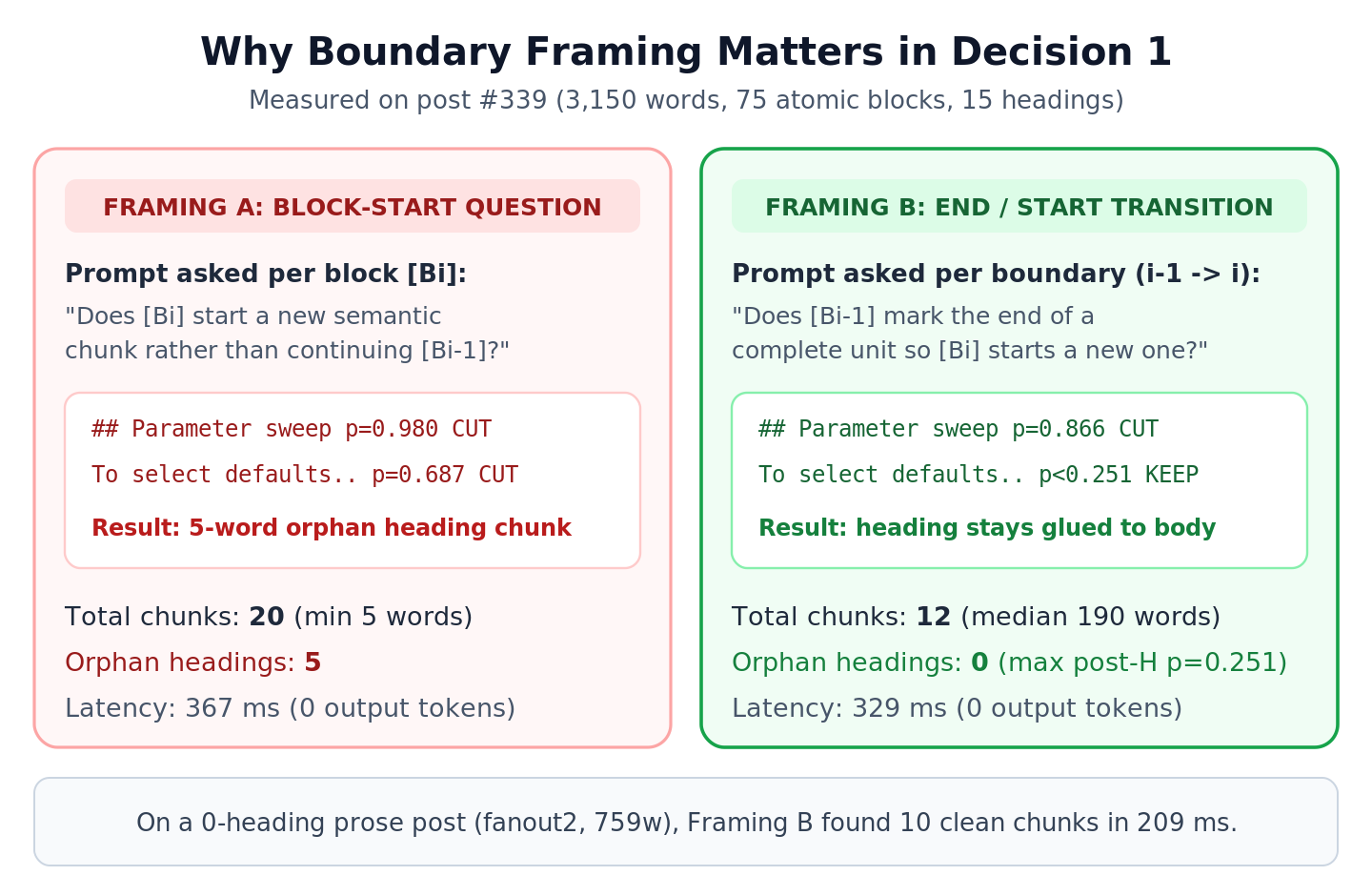 Figure 2: Measured boundary calibration on post #339 comparing block-start framing against end-of-unit / start-of-new transition framing.
Because a bare heading opens a unit rather than completing one, the highest post-heading cut probability dropped to 0.251, orphan headings fell from 5 to 0, and chunk count dropped from 20 to 12 (median 190 words). On the heading-free prose post, the same prompt identified every bold Q&A transition and produced 10 clean chunks (27 to 222 words). Two lightweight guardrails sit after classification: chunks under 30 words that do not start with a heading merge into the preceding chunk, and rare chunks over 900 words split on block boundaries.
Contextual embeddings and the PostgreSQL schema
A passage extracted from the middle of a long post often loses its subject when embedded in isolation. Before calling gemini-embedding-2 (768 Matryoshka dimensions), we prepend the document title and active section heading (Title > Section) to the chunk text, while storing the clean Markdown in search_chunks for display and agent retrieval.
All keyword and vector data live in one PostgreSQL table:
CREATE TABLE IF NOT EXISTS search_chunks (
    unit_type  text NOT NULL,
    unit_id    text NOT NULL,
    chunk_idx  integer NOT NULL,
    slug       text NOT NULL,
    title      text NOT NULL,
    section    text NOT NULL DEFAULT '',
    url        text NOT NULL,
    markdown   text NOT NULL,
    search_tsv tsvector GENERATED ALWAYS AS (
        setweight(to_tsvector('english', coalesce(title, '')), 'A') ||
        setweight(to_tsvector('english', coalesce(section, '')), 'B') ||
        setweight(to_tsvector('english', coalesce(markdown, '')), 'C')
    ) STORED,
    embedding  vector(768) NOT NULL,
    doc_hash   text NOT NULL,
    tokens     integer NOT NULL DEFAULT 0,
    model      text NOT NULL DEFAULT 'gemini-embedding-2',
    updated_at timestamptz NOT NULL DEFAULT now(),
    PRIMARY KEY (unit_type, unit_id, chunk_idx)
);
Two indexes back the table: a GIN index on search_tsv for exact keyword matches and a pgvector HNSW index (vector_cosine_ops, m = 16, ef_construction = 64) on embedding. At query time, we pull the top 80 keyword hits (websearch_to_tsquery) and the top 80 cosine-distance neighbours, then fuse their ranks with Reciprocal Rank Fusion (RRF_K = 60).
Backfill numbers and automatic indexing on publish
We ran the initial backfill in two batches with concurrent workers:
| Batch | Live units | Decision 1 calls | Chunks created | Wall time | Failures |
|---|---|---|---|---|---|
| Posts, concepts, pages | 564 | 1 per eligible doc | 4,171 | 2m 37s | 0 |
| Codebase Explorer elements | 1,547 | 0 (atomic single-chunk units) | 1,547 | 43s | 0 |
| Total | 2,111 | ~564 | 5,718 | 3m 20s | 0 |
For new and updated content, chunking and embedding run inside the existing background daemon thread in semantic_index.refresh(unit_type, slug), triggered on every publish, edit, hide, show, or delete in the web CMS and over MCP. Each unit stores a doc_hash fingerprint of its title, summary, and Markdown; unchanged saves skip both Decision 1 and embedding calls. HTML comments (<!-- ... -->) are stripped inside html_to_markdown() before block splitting so template comments never leak into chunks or OKF files.
One index serving human search and /.well-known/search
Both retrieval surfaces read from the same search_chunks hybrid query, formatting the output for their respective client:
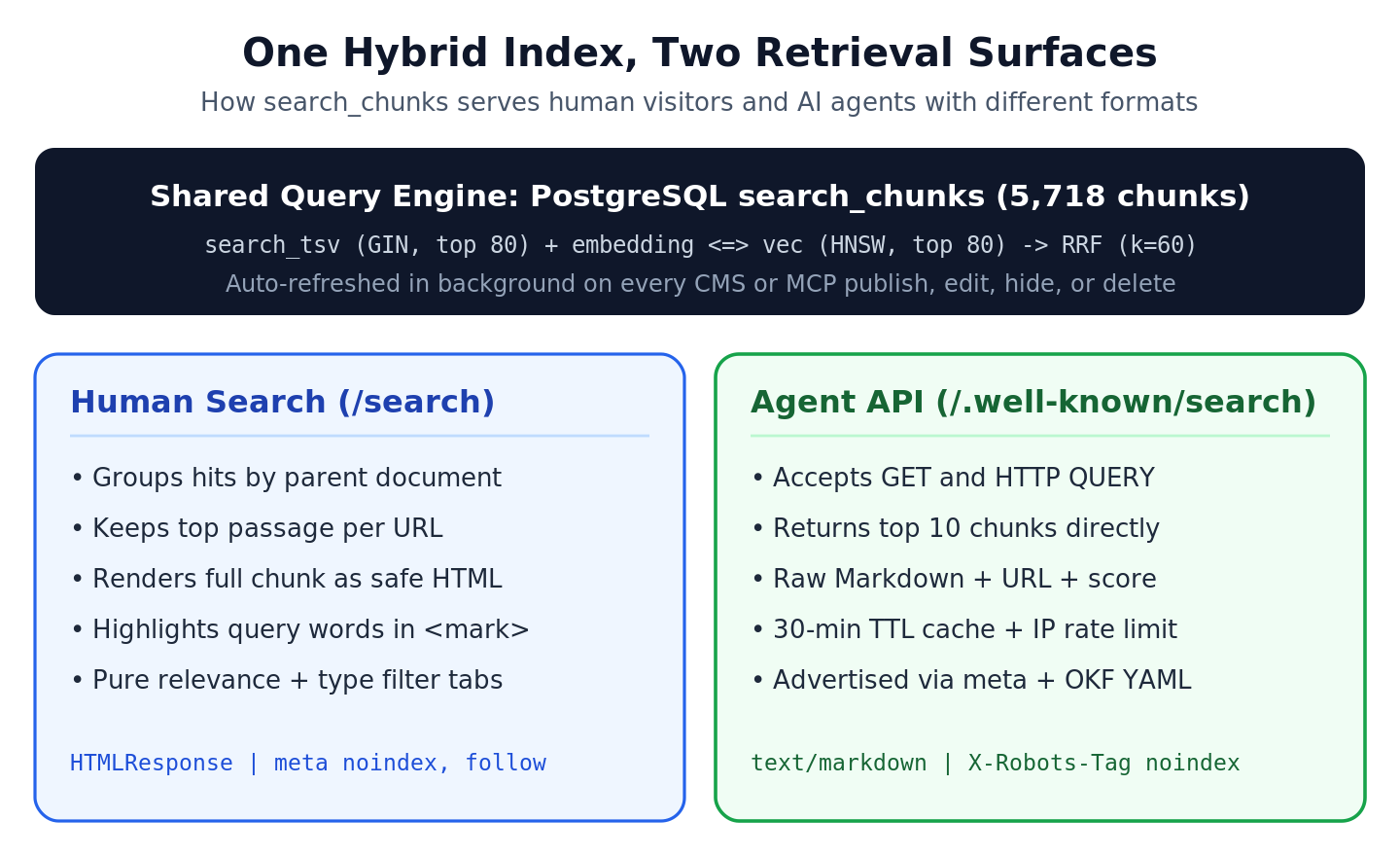 Figure 3: Shared hybrid PostgreSQL index serving rendered HTML chunks to human visitors and raw Markdown chunks to AI agents.
- Agent API (
/.well-known/search): AcceptsGET ?q=...and the IETF Proposed Standard HTTPQUERYmethod (RFC 10008, plain-text or JSON{"q": "..."}body). Returns up to 10 ranked Markdown passages with canonical URL, title, section, and normalized score (text/markdown; charset=utf-8). Guarded by a 30-minute in-memory TTL cache (500 queries), per-IP rate limits (60/min, 600/hr), control-character stripping onq, andX-Robots-Tag: noindex, nofollowso dynamic query URLs stay out of search engine indexes. - Human search (
/search): Groups matching passages by parent document, keeps the highest-scoring chunk per URL, ranks purely by fused relevance, renders the full semantic chunk as safe HTML with query terms highlighted in<mark>, and offers live client-side filter tabs (All, Articles, Concepts, Pages, Tools, Elements).
Discovery advertisement across HTML and Markdown
To match the discovery convention described in our Cloudflare Search for Agents breakdown, we added the four agent:* tags to our HTML <head> templates (homepage and base layout):
<meta name="agent:instructions" content="Use this search API to find relevant content across this site with keywords or natural-language queries, instead of crawling individual pages. Results are returned in Markdown.">
<meta name="agent:endpoint" content="https://dejan.ai/.well-known/search?q={query}">
<meta name="agent:method" content="GET">
<meta name="agent:documentation" content="https://dejan.ai/blog/cloudflare-search-for-agents/">
Every Open Knowledge Format (/okf/*.md) response injects the same four fields into its YAML front matter automatically inside _md_response().
Related concepts
- AI Agent
- AI Search
- DocumentChunker
- Open Knowledge Format
- Retrieval-Augmented Generation
- Semantic Search
- Technical SEO
- Vector Embedding
- Vector Search
Comments
Sign in with Google to comment and annotate this content.