 Dan Petrovic ·
25 August 2026
Dan Petrovic ·
25 August 2026
Experiments and survey data show growing public distrust of AI, with labels reducing content value and widespread opposition to local data centers.
AI becomes invisible by 2030: a background layer that takes care of things and is taken for granted by most, woven into infrastructure, devices, work and family life, with fewer labels, fewer exposure points and fewer visible surfaces.
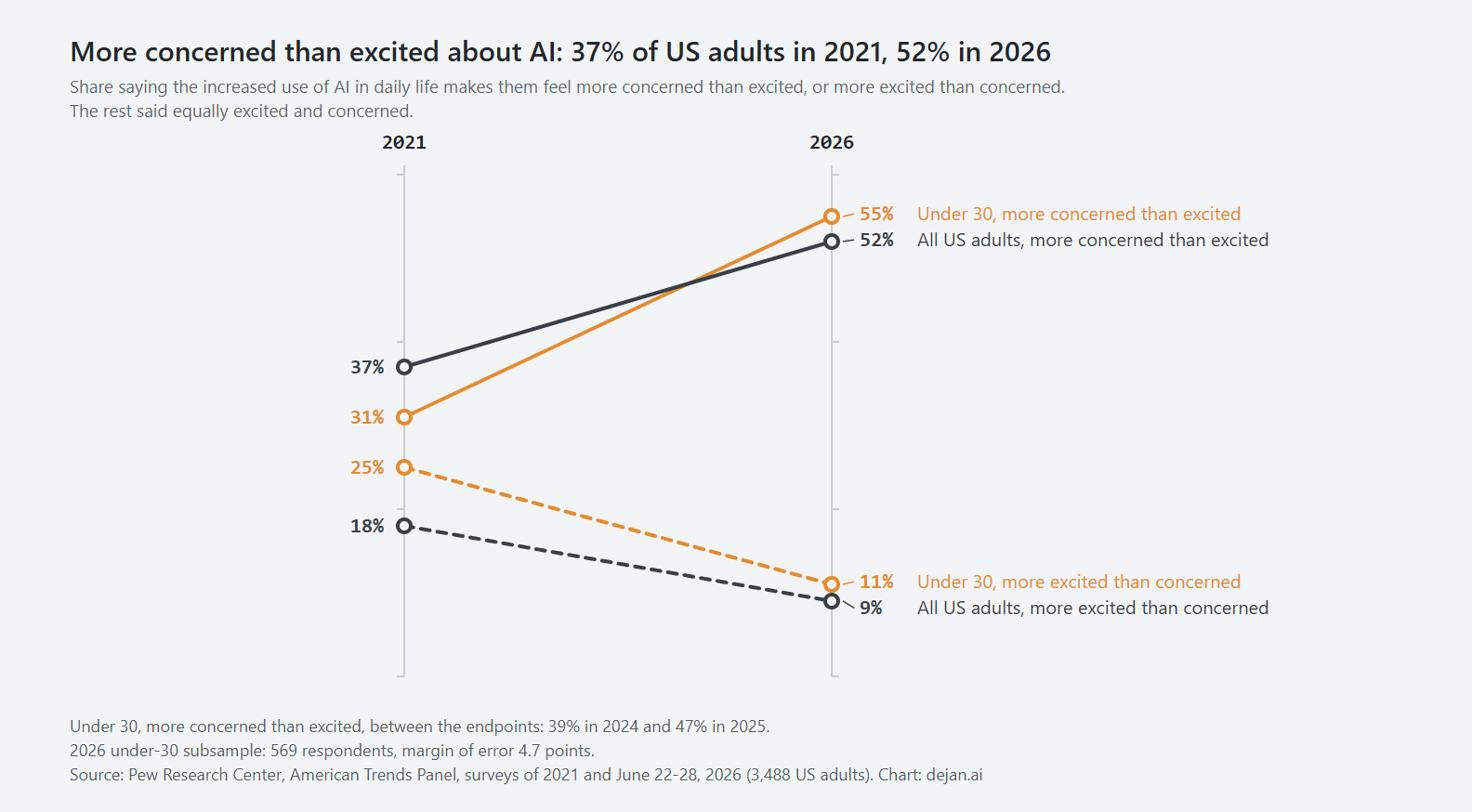
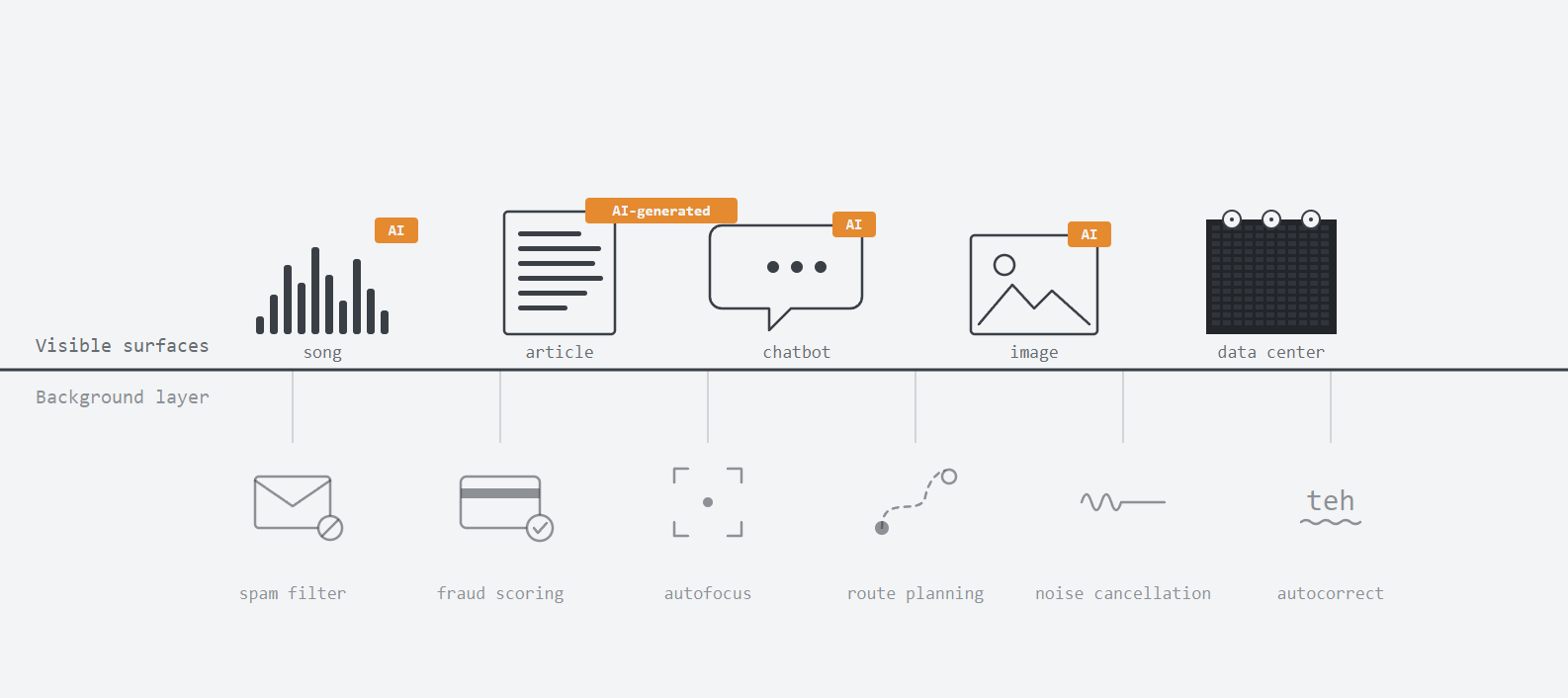
The sentiment research of 2025 and 2026 locates the pressure on the surfaces people can see. In 16 experiments with 27,491 participants, the same creative writing was valued lower once labeled as AI-generated. In listening tests, participants rated AI-generated songs above human-made ones until told the origin, after which willingness to pay fell. Adding the word "AI" to a product description lowered purchase intention in every category tested. 71% of Americans oppose an AI data center in their own area, above the 53% who oppose a nuclear plant. 52% of US adults are more concerned than excited about AI, up from 37% in 2021, and 55% of adults under 30 said the same in June 2026, the first majority in that age group. Spam filtering, fraud scoring, camera autofocus and route planning have run on machine learning for years without a label, and none of the surveys cited below asks about them.
The experiments below hold the content constant and change only what participants are told about its origin.
| Study | Setup | Result |
|---|---|---|
| Raj et al., Wharton, 2025 | 16 experiments, 27,491 participants, creative writing labeled human or AI | Identical text valued lower under the AI label; the drop held when a human was described as involved; perceived authenticity carried most of the effect |
| Schilke and Reimann, 2025 | 13 experiments on disclosure of AI use | Disclosure lowered trust through lower perceived legitimacy |
| ProMarket authors, 2024 experiments | Pop and electronic songs, human-made or AI-generated, origin disclosed or withheld | Participants rated the AI-generated songs higher; disclosure cut the wish to relisten and willingness to pay, mostly among pop listeners |
| Nuremberg Institute for Market Decisions | The same six ads shown with an "AI-generated" or "human-generated" label | The AI label lowered ratings for usefulness, clarity and appeal by a small, consistent margin |
| Cicek et al., Washington State University, 2024 | Product descriptions with and without the word "AI", 1,000+ US adults | Purchase intention fell in every product category tested, through lower emotional trust |
| British Food Journal, 2025 | Food product images labeled AI-generated, three experiments | Purchase intention fell through lower perceived effort and authenticity; the effect grew with price |
Survey data on brand content runs the same way. Capgemini tracked trust in AI-generated content from 73% in 2023 to 55% in 2025, with declines in every age group including Gen Z. YouGov's 2026 data has 32% of consumers trusting a brand less for using AI-generated content and 15% trusting it more. A 2026 Gartner survey has 50% of US consumers preferring brands that keep generative AI out of customer-facing messages, ads and content.
The measurements below cover generated content, chatbots, hiring screens, employer rollouts and buildings.
| Surface | Measure | Figure | Source, fielding, sample |
|---|---|---|---|
| AI in daily life | More concerned than excited | 52% (37% in 2021) | Pew, June 22-28 2026, 3,488 US adults |
| AI overall | Does more harm than good | 39% (31% in 2025) | Bentley-Gallup, May 2026, 3,270 US adults |
| Businesses using AI | Do not trust them to use it responsibly | 79% | Bentley-Gallup, May 2026 |
| AI data center in own area | Oppose | 71% (48% strongly) | Gallup, March 2-18 2026, 1,000 US adults |
| Music made with generative AI | Less interested | 38% (28% more interested) | Luminate, July 2026, 1,758 US adults aware of generative AI |
| AI music competing with human music | Creators worried | 79% (74% in 2023) | PRS for Music, January 2026, 2,630+ members |
| Use of books for AI training | Authors requiring consent and payment | 96% | Authors Guild, 2023-2024, 1,700+ authors |
| AI-generated brand content | Trust the brand less | 32% (15% more) | YouGov, 2026 |
| AI-generated art, books, films | "Not real art" | 35% | Ipsos, March 2025 |
| News from AI chatbots | Trust it | 20% (news overall 37%; 10% use a chatbot for news weekly) | Reuters Institute, 2026, about 100,000 respondents, 48 markets |
| AI screening job candidates | AI does worse than a person | 69% | Bentley-Gallup |
| Employer's AI strategy | Admit sabotaging it | 29% (44% of Gen Z) | Writer / Workplace Intelligence, April 2026, 2,400 knowledge workers |
| AI companions for minors | Support age verification | 56% | Common Sense Media / NORC, October 9-13 2025, 1,096 US adults |
| AI systems, global | Willing to trust | 46% | KPMG / University of Melbourne, November 2024 to January 2025, 48,340 people, 47 countries |
Merriam-Webster chose "slop" as its 2025 Word of the Year on December 15, 2025, defined as low-quality digital content produced in quantity by AI. Macquarie chose "AI slop", Collins "vibe coding" and Oxford "rage bait" in the same season.
Pew, Bentley-Gallup and Gallup use probability samples. Luminate, YouGov, Writer and Capgemini use online opt-in panels, and Luminate, Writer and Gartner are vendor studies. The KPMG/Melbourne study is academically led and co-funded by KPMG.
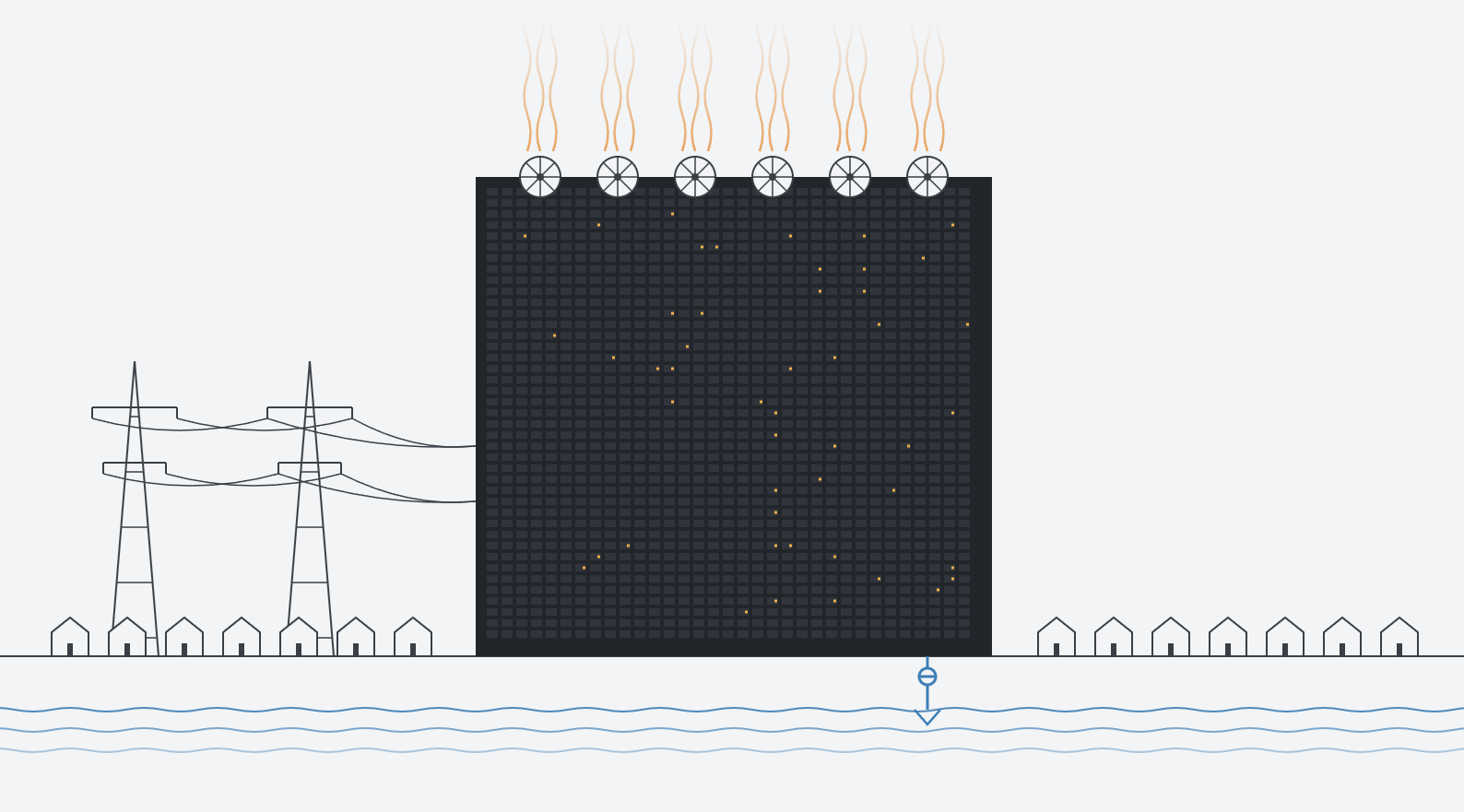
Gallup asked about local data centers for the first time in March 2026 (1,000 US adults by phone, March 2-18, margin of error 4 points). 71% opposed building an AI data center in their area, 48% strongly, against 7% strongly in favor and about a quarter in favor overall. The same poll found 53% opposed to a local nuclear power plant. In a follow-up open-ended question, half of opponents cited resource use, with 18% naming water and 18% naming energy, and 16% cited pollution including noise. 46% said they worry a great deal about the environmental impact of data centers. An Annenberg Public Policy Center poll put opposition to new local data centers at 61%, with 69% of Democrats and 54% of Republicans opposed.
Data Center Watch, a tracking project run by the AI-security firm 10a Labs, counted $64 billion of projects blocked or delayed by local opposition between May 2024 and March 2025, $156 billion delayed or cancelled across 2025, and 75 projects worth about $130 billion in the first quarter of 2026 alone, the largest quarterly figure since its tracking began in 2023. Its count of active opposition groups doubled, from 396 to 833, across 49 states. The project's own report states that attributing delays to activism alone oversimplifies the causes. Estimates of per-query water and energy use vary widely between sources.
The issue entered the 2026 midterm campaigns. A National Republican Senatorial Committee memo reported by Axios warned that data centers were hurting the party in an Ohio race. On a primary day in August 2026, Pennsylvania Governor Josh Shapiro signed an executive order setting stricter standards for data center development, and Byron Donalds won Florida's Republican gubernatorial primary while proposing restrictions on data centers in the state. Two beverage brands, Liquid Death and Garage Beer, released a satirical ad with Jason Kelce about data center water use on the same day. On June 25, 2026, Mark Cuban wrote on X that data centers had become "a proxy for the hate towards AI"; Fortune reported the post drew more than 700,000 views within hours.
In 2021, adults under 30 were the most optimistic group Pew tracked: 25% were more excited than concerned and 31% more concerned than excited. In June 2026 the figures were 11% and 55%, and 73% of under-30s expected AI to reduce jobs over the next 20 years, up from 61% in 2024. Concern among adults 30 and over rose mainly between 2021 and 2023 and then flattened, while concern among under-30s kept rising through 2025 and 2026 until it matched people in their 30s, 40s and 50s. The under-30 subsample was 569 people with a margin of error of 4.7 points.
Bentley-Gallup recorded the same movement on a different question: the share of 18-to-29-year-olds saying AI does more harm than good went from 27% in 2024 to 36% in 2025 to 47% in 2026, the largest rise of any age group. Gallup's Gen Z survey (1,572 people aged 14 to 29, fielded February 24 to March 4, 2026) found weekly use holding steady, at 48% of Gen Z adults and 56% of K-12 students, while sentiment turned more negative on three of the four emotions measured since 2025. At Marquette University's May 2026 commencement, students petitioned against the choice of an AI advocate as speaker, the petition failed, and graduates booed the speaker.
The youngest cohort points the other way. Luminate's panel has 13-to-17-year-olds net positive on AI across every entertainment type measured, while 18-to-24-year-olds are net negative, and net interest in AI music among Gen Z and Gen Alpha fell from -6% in May 2025 to -16% in November 2025. Globally, Ipsos finds under-35s are the most nervous age group (52%) and the most excited (56%) at the same time.
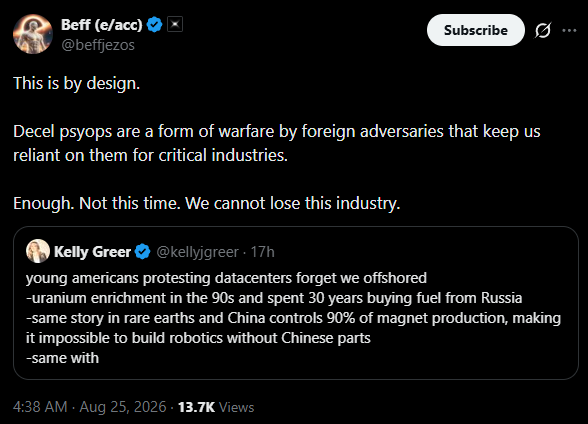
Guillaume Verdon proposes that decel psyops are a form of warfare by foreign adversaries here: https://x.com/beffjezos/status/2091958298086113548
The field has a term for this, the AI effect. Pamela McCorduck documented in her history of AI that each solved problem, from chess to symbolic algebra, was reclassified by critics as something other than intelligence once it worked. Larry Tesler's version is that AI is whatever has not been done yet, and Nick Bostrom's is that a technique stops being labeled AI once it is useful and common enough. Chess engines, optical character recognition, speech recognition and spam filtering are the standard examples. Fraud scoring, camera autofocus, noise cancellation and route planning run on the same kind of models at scale today without an AI label, on the same class of data centers that 71% of Americans oppose having nearby.
Labeling rules are moving in two directions at once. The EU AI Act's transparency obligations, which require AI-generated content to be marked, apply from August 2026. In January 2026, Valve narrowed Steam's AI disclosure requirement to AI the player encounters in the game, after a period in which the count of releases carrying a disclosure went from about 1,000 in all of 2024 to about 8,000 in the first half of 2025, and to 21% of all 2025 releases through October. In Game Oracle's analysis of about 10,000 Steam releases from January to October 2025, games with an AI disclosure averaged 4 user reviews in their first month against 7 for games without one; the author notes that disclosure correlates with other markers of low-budget releases.
One unlabeled system draws the strongest rejection in the Bentley-Gallup task comparison: 69% of Americans say AI does a worse job than a person at recommending whom to hire, above the 68% for driving and 62% for medical advice. The hiring screen scores the applicant without any surface the applicant sees. No published experiment contrasts unlabeled AI that works on the user's behalf with unlabeled AI that acts on the user.
Gallup's State of the Global Workplace 2026 reports that in organizations that have deployed AI, 65% of US workers say it has improved their productivity, while 12% strongly agree it has transformed how work gets done. Pew has 71% of US adults expecting fewer jobs over 20 years, and Bentley-Gallup has 79% expecting fewer US jobs over 10 years.
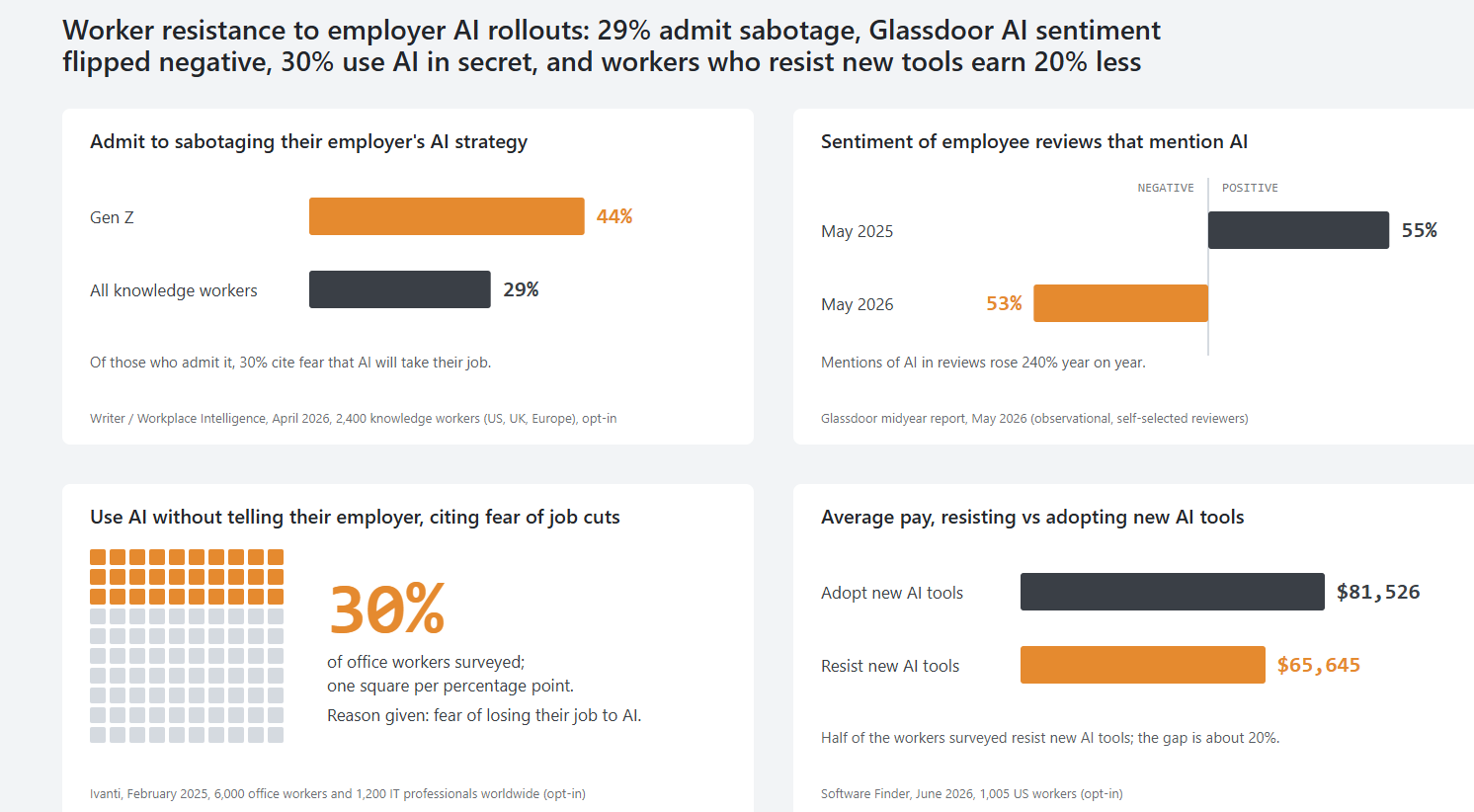
Opt-in worker surveys record active resistance. Writer and Workplace Intelligence (April 2026, 2,400 knowledge workers including 1,200 executives in the US, UK and Europe) found 29% admitting to sabotaging their employer's AI strategy, 44% among Gen Z, with 30% of those citing fear that AI would take their job. Software Finder (June 2026, 1,005 US workers) found half of workers resisting new AI tools, and resisters earning about 20% less than adopters ($65,645 against $81,526). Ivanti (February 2025, 6,000 office workers) found 30% using AI without telling their employer, for fear of job cuts. Glassdoor's May 2026 midyear report counted AI mentions in employee reviews up 240% year on year, with sentiment at 53% negative, from 55% positive a year earlier.
Klarna's AI assistant handled 2.3 million customer conversations in February 2024, the work of about 700 agents by the company's count. In May 2025 the company began hiring human agents again, with CEO Sebastian Siemiatkowski saying cost had weighed too heavily in the decision and service quality had fallen; Klarna later described the human hiring as a pilot and said its AI investment continued.
Wired published "Silicon Valley Doesn't Get Why You Hate AI" on August 20, 2026, and TechCrunch ran "AI was supposed to win people over by now, it hasn't" the day before. Mark Zuckerberg published an essay of about 6,500 words on his AI outlook in August 2026; Dario Amodei responded on X on August 15 that public perception had become a "crisis of trust" and that people suspect the industry is devising new ways to exploit them. Airbnb CEO Brian Chesky attributed the backlash in part to the industry not shipping products that regular people like and in part to how the industry talks about AI. Bentley-Gallup's 2026 data has self-reported knowledge of AI at 70%, up 6 points on 2024, in the same year that harm-over-good rose 8 points.
Ipsos's 2026 AI Monitor (23,532 adults in 32 countries, fielded March 20 to April 3, 2026) has Asia and Latin America net optimistic and Europe and North America net nervous, with excitement and nervousness at near parity worldwide. In 17 of the 28 countries surveyed in consecutive years, fewer people than a year earlier said AI's benefits outweigh its drawbacks. 46% across the 32 countries said they would trust a generative AI tool less if advertisers influenced its answers. In Pew's 25-country study, the share more concerned than excited was highest in the United States and Italy (50%), Australia (49%), Brazil (48%), Greece (47%) and Canada (45%), and lowest in South Korea (16%), India (19%), Israel (21%), Nigeria (24%), Turkey (26%), Japan (28%) and Germany (29%). KPMG and the University of Melbourne (48,340 people in 47 countries, November 2024 to January 2025) found 66% using AI regularly, 83% expecting benefits, 46% willing to trust AI systems and 70% wanting regulation. In China, Ipsos found AI trusted above a human for some kinds of immediate health advice.
Two datasets on AI advertising to young adults give opposite readings. An EMARKETER survey from April 2025 found 57% of millennials and 50% of Gen Z liking an ad or sponsored post more when told it was AI-made. IAB and Sonata Insights surveyed 505 US Gen Z and millennial consumers between October 2025 and January 2026 and found 45% positive about AI-generated ads, against 82% of advertising executives who expected them to be positive, with 39% of Gen Z negative compared with 20% of millennials. Buffer's analysis of 1.2 million social posts found AI-assisted posts at a median 5.87% engagement rate against 4.82% for fully human-written posts.