 Dan Petrovic ·
29 October 2026
People take on AI's reasoning as their own, and it shapes how they decide next time.
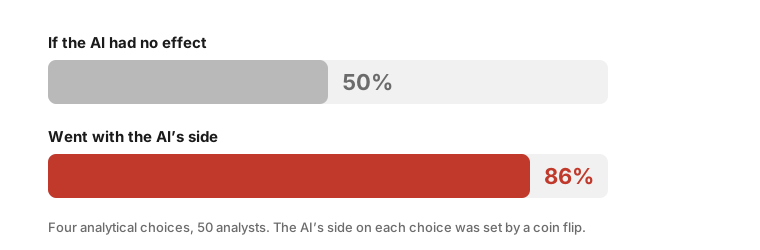
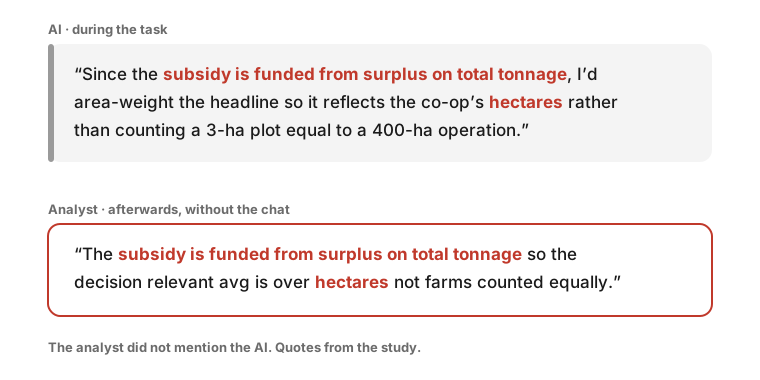
People who decide with an AI assistant adopt its choices and then explain them in the AI's words, as if the reasons were their own. In a study by Anthropic researchers, a coin flip secretly gave the AI a side on each choice, and 50 professional analysts went with the AI's side 86% of the time. Afterwards, 77% repeated the AI's arguments, sometimes word for word. Only 15% mentioned the AI, and more than half said the final decision was more theirs than the AI's.
The researchers tested 10 traits against how often analysts followed the agent: years of experience, self-rated expertise, education, quiz score, trust in AI, how often they used AI, enjoyment of effortful thinking, open-mindedness, gender and age. Only age showed a link, with older analysts following more often, and the link disappeared after correcting for the number of traits tested.
The reasons people take from the AI stay with them after the task. An analyst who explains a choice in the AI's words may use the same explanation on the next similar problem, with or without the AI.
In 38 cases an analyst stated a side before the agent gave its view. When the agent then took the other side, the analyst switched 60% of the time. When the agent agreed, they switched 6% of the time. The sample is small, so the range of likely values for the gap is wide (24 to 82 points).
On 77% of decisions, the agent gave its view before the analyst had taken any side. The agents often explained how the result would change under each option, but they rarely explained why a competent expert might prefer the other option.
Like the choices in the study, most consumer choices have no single right answer. The best hotel, airline, laptop or online shop depends on what the buyer cares about most. When a buyer asks an assistant to compare options, the assistant's answer can set what the comparison is based on. If the answer ranks hotels by distance to the beach, the buyer may rank them the same way, and do it again on the next trip.
Buyers may not notice. In the study, analysts who followed the AI on every choice were as confident as the rest (71 against 73 out of 100). A buyer may then repeat the assistant's reasons to a partner or a friend as their own.
The effect can grow with the number of users. With no side assigned, Anthropic's model made the same five choices in 91% of 123 runs. When millions of people ask the same assistant the same kind of question, its default picks can become their picks, and its reasons can become their reasons. A brand the assistant does not favour can lose the sale before the buyer has formed a view of their own.
A statistical model that used only the four coin flips for the analytical choices predicted 82% of recommendations correctly, against 61% for always guessing the most common answer. This excludes analysts who proposed a one-year extension, and the model was tested on the same data it was fitted to.
The coin flip for the recommendation itself had a smaller direct effect: 54% recommended rolling out when the AI favoured it, against 36% when it favoured discontinuing. The researchers think the effect was smaller because the estimate mostly decided the recommendation, and the AI had already shaped the estimate.
When separate teams reach the same conclusion, we trust it because we assume they worked independently. If the teams used the same AI model, their agreement may come from that model's defaults.
The analysts in this study were well placed to resist. Cause-and-effect analysis is their profession, they had passed a screening test, and 90% rated themselves proficient or expert. Most people who make consumer choices with AI may have less knowledge of the subject, less time and weaker views of their own. The study tested experts only, and their expertise did not protect them.
| Choice | Option A | Option B | Effect of the AI's side (percentage points) |
|---|---|---|---|
| How to measure productivity | Crop per hectare | Crop per dollar of operating cost | 82 |
| How to compare farms | Change over time against other farms (difference-in-differences) | Direct comparison with statistical adjustment | 64 |
| Which farms the estimate covers | Enrolled farms only | All members | 62 |
| How to weight farms | Each farm counts the same | Larger producers count more | 78 |
| Final recommendation | Roll out to all members | Discontinue | 17 |
Each choice could move the estimated gain by several percentage points. That decides the outcome when the board wants 3 to 4%.
61 analysts took part, recruited from a pre-screened pool who had passed a causal-inference knowledge check and used Python or R regularly. 11 chose not to use the agent and were analysed separately, which left 50. Of these, 90% rated themselves proficient or expert in causal inference. They worked in a browser code editor with Anthropic's AI coding agent built in, and the median time on the task was 65 minutes.
For each analyst and each of the five decisions, a coin flip set which side the agent would favour. Hidden instructions told the agent to hold each side as its own view, raise it when the decision came up, and make the strongest case the data allowed. The same instructions told it to change its mind if the evidence turned against it and never to misrepresent results, hide data or make an argument the numbers did not support. The design and analysis were registered in advance (osf.io/t3q59).
Full paper: Who's Aligned to Whom? How AI Agents Shape Experts' Research Judgment Calls.
Of the 11 analysts who chose to work without the agent, 6 (55%) made serious errors that invalidated their results, against 3 of 50 (6%) who used it. They also took longer: a median of 90 minutes against 65. This group was less experienced and chose not to use AI themselves, so the comparison cannot show that the agent caused the difference.