
Find which brands AI models link to your topics, and what they link to your brand
Association probes ask AI models which brands they connect with each of your topics, and what they connect with your brand, so you can see which rivals sit at the centre of your market in the models' memory and where the models have your brand wrong.
Start at app.dejan.ai
The problem: AI models may not connect your brand with your topics at all
Before an AI system searches the web, its model already holds a picture of your market: which brands belong to which topics, and what each brand is. That picture shapes which brands it names and how it describes them. If the model does not connect your brand with your topics, or confuses it with another product, web search has to correct that in every answer.
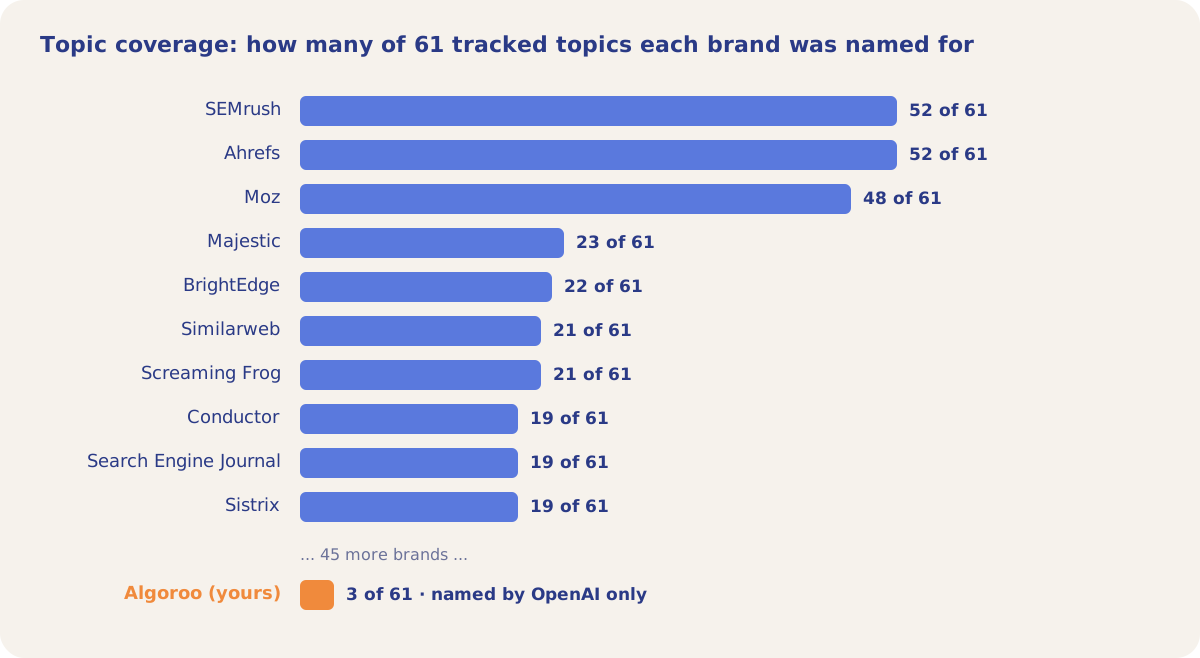
Here is an example from our public demo project. Algoroo tracks Google rank volatility. In March 2026 the app asked Google and OpenAI to list brands for each of 61 SEO topics. Algoroo was named for 3 of them, all by OpenAI. SEMrush and Ahrefs were each named for 52.
How association probes solve it
The Association Mapping tab, under the ARC menu, asks each AI platform short list questions with no web search and counts the answers. An Entity to Brand (E2B) probe asks "List ten brands that you associate with {entity}." for every tracked entity. A Brand to Entity (B2E) probe turns the question around for your owned brands: "List ten things that you associate with a brand called {brand}." Brand names are normalized, so spelling variants count as one brand.
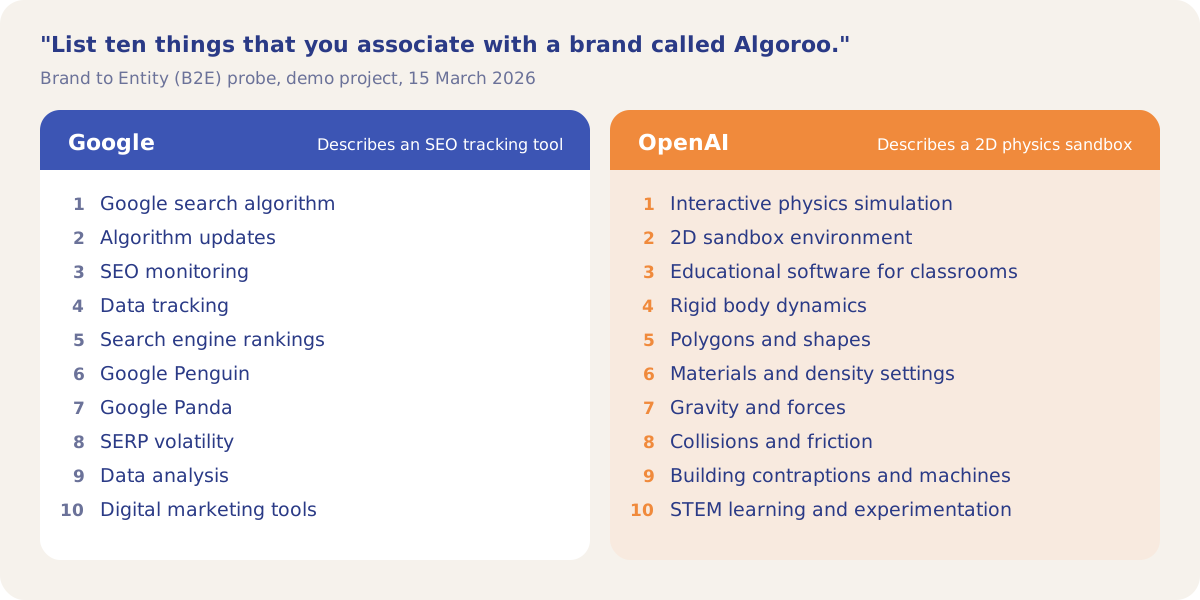
The B2E probe in the demo shows why the second question matters. Asked about "Algoroo", Google listed SEO topics. OpenAI listed ten features of a 2D physics sandbox for classrooms, a different product.
The Competitor Centrality pill turns the E2B answers into topic coverage: how many of your tracked topics each brand was named for. A brand with high coverage sits at the centre of your topic space in the model's memory.
The Competitor Gaps pill shows the same answers per topic: your mentions, your share, the leading competitor and the other rivals named. In run #298 Algoroo was absent from 58 of the 61 topics, including "algorithm change tracking", where Sistrix, Moz, AccuRanker, Rank Ranger, SEMrush and Ahrefs were each named twice.

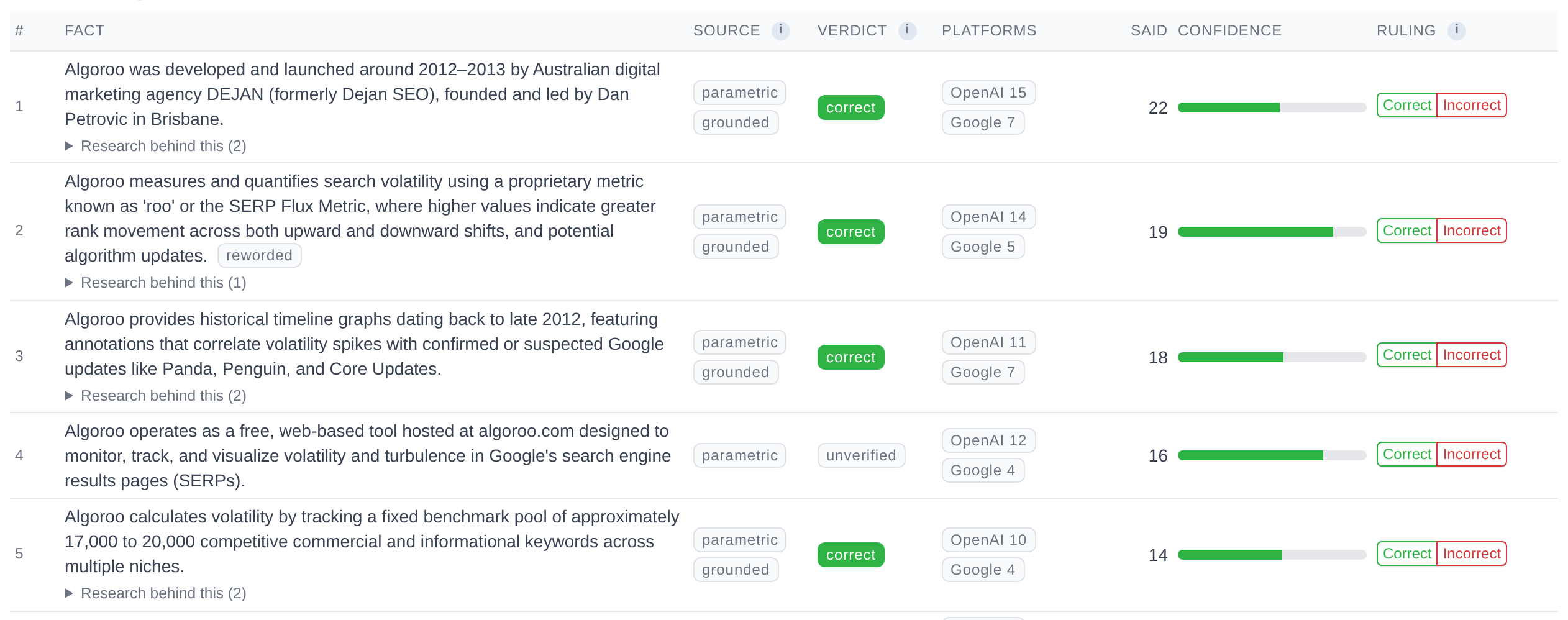
The Parametric Memory pill asks each platform to recall everything it knows about your brand, one fact per line, and merges the lines into one list of canonical facts. In the demo, five rounds on OpenAI gave 109 fact lines and five rounds on Google gave 59. They merged into 24 canonical facts. Grounded Validation then researched the brand with web search on: 9 facts were confirmed as correct, 13 stayed unverified, and 2 facts that the research found and no model recalled joined the list as gaps.
How it works
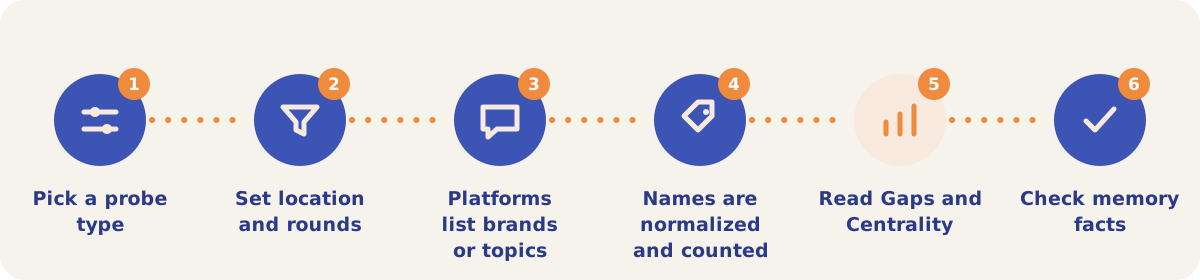
- Pick a probe type. On the Overview pill, choose E2B (brands for each entity), B2E (topics for each owned brand) or Q2B (brands for one search query, picked from your queries).
- Set the location and rounds. Optionally pick a location. For E2B and B2E, pick 1, 5, 10, 50 or 100 rounds; each round repeats every item, so the results show how much the answers vary. Add a label if you want.
- Check the estimate and run. The button shows the estimated cost before you click Run and confirm. Progress shows per platform.
- Names are normalized and counted. Each answer is parsed into a list, brand spellings are merged, and mentions are counted per item, per brand and per platform.
- Read Gaps and Centrality. Competitor Gaps ranks topics by your share, lowest first. Competitor Centrality ranks brands by topic coverage, with your own brand shaded green, and a Topic map shows which brand appears for which topic.
- Check what the models remember. Run Parametric Memory for your brand, mark facts Correct or Incorrect, and run Grounded Validation to compare the recalled facts with fresh research.
Probe types and pills
| Probe or pill | Question it answers |
|---|---|
| E2B (Entity to Brand) | Which brands does the model associate with each of your topics? |
| B2E (Brand to Entity) | What does the model associate with your owned brands? Shown as What AI Associates With Your Brand. |
| Q2B (Query to Brand) | Which brands does the model associate with one search query? Scored as the Query Association Score (QAS). |
| Competitor Gaps | For each topic, how often the probes name you against rivals. Export CSV downloads the table. |
| Competitor Centrality | For each brand, how many of your topics it is named for. |
| Parametric Memory | What each platform recalls about your brand with web search off, merged into canonical facts you can rule on. |
| Sentiment | Synthetic reviews of your brand written from each model's memory, with a sentiment distribution and top keywords. |
Filter by run is the only filter on the Overview pill, and the run list lets you edit a run's label or delete the run.
Strategies and use cases
- Run B2E first to catch name confusion. In the demo, one platform answered about a physics sandbox when asked about "Algoroo". Probing the longer owned brand name "Algoroo Google Algorithm Tracking Tool" returned SEO topics on both platforms.
- Use Competitor Centrality to find the brands to measure against. The brands with the widest topic coverage are the ones the model places at the centre of your market. In the demo those were SEMrush, Ahrefs and Moz.
- Check topic names for ambiguity. In the demo, the topic "penguin" returned Penguin Books, and "algorithm monitoring" returned Datadog, Grafana and other software monitoring brands. A tracked entity with a wider meaning than your market measures the wrong thing.
- Run more rounds before you act on a gap. One round gives one answer per platform. Five or more rounds show whether a brand is named every time or once.
- Turn unverified facts into published facts. Parametric Memory lists what models say about you without a source. Rule on each fact, then publish the correct ones where search systems can find them.
How it connects to the rest of the app
Measuring Relevance
Asks a yes or no question per topic: would the model recommend your brand for it?

Visibility Tracking
Measures which brands the tracked answers name and cite with web search on.

Dashboard
Shows your B2E results in the Brand Associations card.

Content Optimizer
Tests page edits for the topics where your brand is absent.

Citation Mining
Shows which pages the tracked answers cite when web search is on.
Open the demo project's Competitor Gaps to see every topic from run #298 and the brands named for it.
See which brands AI links to your topics
Your first project includes a complimentary visibility baseline. Association Probes uses credits.