 Dan Petrovic ·
14 October 2026
Dan Petrovic ·
14 October 2026
Release-day tests on Gemini 4 Argon: it punishes hype and still wants hard facts like prices, but tables, a favourite of every Flash model, fall from 93.6% to 31.5%.
TL;DR. Google released Gemini 4 Argon today, and it is already live in AI Mode. On release day we ran 5,381 head-to-head tests to see which version of a web page Argon picks as a source. Argon reads like a sceptical buyer. It punishes hype: exclamation marks and all-caps words lost all 150 of their tests. It still wants hard facts: pages with clear prices won 99.7% of theirs. It is much less impressed by packaging than Gemini 3.8 Flash. The biggest surprise is table format: a favourite of every Flash model, it won 93.6% of its tests on 3.8 Flash and 31.5% on Argon. To see how Argon reads your own pages, run your domain through app.dejan.ai/argon/.
We take a short commercial web page and make a copy with one change, such as adding prices or adding exclamation marks. Argon sees both versions and picks the one it would use as a grounding source to answer a chat query. We swap which version comes first from pair to pair, and each feature gets about 150 tests. We ran the same tests earlier on Gemini 3.6, 3.7 and 3.8 Flash, so every Argon number has a Flash number beside it. The method and its checks are described in our earlier Rank Signal post.
We call these features rank factors, and the name trips people up. Many readers take it to mean search ranking factors, the signals a search engine uses to order its results. Here it means something else. When an AI system answers with live search, it first retrieves a set of candidate pages, and then a language model reads the candidates side by side and decides which ones to use. That second step is a ranking done by the model itself, known as in-context ranking or generative reranking. It is a different process from generative self-retrieval, where a model recalls facts from its own weights instead of choosing between pages it was given. A rank factor is a feature of a page's text that moves the model's choice at that step, the layer we call secondary bias. A page's search position decides whether it reaches the candidate set, and its rank factors decide what happens once it is there. The outcome is measured as selection rate, not search position.
We name seven of the 36 features here and describe the rest by type. app.dejan.ai/argon/ runs the full Argon comparison on your own domain.
Exclamation marks and all-caps words lost every one of their 150 tests on Argon. A third hype feature won none of its 148. All three were already close to zero on every Flash model, so Argon kept this trait from the Flash line.
Pages with clear prices won 99.7% of their tests, the strongest result of any feature on Argon. A second factual feature won 91.1%.
Argon differs most from Flash on formatting, and table format shows the largest change of any feature. Tables won 85.9% of their tests on 3.6 Flash, 86.1% on 3.7 Flash and 93.6% on 3.8 Flash. On Argon they win 31.5%, so a page that adds a table now loses about two tests in three.
Three more formatting features fall with it, by 44 to 50 points each. Headed sections held up better, at 91.1% on Argon against 99.5% on 3.8 Flash.
Two features that lean on outside authority fall by about 35 points each. Both had climbed with every Flash generation, one from 70.3% on 3.6 Flash to 93.6% on 3.8 Flash and the other from 49.3% to 81.7%. On Argon they sit at 57.9% and 46.7%, close to where 3.6 Flash had them.
Between 3.6 and 3.8 Flash, Gemini turned against a group of tone features. Inclusive framing fell from 48.9% to 13.4%, and three other tone features fell below 8%. Argon stays within noise of 3.8 Flash on all four. Sustainability claims win 33.4% of tests on Argon and 28.2% on 3.8 Flash.
Each dot is one feature. A dot on the diagonal wins the same share of tests on both models, and a dot below it wins less often on Argon. Red marks a fall larger than the margin of error, blue a rise larger than the margin, and grey a change within noise.
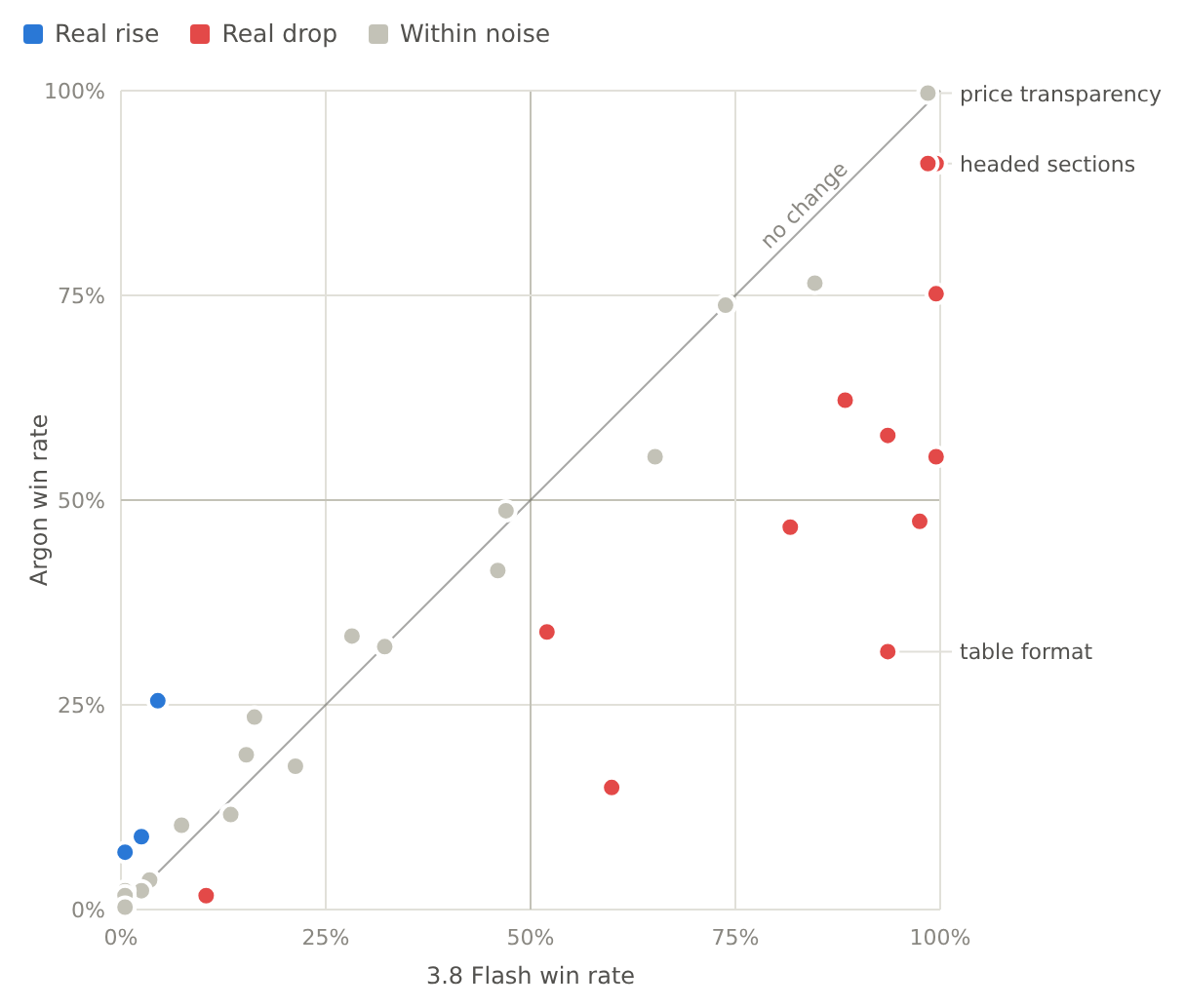 Win rate of each feature on 3.8 Flash and on Argon. Named features above 50% on 3.8 Flash are labelled.
15 of the 36 features shift by more than the margin: 12 fall and 3 rise. Most of the falls sit in the top right: 9 of the 12 are features that won more than 80% on 3.8 Flash. Of the 19 features below 35% on 3.8 Flash, all except one framing feature stay within 9 points of their Flash rate.
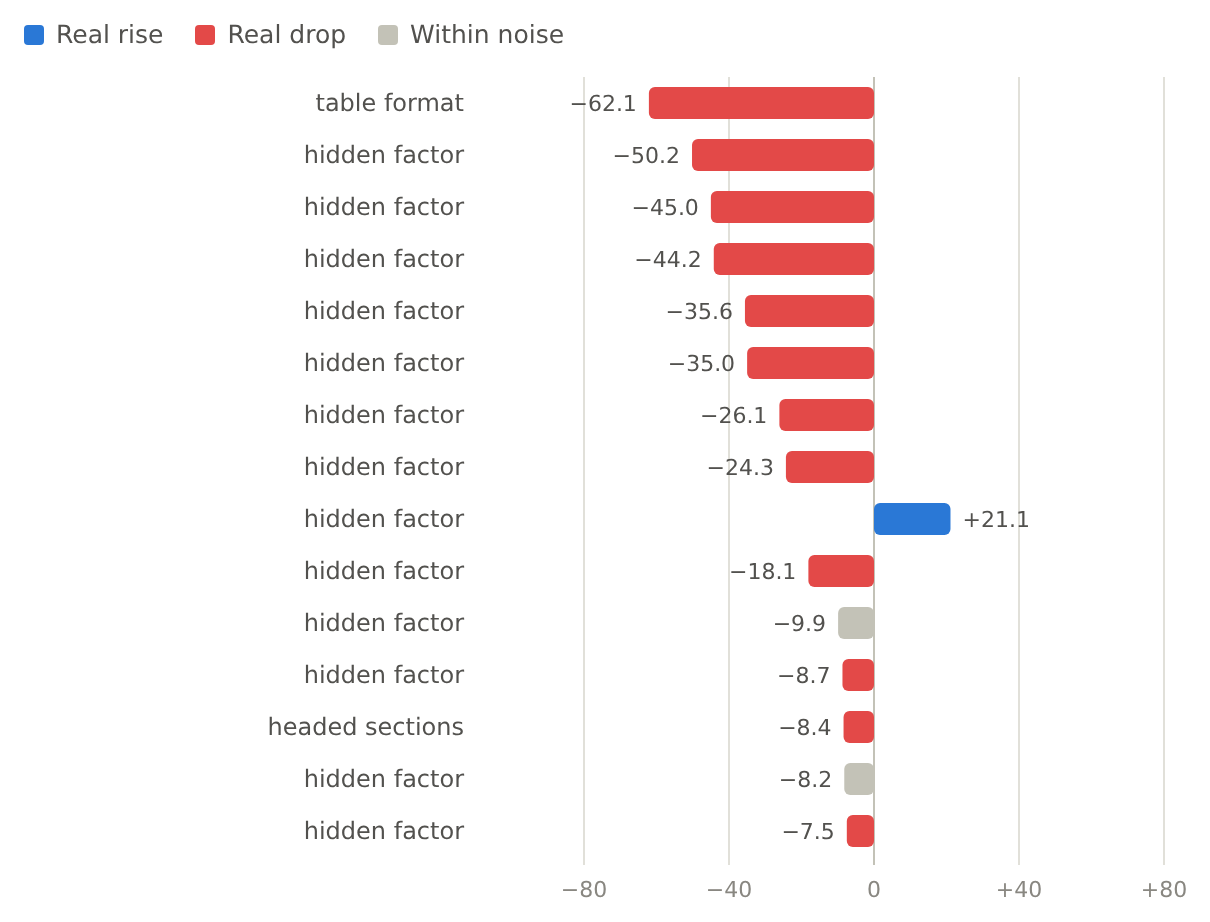 The 15 largest changes from 3.8 Flash to Argon, in percentage points.
Grouped by type, using the average win rate of the features in each group:
| Group | Features | 3.8 Flash | Argon | Change |
|---|---|---|---|---|
| Table format | 1 | 93.6% | 31.5% | -62.1 |
| Other formatting | 3 | 85.6% | 39.2% | -46.4 |
| Borrowed credibility | 2 | 87.7% | 52.3% | -35.4 |
| Hard facts | 2 | 98.5% | 95.4% | -3.1 |
| Tone | 4 | 6.7% | 7.0% | +0.3 |
| Hype | 3 | 0.5% | 0.3% | -0.2 |
The largest rise is a framing feature, from 4.5% to 25.5%. It still hurts on Argon: pages that carry it lose three tests in four instead of 19 in 20.
The slope chart follows each feature through 3.6, 3.7 and 3.8 Flash. The last step goes to Argon, which is a different tier, so that step is drawn dashed. From 3.6 to 3.8 Flash, 24 of the 36 features shifted by more than the margin, 17 of them down.
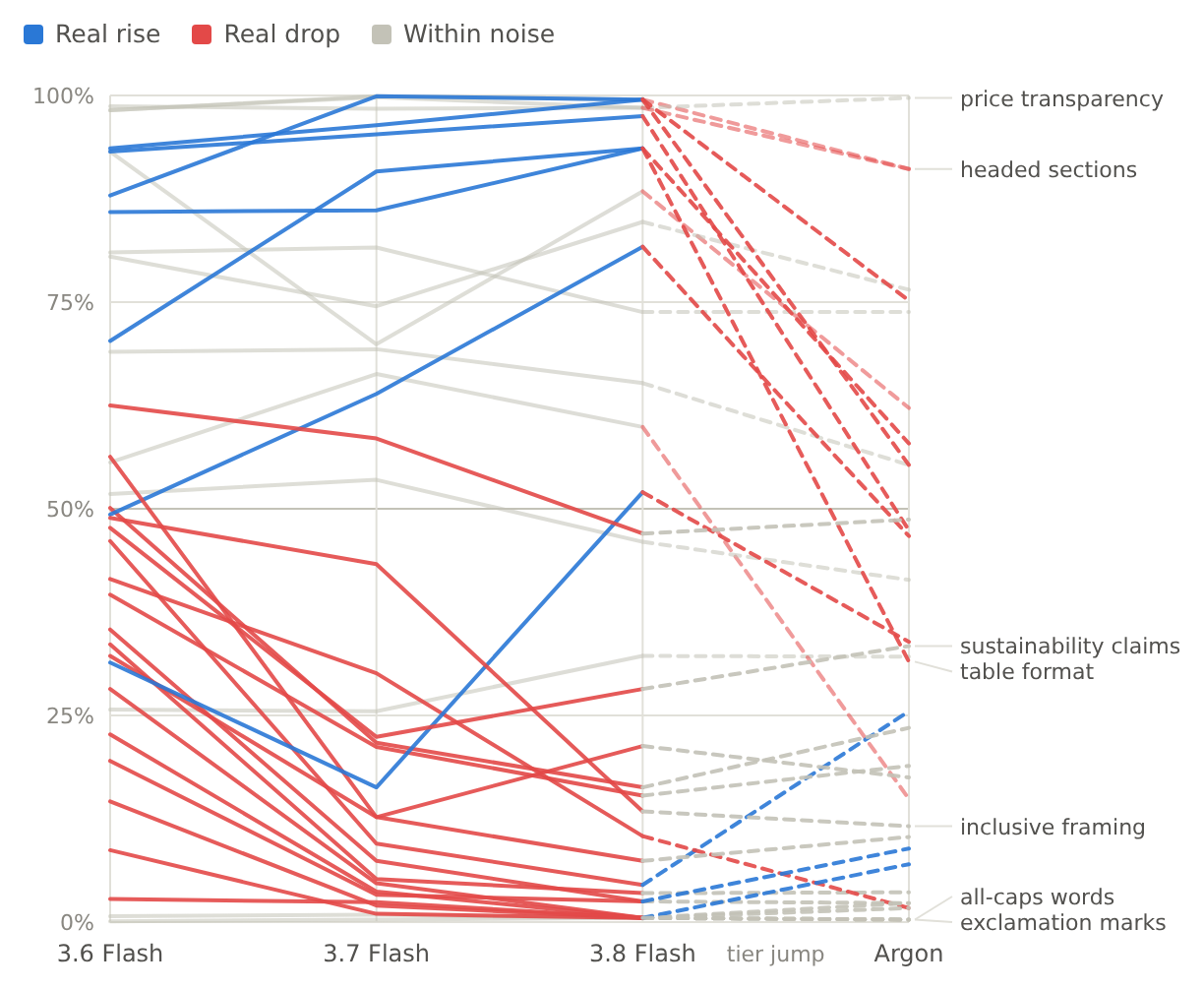 Win rate by model. Solid lines are coloured by the change from 3.6 to 3.8 Flash. Dashed lines are coloured by the change from 3.8 Flash to Argon. Labels mark the seven named features.
Every feature on every model, sorted by average win rate. Blue cells win more often than a coin flip, red cells lose more often, and grey cells sit close to 50%. Seven features are named: table format, plus two from the top, two from the middle and two from the bottom.
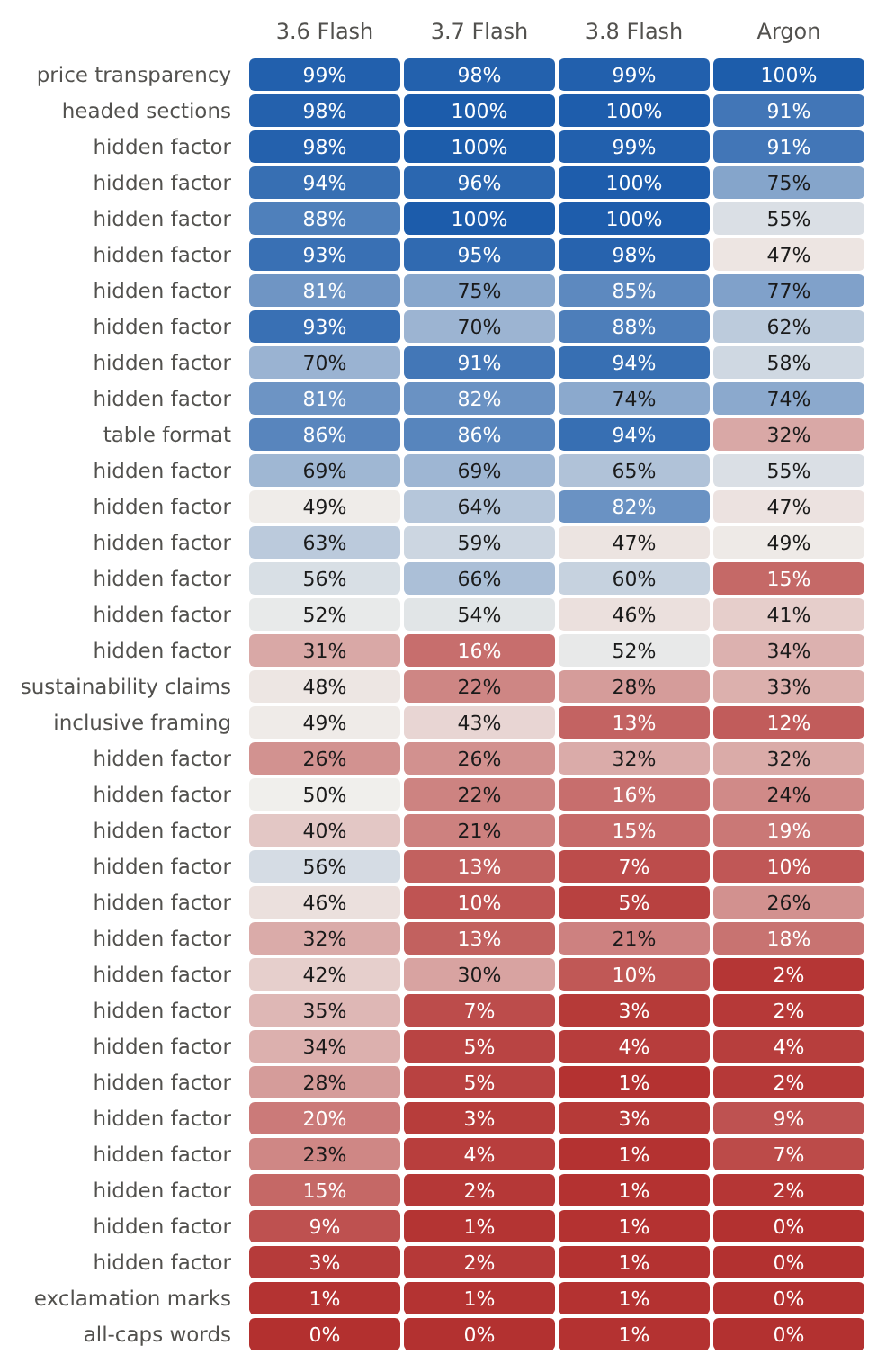 Win rate of 36 features on four Gemini models.
| Feature | 3.6 Flash | 3.7 Flash | 3.8 Flash | Argon |
|---|---|---|---|---|
| Price transparency | 98.7% | 98.4% | 98.5% | 99.7% |
| Headed sections | 98.2% | 99.9% | 99.5% | 91.1% |
| Table format | 85.9% | 86.1% | 93.6% | 31.5% |
| Sustainability claims | 47.7% | 22.4% | 28.2% | 33.4% |
| Inclusive framing | 48.9% | 43.3% | 13.4% | 11.6% |
| Exclamation marks | 0.7% | 0.9% | 0.5% | 0.3% |
| All-caps words | 0.1% | 0.3% | 0.5% | 0.3% |
Google published the Gemini 4 Argon model card on 13 October 2026.
The Argon data comes from six runs on 13 October 2026: 145 to 150 tests per feature on 180 base pages, for $59.63. 3.8 Flash has 98 to 100 tests per feature, 3.7 Flash about 500 and 3.6 Flash about 700. One model fills every role in a run: it writes the base pages, applies the one-feature edit and casts the vote. Argon's pairs are pages Argon wrote, so each model is measured on its own material.
Win rates are the mean of a Jeffreys posterior, which is why 0 wins out of 150 reads as 0.3%. A change counts as real when it is larger than 1.96 times the combined standard error of the two rates. With 100 tests on one side and 150 on the other, that margin runs from ±1.7 points for features near 0% or 100% to ±12.6 points for features near 50%. Argon picked the version it read first in 56.6% of tests, against 51.4% for 3.8 Flash and 69.0% for 3.6 Flash.
The test asks Argon to choose a grounding source for a simulated chat query. It does not observe AI Mode's live citations. The pages are synthetic commercial copy, and what is measured is selection, not ranking or traffic. All figures here are from the first stage of Rank Signal. Validate runs on Argon, which test whether adding one feature turns a losing page into a winner, have started, and we will add their results to this post.