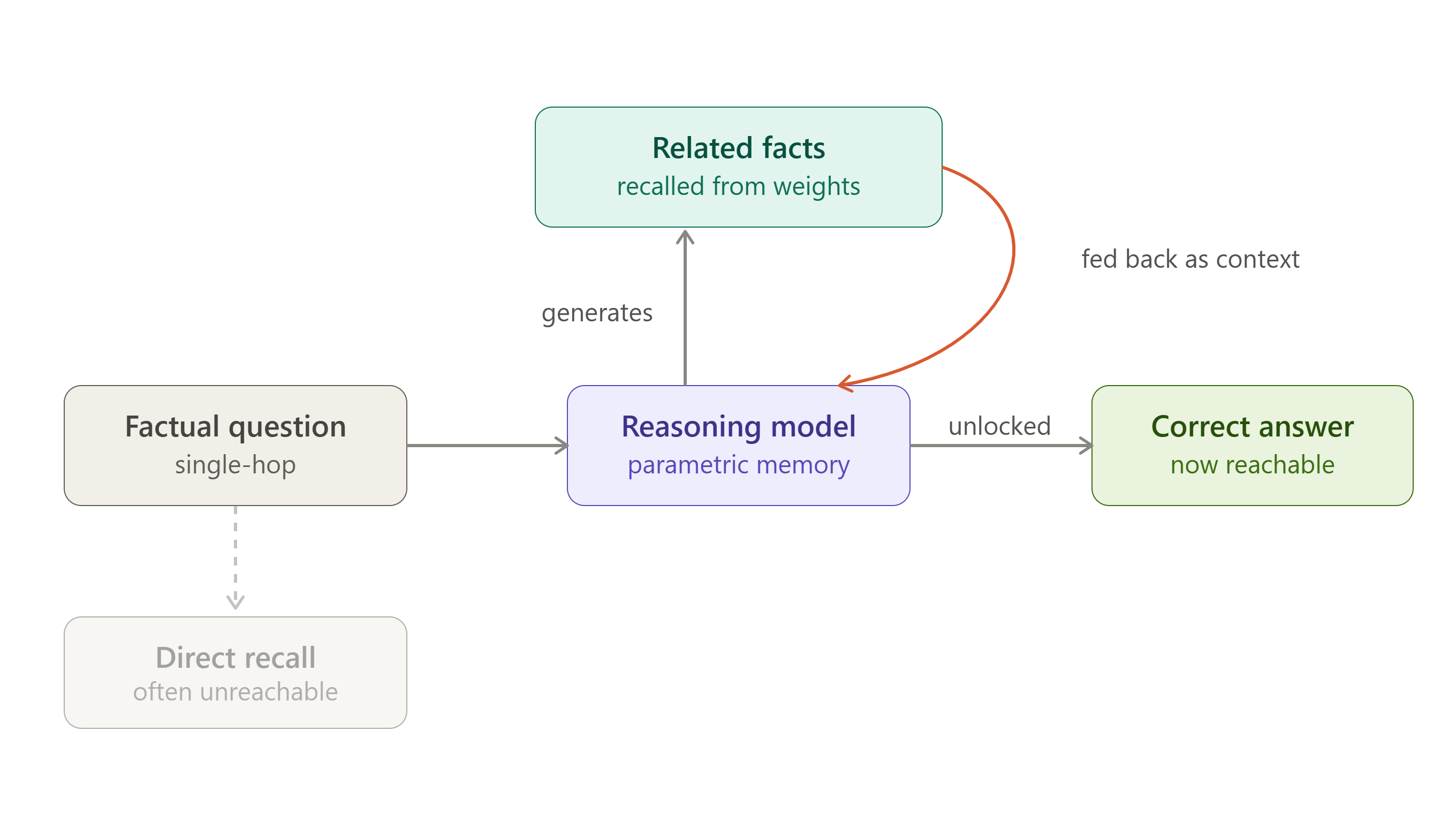
A reasoning model surfacing facts from its own parameters by generating them as text, where those generated facts then condition and improve its final answer.
Generative self-retrieval is a mechanism by which a reasoning language model accesses knowledge stored in its own parameters by writing it out as text. During its chain-of-thought, the model generates facts that are topically related to the question, and those generated facts serve as context that conditions the final answer. The retrieval happens through generation itself: producing the related facts is what brings them into the model's working context, where they raise the probability of recalling the correct answer.
The term was introduced by Gekhman et al. (2026) in "Thinking to Recall: How Reasoning Unlocks Parametric Knowledge in LLMs." It draws on the cognitive idea of spreading activation, where processing one concept lowers the retrieval threshold for related concepts in a semantic network. A reasoning model appears to do something analogous: by recalling neighboring facts, it builds a contextual bridge toward an answer that would otherwise stay out of reach. The paper supports this by extracting the facts a reasoning trace surfaced, feeding them back to the model with reasoning switched off, and recovering most of the accuracy gains, which indicates the surfaced facts themselves carry the benefit. A case study makes it concrete: to name the 10th King of Nepal, the model first lists the preceding nine, and that scaffolding is what lets it reach the tenth.
The mechanism is powerful and fragile at once. Because the model generates the intermediate facts from its own parameters, those facts can be hallucinated, and traces containing hallucinated facts are substantially more likely to produce hallucinated final answers.